
AI-Powered Restaurant Revolution: How Marc Lore's Vision is Transforming Food Entrepreneurship
TL;DR
- Marc Lore's Wonder is launching Wonder Create, an AI-powered platform that enables anyone to design and launch a virtual restaurant brand in under 60 seconds by simply typing a description of their concept.
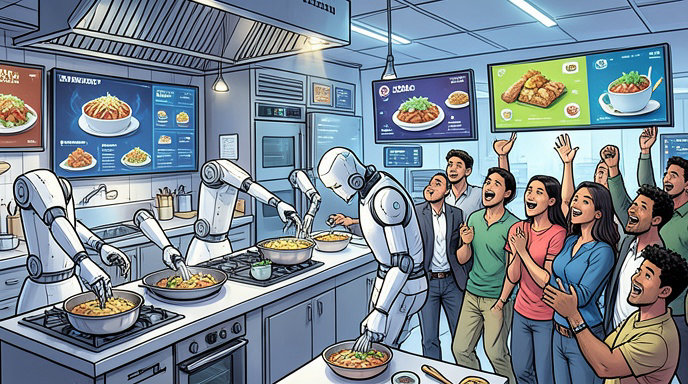
- Wonder operates "restaurant factories" — robotic, all-electric kitchens capable of running 25-30 different restaurant concepts simultaneously, each with access to a 700-ingredient library and proprietary cooking technology that can sear steak in six minutes or bake pizza in 90 seconds.
- The vertically integrated model democratizes food entrepreneurship by allowing influencers, food entrepreneurs, and aspiring restaurateurs to test concepts, reach audiences, and scale without traditional brick-and-mortar overhead, while Wonder maintains control over technology, operations, and its delivery network.
FROM GHOST KITCHENS TO RESTAURANT FACTORIES: WONDER'S RADICAL REIMAGINING
Marc Lore has built a reputation for seeing around corners in e-commerce. His previous exits—Jet.com to Walmart for $3.3 billion and Diapers.com before that—established him as a serial entrepreneur capable of identifying and scaling transformative business models. Now, he's applying that same visionary approach to an industry that has remained largely unchanged for decades: restaurants.
Wonder, his latest venture, represents a fundamental reimagining of how restaurants operate, scale, and innovate. Rather than building traditional brick-and-mortar establishments, Lore is constructing what he calls "restaurant factories"—AI-powered, robotic kitchens that function as platforms for launching unlimited virtual food brands. The result is a business model that blends automation, artificial intelligence, and the ghost kitchen trend into something entirely new.
THE WONDER CREATE REVOLUTION: LAUNCHING A RESTAURANT IN UNDER A MINUTE
At the heart of Wonder's vision is Wonder Create, an initiative that could fundamentally democratize food entrepreneurship. The concept is deceptively simple: anyone—from seasoned food entrepreneurs to social media influencers—can now launch their own restaurant brand in under 60 seconds using nothing more than a text prompt.
Here's how it works. A would-be restaurateur types a description of their concept into the platform. The AI then handles everything: naming the restaurant, designing branding, writing descriptions, generating food photography, setting pricing, providing nutritional information, and creating all the recipes. If the user wants refinements, they simply adjust their prompt and regenerate.
"You type in what kind of restaurant you want to build. It builds the restaurant—AI does—in under a minute," Lore explained during a recent appearance at The Wall Street Journal's Future of Everything conference. "It does the name, branding, description, pictures, pricing, health information, and all the recipes for your restaurant."
The possibilities are staggering. Someone could input "Korean-Mexican fusion with a focus on fermented ingredients," and the system would generate a complete, functional restaurant concept ready to go live. Once approved, the virtual restaurant launches across Wonder's entire network of locations, immediately gaining access to a massive customer base without requiring a single dollar of capital investment from the entrepreneur.
PROGRAMMABLE KITCHENS: THE TECHNOLOGY POWERING THE VISION
Behind Wonder Create lies years of substantial technological investment. The company has poured over $1 billion into software engineering, culinary engineering, and food science to create what Lore calls "programmable cooking platforms."
These aren't ordinary kitchens. Each Wonder location is equipped with all-electric cooking equipment that can operate as 25 to 30 different restaurant concepts simultaneously. The kitchens have access to a 700-ingredient library and employ proprietary robotic systems capable of executing complex culinary tasks with precision and speed.
Consider some of the technological achievements: Wonder's systems can sear steak to restaurant quality in just six minutes without open flames, cook pasta without water, and bake pizza in 90 seconds. These capabilities emerged from years of collaboration between engineers, chefs, and food scientists working to match the quality of best-in-market restaurants while using only two or three distinct pieces of electric cooking equipment.
The software layer is equally sophisticated. Wonder developed sequencing algorithms that ensure food from multiple different restaurants finishes cooking at precisely the same time, allowing orders from five different concepts to arrive together while still hot. This coordination is critical to the customer experience and represents a significant technical achievement.
VERTICALLY INTEGRATED DOMINANCE: CONTROLLING THE ENTIRE EXPERIENCE
What sets Wonder apart from traditional restaurant groups or delivery platforms is its vertically integrated model. The company owns all restaurant brands operating on its platform, controls the cooking technology, manages kitchen operations, and operates its own delivery network. This end-to-end control eliminates royalty payments, enables unlimited scaling, and allows Wonder to guarantee an industry-leading 95 percent on-time delivery rate.
Lore describes the model as reverse-engineering how traditional restaurant groups operate. "Think of us as a restaurant group that owns a delivery platform," he said. "Imagine if Chipotle, Sweetgreen, and Five Guys all got together and said, 'let's cook all our same stuff in the same kitchen... and let's build our own delivery network so we control the experience end to end.' That's how we're reverse engineering the business."
This approach has already proven successful. Since opening its first location two years ago, Wonder has expanded to 120 locations across the Northeast, with plans to reach 400 locations by next year. The company's growth trajectory includes reaching 200 locations by 2026, with a standalone IPO targeted for 2028.
DEMOCRATIZING FOOD ENTREPRENEURSHIP: WHO BENEFITS?
The implications of Wonder Create extend far beyond traditional restaurant entrepreneurs. The platform opens doors to entirely new categories of food creators and brands.
Influencers can now launch their own branded restaurant experiences without the capital requirements, operational complexity, or personal time commitment of opening a physical chain. A social media personality with a large following could create a restaurant brand that serves their audience through Wonder's network, deepening engagement and monetizing their platform in entirely new ways.
Food entrepreneurs can test recipes and concepts at scale before committing to brick-and-mortar locations. A chef could launch an experimental cuisine concept through Wonder, gauge customer reaction, refine the menu based on real-world data, and then decide whether to open a traditional restaurant with confidence that the concept has already proven itself.
Established restaurant groups can test new concepts and cuisines without the overhead of new locations. The platform becomes a laboratory for culinary innovation, allowing chefs and restaurateurs to experiment with cuisines they've never offered before, reaching customers across Wonder's entire network.
THE GEOGRAPHIC ADVANTAGE: BRINGING OPTIONS TO UNDERSERVED MARKETS
Wonder's model works particularly well in suburban and less densely populated areas where traditional restaurant options are limited. Rather than waiting for established chains to build locations in their communities, residents of these areas suddenly gain access to 25 to 30 different restaurant concepts from a single Wonder kitchen.
This geographic flexibility represents a significant competitive advantage and addresses a real gap in the market. Many communities simply cannot support the economics of traditional restaurants, yet their residents want dining variety and quality. Wonder's model makes that possible.
A SUPERAPP FOR MEALTIME: THE BROADER VISION
Wonder's ambitions extend beyond restaurant factories. The company has strategically acquired Blue Apron, GrubHub, and the media brand Tastemade, assembling the pieces of what Lore envisions as a comprehensive superapp for mealtime.
The vision includes AI-powered meal planning that considers individual preferences, dietary needs, and health goals. In the future, when customers order through Wonder's platform, AI will analyze the 375,000 menus available through GrubHub and recommend specific dishes tailored to each individual's preferences and nutritional targets. The platform becomes not just a delivery service, but a personalized food concierge powered by machine learning.
This integration of meal planning, restaurant discovery, ordering, and delivery creates a unified ecosystem where every component reinforces the others. The more data Wonder collects about customer preferences, the better its AI recommendations become. The better its recommendations, the higher customer satisfaction and order frequency. The higher the volume, the more efficiently Wonder's kitchens operate.
THE DEMOCRATIZATION-OR-DISRUPTION QUESTION
Wonder Create and the broader Wonder platform represent either the ultimate democratization of food entrepreneurship or a potentially dystopian future where algorithms replace culinary creativity—likely some of both.
On the democratization side, the platform removes nearly every barrier to entry for food entrepreneurs. No capital requirement. No real estate search. No hiring and training staff. No supply chain management. No complex business operations. Just a text prompt, and you're live across hundreds of locations serving thousands of customers.
The disruption angle is equally significant. Traditional restaurateurs suddenly face competition from concepts that can launch in seconds. A competitor can test a new cuisine or concept and iterate based on real customer feedback faster than a traditional restaurant can conduct market research. The playing field has fundamentally shifted.
For consumers, the implications are mixed. They gain access to more variety, faster innovation, and personalized recommendations. But they also lose the authenticity and personal touch that comes from restaurants built on individual vision and culinary passion. An AI-generated Korean-Mexican fusion concept might be technically competent, but it lacks the soul of a restaurant built by someone who genuinely loves that cuisine.
MARC LORE'S TRACK RECORD AND THE CREDIBILITY FACTOR
What lends credibility to this vision is Lore's track record. He's not a theoretical futurist making wild predictions about technology that doesn't exist. He's a proven entrepreneur who has successfully scaled multiple businesses to billion-dollar valuations. His $3.5 billion investment in GrubHub gives him the distribution infrastructure to actually test these concepts at scale.
Moreover, Wonder has already demonstrated that the core technology works. The company is currently operating 120 locations, cooking 30 different cuisines from the same kitchens, and delivering food hot in under 30 minutes. These aren't theoretical achievements—they're operational realities.
THE ROAD AHEAD: SCALING THE VISION
As Wonder scales toward 400 locations by next year and pursues an IPO in 2028, the company will face significant challenges. Consumer acceptance remains uncertain. Will people embrace AI-generated restaurants the way they've adopted other forms of automation? Will the food quality and consistency meet expectations? Will the loss of culinary authenticity matter to customers, or will convenience and variety trump everything else?
There are also regulatory questions. How will health departments classify these facilities? What labor standards apply? How will traditional restaurant associations and small restaurateurs respond to this disruption?
Yet the infrastructure is being built regardless of these uncertainties. Wonder's expansion continues. Its technology improves. Its restaurant library grows. The question isn't whether AI-powered restaurant factories will exist—they already do. The question is how quickly they'll scale and how thoroughly they'll reshape the restaurant industry.
For traditional restaurateurs, the message is clear: start thinking now about what happens when your competition can launch a new concept in the time it takes to write a prompt. The restaurant industry's transformation has already begun.

Get All The Latest Updates Delivered Straight To Your Inbox For Free!