
Amazon Disrupts Logistics: Introducing Amazon Supply Chain Services
TL;DR
- Amazon has launched Amazon Supply Chain Services (ASCS), opening its vast logistics network— including over 200 U.S. fulfillment centers, 80,000 trailers, and 100+ aircraft—to businesses of all sizes and industries beyond its e-commerce platform.
- Early adopters like Procter & Gamble, 3M, Lands’ End, and American Eagle Outfitters are already using ASCS for freight, storage, fulfillment, and parcel delivery, signaling rapid traction.
- This move positions Amazon as a direct rival to UPS and FedEx, potentially reshaping the $1.5 trillion logistics industry by offering scalable, tech-driven solutions akin to AWS for cloud computing.
A Game-Changer in Logistics
Amazon, the e-commerce titan long known for revolutionizing online shopping, is now setting its sights on the trillion-dollar logistics sector. On May 4, 2026, the company unveiled Amazon Supply Chain Services (ASCS), a bold initiative that flings open the doors of its proprietary logistics empire to any business willing to plug in. No longer reserved for Amazon's retail operations or its third-party sellers, this network promises to move raw materials, store inventory, and deliver finished products with the same efficiency that powers Amazon.com. It's a seismic shift, likened internally to how Amazon Web Services democratized cloud computing two decades ago.
What ASCS Brings to the Table
At its core, ASCS is a comprehensive suite of logistics tools tailored for versatility. Businesses can tap into full truckload and less-than-truckload freight, intermodal transport, air freight, and even inbound shipping from China complete with customs clearance. For the final mile, there's 2-to-5 day parcel shipping, bulk storage, distribution, and advanced fulfillment capabilities, including inventory forecasting across multiple sales channels like websites, social media, and brick-and-mortar stores.
This isn't a lightweight offering—it's backed by Amazon's colossal infrastructure: over 200 fulfillment centers in the U.S. alone, 80,000 trailers, 24,000 intermodal containers, and a fleet exceeding 100 aircraft. Peter Larsen, vice president of Amazon Supply Chain Services, emphasized the proven scale: "Amazon is bringing the infrastructure, intelligence, and scale of its supply chain services—proven over decades—to businesses everywhere." For the past three years, hundreds of thousands of sellers have already relied on this network to handle millions of packages, proving its reliability beyond Amazon's storefront.
Early Wins and Real-World Impact
The launch isn't hype—major players are jumping aboard. Consumer goods giant Procter & Gamble is using ASCS for freight to shuttle goods and raw materials to production sites. Industrial leader 3M leverages it for similar transport needs, while apparel brands Lands’ End and American Eagle Outfitters are unifying inventory for seamless fulfillment across channels, including direct-to-consumer deliveries. These partnerships span retail, manufacturing, healthcare, and automotive, showing ASCS's cross-industry appeal.
For small businesses, this levels the playing field: affordable access to enterprise-grade logistics without building from scratch. Large enterprises gain optimization tools to cut costs and disruptions, with Amazon's AI-driven forecasting mitigating supply chain headaches in a post-pandemic world.
Stirring the Pot: Competition Heats Up
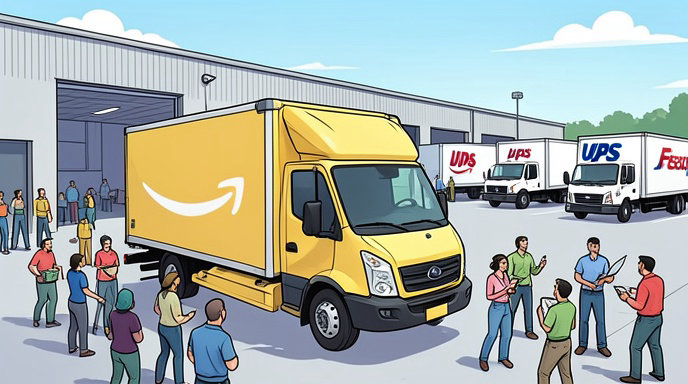
ASCS catapults Amazon into direct confrontation with logistics behemoths UPS and FedEx, who have dominated for decades. Amazon's advantages? Unmatched scale, data intelligence from e-commerce, and a bias for speed—think Prime's two-day delivery extended to B2B. Analysts predict pricing pressure as Amazon undercuts on volume, potentially eroding margins for incumbents. Unlike pure-play shippers, Amazon integrates end-to-end: from factory floor to customer doorstep, all unified under one roof.
Yet, it's not without risks. Regulators may scrutinize Amazon's market power, and rivals could counter with partnerships or tech upgrades. Still, with e-commerce's logistics arm growing as a new revenue stream, Amazon is betting big on this "AWS moment" for supply chains.
The Broader Ripple Effects
For small businesses, ASCS means scaling without the warehouse woes—store inventory in Amazon's network and fulfill anywhere. Large firms like P&G can streamline global ops, reducing reliance on fragmented providers. The logistics industry, valued at $1.5 trillion globally, faces transformation: faster adoption of AI, predictive analytics, and multimodal transport could become table stakes.
Industries like healthcare (temperature-controlled shipping) and automotive (just-in-time parts) stand to benefit most, but retail's multichannel sellers will thrive too. As Amazon's supplychain.amazon.com site puts it: "The logistics network powering our business is ready to transform yours." In an era of disruptions—from trade wars to climate events—ASCS offers resilience at scale.
This launch underscores Amazon's playbook: build for yourself, then monetize for the world. The logistics wars have just begun, and Amazon is armed to the teeth.

Get All The Latest Updates Delivered Straight To Your Inbox For Free!