
AI Optimism Divide: Why Americans Are Wary of Artificial Intelligence Despite Wall Street's Excitement
TL;DR
- Pew Research finds Americans are still more concerned than excited about AI, with only a small share expecting it to improve society.
- The public and AI experts remain sharply divided: experts are far more likely to see AI as beneficial, while everyday Americans focus on risks to creativity, relationships, and control.
- The gap matters because adoption is accelerating even as trust lags, shaping how AI products may be built, marketed, and regulated next.
AI Optimism Divide: Why Americans Are Wary of Artificial Intelligence Despite Wall Street's Excitement
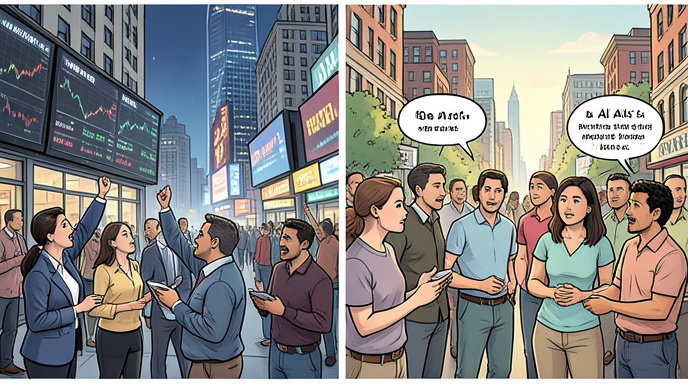
Wall Street may be treating artificial intelligence as the defining technology of the decade, but many Americans are not sharing the enthusiasm. Pew Research says the public remains broadly wary of AI’s growing role in daily life, with half of U.S. adults saying they feel more concerned than excited about increased AI use. Only 10% say they are more excited than concerned.
That skepticism sits in sharp contrast to the market narrative. Investors continue to pour money into AI infrastructure, chips, software, and startups on the assumption that the technology will drive major productivity gains and new business models. But Pew’s data suggests the public mood is far less celebratory, even as AI becomes more visible in workplaces, schools, healthcare, and consumer tools.
The headline number: just 16% expect AI to improve society
One of the clearest signs of the divide is how Americans rate AI’s long-term effect on society. In Pew’s 2025 survey, only 17% of the public said AI will have a positive impact on the United States over the next 20 years, while 35% expected a negative impact. By comparison, 56% of AI experts said the long-term impact would be positive.
The same skepticism appears in broader Pew findings about AI’s effect on people and society. Americans were more likely to say AI will erode, rather than improve, human abilities such as creative thinking and forming meaningful relationships. Pew also found that concern about AI outweighs excitement across major demographic groups.
Why Americans are uneasy
Pew’s research points to a recurring theme: people worry that AI may make life easier while also making humans worse at important tasks. The most common concern in open-ended responses was that AI could weaken human skills and social connections.
Among the specific fears:
- 53% of Americans said AI will worsen creative thinking, while only 16% said it will improve it.
- 50% said AI will hurt people’s ability to form meaningful relationships.
- Many respondents said AI could encourage complacency, overreliance on machines, and loss of critical thinking.
That anxiety is not simply about machines replacing jobs. It is also about what happens when people outsource writing, planning, searching, tutoring, and decision-making to systems they do not fully understand.
Americans want help from AI, but not surrender
The public’s view is not purely anti-AI. Pew found that a majority of Americans are open to AI assisting with day-to-day tasks and activities, and many support uses such as weather forecasting, medical research, and fraud detection.
But there is a catch: Americans want control. Pew reported that 61% want more control over how AI is used in their lives, and 57% say they have “not too much” or “no control” over whether AI is used at all.
That tension explains much of the public mood. People are willing to accept AI as a tool, but not as an authority. They are more comfortable with AI analyzing large data sets than making personal, moral, romantic, or religious decisions.
The expert-public gap is widening
The gap between experts and the general public is one of the most striking findings in the Pew data. Experts are much more likely to see AI as broadly beneficial, especially for work and productivity. In Pew’s comparison, 73% of experts expected AI to improve how people do their jobs, compared with only 23% of U.S. adults.
That difference helps explain why Silicon Valley and Wall Street often sound more bullish than the public feels. Technologists tend to focus on capability gains, automation, and efficiency. Ordinary users are more likely to focus on uncertainty, trust, and the risk of losing human judgment.
AI adoption is rising even as trust stays fragile
The public’s caution is not stopping AI from spreading. Pew’s March 2026 summary says AI has become part of everyday life for many Americans at work, at school, in health care, and beyond.
Broader survey evidence also suggests that personal use is already widespread. A Brookings survey found that 57% of respondents reported using generative AI for at least one personal purpose, most commonly for internet searches or web browsing.
That means the real story is not whether Americans will encounter AI. They already are. The question is whether they will trust it enough to let it shape more important parts of life, from education and jobs to healthcare and relationships.
What this means for the AI industry
The Pew findings carry a clear message for companies building AI products: technical capability alone will not win public acceptance. If users believe AI reduces creativity, weakens relationships, or removes human control, adoption may stall outside narrow productivity use cases.
That puts pressure on developers to make AI systems more transparent, more controllable, and more obviously useful. It also suggests regulators and policymakers will face growing demand for guardrails, especially around personal data, content labeling, and high-stakes decisions. Pew found that Americans feel strongly about being able to tell whether text, images, or video were made by AI or humans.
The bigger cultural divide
At its core, the AI debate is no longer just about whether the technology works. It is about what kind of society people want to live in. Investors see a platform shift with massive economic upside. Many Americans see a technology that may be powerful, but also intrusive, opaque, and potentially corrosive to human skills.
That disconnect helps explain why AI can look unstoppable in the markets while still feeling unsettled in public opinion. The technology may be advancing quickly, but the social license to use it widely is still being negotiated.

Get All The Latest Updates Delivered Straight To Your Inbox For Free!