
Revolutionizing Alloys: The Future of Super Metals in Diverse Industries
TL;DR
- Foundation Alloy has raised $22 million in Series A funding to scale its solid-state metals platform and expand production.
- The startup makes super-strong alloys without melting metal, using a powder-based process that can cut development time and energy use.
- Its early applications span defense, aerospace, automotive, luxury watches, and premium kitchen tools, signaling a broad commercial push.
Foundation Alloy is moving a centuries-old industry into a new phase: instead of melting metal into alloys, it engineers them in the solid state. With fresh funding and early customer trials, the MIT-born startup is aiming to turn exotic, high-performance metals into a scalable manufacturing platform.
A new way to make metal
For most of modern industry, alloy production has followed the same basic logic used since antiquity: heat metals until they liquefy, mix them, then cast them into a final form. Foundation Alloy’s approach breaks from that model by using a solid-state process that never melts the metal at all.
According to MIT News, the company’s technology was developed over years of research by former MIT professor Chris Schuh and collaborators, and it is designed to simplify the development and manufacturing of next-generation alloys. Foundation Alloy describes the platform as MetalsFIRST™, a fully integrated solid-state metallurgy system built for industrial scale.
Why investors are paying attention
Foundation Alloy recently announced $22 million in Series A financing to scale production of its MetalsFIRST platform. The company says the funding will help move its process from pilot-stage demonstrations toward industrial volumes.
The startup’s pitch is not just about making stronger metals; it is also about compressing the product-development cycle. MIT News reports that Foundation Alloy says its alloys can be made twice as strong as traditional metals and can speed product development by 10x, reducing iteration timelines from years to months. The company also claims its solid-state approach uses about an order of magnitude less energy than conventional melting-based methods.
What makes the process different
Foundation Alloy’s method relies on powdered raw materials that are mechanically combined rather than melted. In TechCrunch’s reporting, the company’s CEO described the process as “colliding metal powder particles instead of liquefying them,” which allows the startup to create material properties that are difficult to achieve with conventional alloying.
That distinction matters because high-performance metals often involve tradeoffs. Stronger alloys can become harder to machine, less ductile, or more brittle. Foundation Alloy says its process is designed to overcome those limitations and produce metals that can withstand both heat and mechanical stress.
Where the metals could be used
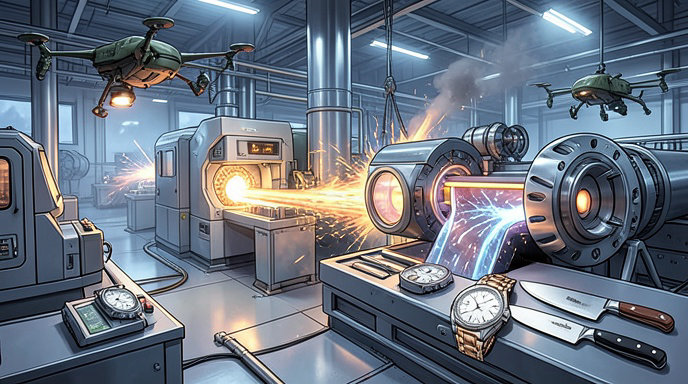
The company is already piloting its materials across sectors including automotive, aerospace, semiconductors, and defense. TechCrunch also reported applications in high-end chef’s knives and luxury timepieces, underscoring the range from industrial hardware to premium consumer goods.
MIT News noted that Foundation Alloy has received grants to develop parts for critical components of nuclear fusion reactors, suggesting that the technology may also have a role in extreme-environment energy systems. The company’s initial product lineup includes high-performance refractory alloys, and it has already launched molybdenum-based materials such as Molyclast MC1200, which it describes as a highly robust commercial alloy.
Defense and industrial manufacturing are early targets
Among the most immediate use cases is defense tooling and components. Foundation Alloy has said its metals could help revamp tooling used to make larger defense systems, and it has described the defense sector as a major opportunity for its technology.
That focus makes sense in light of the broader manufacturing challenge. Defense, aerospace, and advanced industrial suppliers often need materials that can survive extreme loads and temperatures while remaining manufacturable at scale. Foundation Alloy’s pitch is that solid-state metallurgy can provide those properties faster and with less energy than traditional methods.
The bigger manufacturing bet
The broader significance of Foundation Alloy is not just that it can make a few impressive metals. The company is trying to build a repeatable platform for designing and producing advanced alloys on demand.
If it succeeds, the implications extend well beyond specialty materials. Faster alloy development could reshape how manufacturers prototype tools, qualify parts, and source materials for demanding applications. That could matter in sectors where supply-chain resilience, performance, and energy efficiency are increasingly strategic concerns.
What to watch next
The key question is whether Foundation Alloy can scale its solid-state process from promising pilots to reliable mass production. Its funding round, new U.S. facility plans, and distribution partnerships suggest the company is moving aggressively toward commercialization.
For now, the startup sits at an interesting intersection of deep tech and practical manufacturing. If its technology delivers on its claims, super metals may soon move from niche lab breakthroughs to everyday components in drones, watches, knives, and other products where strength and precision matter most.

Get All The Latest Updates Delivered Straight To Your Inbox For Free!