
Revolutionizing Smart Speakers: Google's Bold Move with Gemini
TL;DR
- Google is replacing Google Assistant on smart speakers and displays with Gemini for Home, bringing more conversational, context-aware control to the smart home.
- A new Google Home Speaker is on the way, priced at $99, with Gemini at its core and launch timing described as spring 2026 or, in the latest report, shipping starting June 25 with preorders opening the same day.
- Google is also introducing a Google Home Premium subscription for advanced features such as Gemini Live, AI-powered notifications, and richer camera/search tools.
Google’s smart home pivot
Google is making one of its biggest smart home bets yet by shifting from rigid voice commands to generative AI-powered conversation. With Gemini for Home, the company says smart speakers, displays, cameras, and the Google Home app will understand natural language better, handle follow-up questions, and respond more like a real assistant than a command parser.
That move matters because it changes the basic promise of the smart speaker. Instead of repeating the same phrasing every time, users will be able to speak more naturally, preserve context across exchanges, and ask for more complex help with media, routines, and device control.
The new Google Home Speaker
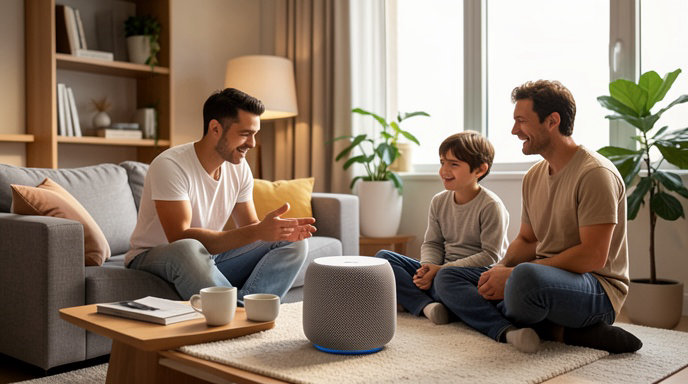
At the center of the announcement is a new Google Home Speaker built specifically for Gemini. Google’s teaser and related reports describe it as a $99 smart speaker that includes hardware tuned for AI workloads, along with features like background noise suppression, reverb management, and echo cancellation.
The speaker is expected to come in multiple color options, with reports mentioning shades including Porcelain, Hazel, Jade, and Berry. Google has also positioned the device as part of a broader smart home strategy, with launch availability reported across the U.S., Canada, the U.K., parts of Europe, Australia, and New Zealand.
Gemini replaces Google Assistant
The biggest software shift is that Gemini for Home will replace Google Assistant on Google’s speakers and smart displays. Google says the new voice assistant will be more conversational and better at understanding context, while still supporting familiar “Hey Google” wake-word interactions.
Early reporting suggests this won’t be limited to brand-new hardware. Coverage indicates that Gemini’s basic functionality is coming to a wide range of existing Google Home and Nest devices, including older speakers and displays, while the more advanced conversational experience may depend on newer hardware.
What gets better with Gemini
Google is pitching Gemini for Home as more than a voice upgrade. The company says it will improve:
- Smart home control with more natural phrasing and context retention.
- Media requests, including more complex follow-up commands.
- Camera and doorbell alerts, with AI-generated summaries and natural-language video history search.
- Automations through the Google Home app’s “Ask Home” feature, which lets users describe what they want in plain language.
That last feature could be especially important. If Google delivers on it, users may no longer need to navigate nested menus or memorize automation logic to build routines. They could simply describe the outcome they want and let Gemini translate that into an action.
Premium features and pricing
Google is also carving out a paid tier called Google Home Premium for the most advanced capabilities. According to Google, features such as Gemini Live, AI-powered notifications, Home Brief, video-history search, and automation help through Ask Home are tied to this subscription.
Reports indicate the premium offering is designed to unlock richer, more interactive experiences, while core conversational control remains available more broadly. That split suggests Google is following a familiar AI product strategy: basic utility for all users, with advanced features reserved for paid tiers.
Why this matters for the smart home market
Google’s move raises the bar for what a smart speaker is supposed to do. For years, voice assistants have been most useful for simple tasks like setting timers, playing music, or turning on lights. Gemini for Home aims to make the assistant feel less like a remote control and more like a conversational interface for the entire home.
That could have wider implications for the market. If Google succeeds, competitors will need to answer a tougher question: can their assistants handle natural conversation, context, and automation as fluidly as a modern AI chatbot? Google is clearly betting that the answer is no today—and that Gemini can help close that gap.
The bigger strategic bet
The new speaker matters, but the larger story is Google’s attempt to reframe the smart home around generative AI rather than legacy voice commands. The company is pairing new hardware with a redesigned software experience and a subscription model, signaling that it sees Gemini as the next platform layer for Home and Nest products.
That makes the Google Home Speaker more than just another Nest-style device. It is a reference design for Google’s AI-first home strategy, one that could define how the company thinks about living rooms, kitchens, and connected devices for the next several years.

Get All The Latest Updates Delivered Straight To Your Inbox For Free!