
Rivian Restructures Workforce as R2 Deliveries Begin
TL;DR
- Rivian said it is cutting hundreds of jobs—less than 2% of staff—as it reorganizes teams to support a profitable scale-up around the R2 launch and deliveries.
- The latest reductions mainly affect service, customer support, sales, and marketing functions, while the company says impacted employees may apply for other open roles.
- Rivian is also slowing its autonomy-profit timeline, saying it no longer expects to hit its 2027 adjusted core profit target as it increases R&D spending on autonomous driving.
Rivian Restructures Workforce as R2 Deliveries Begin
Rivian is laying off hundreds of employees in a move it says is meant to help the company “profitably scale” its business, even as deliveries of its smaller R2 electric vehicle get underway. The cuts amount to less than 2% of Rivian’s workforce, according to the company, which had 15,232 employees at the end of last year.
A company spokesperson said the restructuring affects several teams in service and customer support, with Reuters adding that the cuts also hit parts of sales and marketing. Rivian said affected employees can apply for other open roles inside the company.
Why the company is reorganizing now
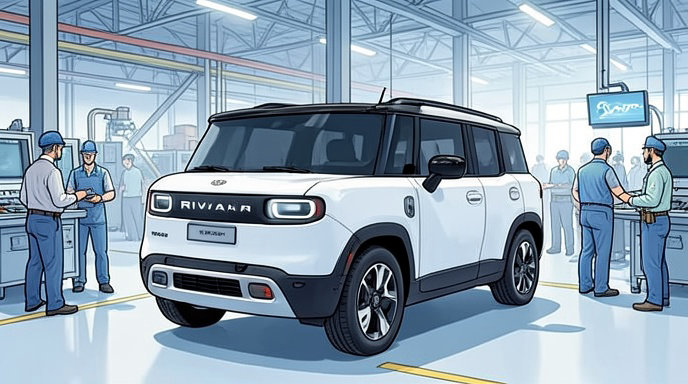
The latest layoffs reflect a broader effort to simplify Rivian’s operations as it prepares to ramp up the R2, the lower-cost model that the company sees as central to expanding demand. Reuters reported that Rivian began production of the R2 in April, and that deliveries are now underway.
That push comes after an earlier round of cuts in October, when Rivian reduced its workforce by more than 600 employees, or about 4.5%, as it reworked customer-facing operations ahead of the R2 rollout. Those changes were designed to reduce handoffs between teams and create a more streamlined path from sale to delivery.
Autonomy spending is shifting the timeline
The workforce reduction also lands at a moment when Rivian is changing its financial expectations around autonomous driving investment. Reuters reported that the company now says it no longer expects to meet its 2027 adjusted core profit target, citing higher spending on research and development tied to its autonomous-driving roadmap.
That suggests Rivian is choosing to spend more aggressively on long-term technical capabilities, even if that delays near-term profitability milestones. In practical terms, the company appears to be balancing two priorities at once: reducing operating complexity while continuing to fund future product and software bets.
The R2 is central to Rivian’s strategy
Rivian’s bet on the R2 is straightforward: a lower-priced vehicle should broaden the market beyond the premium segment that has defined much of its early business. Analysts and reports around the company’s restructuring have repeatedly tied the workforce changes to the need to support R2 production and strengthen Rivian’s path to profitability.
The company’s earlier restructuring also consolidated functions such as vehicle operations, service, delivery, and marketing, signaling a move toward a more centralized operating model. The newest cuts appear to continue that effort, focusing on support and customer-facing teams rather than manufacturing, according to prior reporting on Rivian’s restructuring plans.
What it means for Rivian’s next phase
For Rivian, the message is one of discipline: fewer internal layers, tighter coordination, and more selective spending as it scales the R2 program. The company is still betting that a more affordable model will help expand demand, but it is also acknowledging that execution will likely be more expensive and more complex than earlier forecasts suggested.
At the same time, the decision to keep investing in autonomy signals that Rivian is not retreating from advanced software and driver-assistance ambitions. Instead, it is prioritizing where to absorb costs now, and where to keep spending for the longer term.
What investors and buyers should watch next
The next key questions are whether Rivian can sustain R2 momentum, keep execution tight during the production ramp, and translate the restructuring into better margins over time. Investors will also be watching whether the company can hold the line on operating expenses while autonomous-driving investment continues to rise.
For customers, the immediate impact should be limited to the company’s internal reorganization rather than production access, but the broader test is whether Rivian can deliver the R2 at scale without repeating the margin pressures that have challenged its earlier vehicles.

Get All The Latest Updates Delivered Straight To Your Inbox For Free!