
Tech Turmoil: AI's Role in 2026's Major Layoffs
TL;DR
- Tech companies worldwide have shed well over 100,000 jobs in 2026, with AI cited as a primary or secondary driver in many of the largest cuts.
- Giants like Meta, Oracle, Snap, Block, Intuit, and PayPal are restructuring, redirecting payroll savings toward AI infrastructure and efficiency gains.
- Analysts warn that while AI is boosting productivity and profits, it is also accelerating a shift toward leaner, more specialized teams and raising concerns about long‑term employment impacts across the sector.
AI reshapes the tech workforce in 2026
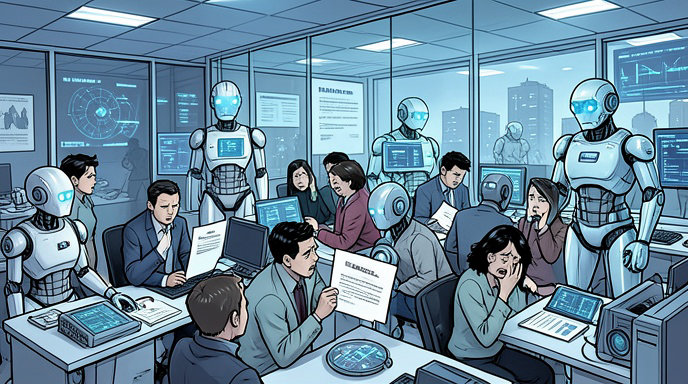
The first half of 2026 has cemented a new narrative in the tech industry: record revenues and record layoffs, with artificial intelligence positioned at the center of both. Companies that once raced to hire during the pandemic are now streamlining headcount, citing AI‑driven efficiencies, automation, and the need to fund massive infrastructure buildouts. The result is a wave of large‑scale layoffs that are reshaping how work gets done inside some of the world’s most influential tech firms.
From Silicon Valley to global startups, the pattern is strikingly similar—leadership teams announce “strategic realignment,” cut thousands of roles, and point to AI as both the engine of growth and the reason for the cuts. As the dust settles, the question is no longer whether AI will transform jobs, but how quickly and how deeply that transformation will play out.
A record year of cuts
By mid‑2026, tech layoffs have already surpassed levels seen in previous downturns. Data from workforce analytics and outplacement firms indicates that more than 100,000 tech roles have been eliminated across 130+ companies in the first five months of the year. One tracker notes that over 140,000 jobs have been cut in the first half of 2026 alone, a 33% increase over the same period in 2025.
Analysts warn that the sector is on pace to approach or even exceed the post‑pandemic peak of roughly 430,000 layoffs in 2023. What sets 2026 apart is the frequency with which AI is named in earnings calls, internal memos, and public statements as a key factor behind these workforce reductions.
AI as the stated driver
Across multiple firms, executives are explicit about the role of AI in their decisions. Oracle, for example, disclosed that it has reduced its workforce by 21,000 employees over the past 12 months, a 13% decline. In its annual regulatory filing, the company stated that “the adoption and deployment of AI technologies across our operations have resulted, and may continue to result, in reductions to our workforce.”
Meta has similarly tied its 2026 layoffs to AI strategy. The company cut around 8,000 employees—about 10% of its workforce—while moving roughly 7,000 workers into new AI‑focused roles. Internal communications describe the cuts as a way to offset the rising costs of AI research and infrastructure.
Other notable examples include:
- Snap reducing its workforce by 16%, eliminating 1,000 jobs, with executives citing rapid AI advancements that allow smaller teams to handle the same workload.
- Block, founded by Jack Dorsey, cutting more than 4,000 roles—nearly half its workforce—to build smaller, AI‑enabled teams.
- Intuit planning to cut about 3,000 jobs (17% of its workforce) as part of a restructuring centered on AI investment and organizational simplification.
- PayPal announcing plans to cut around 20% of its global workforce over the next two to three years, or more than 4,500 jobs, as part of a turnaround strategy built around AI adoption.
Even outside pure tech, companies are echoing the same language. General Motors, for instance, eliminated 500–600 IT jobs in Austin, Texas, and Warren, Michigan, citing a reevaluation of workforce needs amid uncertain market conditions and the growing influence of AI and automation.
The funding shift: Payroll savings to AI budgets
What links many of these layoffs is a clear financial logic: reduce headcount to free up capital for AI infrastructure. Analysts estimate that U.S. tech firms are redirecting billions of dollars from payroll into AI‑related spending, including data centers, cloud capacity, and specialized talent.
Goldman Sachs data suggest that AI‑related payroll reductions across major U.S. employers are running at more than 16,000 per month in 2026. Challenger, Gray & Christmas reports that AI was the most‑cited reason for tech layoffs in March 2026, accounting for roughly a quarter of that month’s cuts.
This pivot is not subtle. One firm described its restructuring as a way to “offset the cost of AI investments,” while others speak of “building leaner, more efficient teams” powered by AI‑augmented workflows. The message to investors is straightforward: short‑term pain in the form of job losses is being traded for long‑term gains in AI‑driven margins and capabilities.
Sector‑wide patterns and implications
The impact is not confined to a handful of giants. Layoffs.fyi and other trackers show that more than 165,000 tech jobs have been cut over the past 12 months globally, with AI‑driven automation and AI‑centered strategy repeatedly appearing in company explanations.
In the first quarter of 2026 alone, nearly 80,000 tech workers were laid off, with more than 47% of those cuts directly attributed to reduced need for human labor due to AI and workflow automation. In March 2026, about 20% of all tech layoffs worldwide were linked to AI and automation, according to one analysis.
Survey data from Resume.org indicate that 55% of 1,000 U.S. hiring managers expect layoffs in 2026, and 44% anticipate AI will be a top driver. That sentiment is shaping how companies approach hiring, retention, and skill development.
Skills, roles, and the “AI‑ready” workforce
As companies slim down, the skills they value are shifting rapidly. Many of the layoffs are concentrated in routine, repetitive, or highly automatable roles, from certain engineering and support functions to administrative and operational positions. At the same time, demand is rising for AI‑specialized roles in machine learning, data engineering, and AI product management.
Meta’s move of 7,000 employees into AI‑focused roles illustrates this trend, even as those roles reportedly come with heavier workloads and mixed employee sentiment. Similar transitions are playing out at Oracle, Snap, and others, where surviving teams are expected to be “AI‑ready” and capable of working alongside large language models, code‑generation tools, and automated workflows.
The broader labor market picture is still evolving. A 2025 Yale University analysis of U.S. labor data found that, despite the hype, AI had not yet triggered a dramatic, visible shift in overall job distribution. However, that study predates the 2026 wave of AI‑driven cuts, and experts now warn that the impact may be accelerating faster than models predicted.
What the future might look like
The 2026 layoff wave underscores a central tension in the age of generative AI: companies can achieve more with fewer people, but at a social and economic cost. While AI is boosting productivity and profitability, it is also forcing a rapid reconfiguration of work structures, career paths, and workplace expectations.
Industry observers suggest several possible outcomes:
- Continued job reductions in roles that are highly susceptible to automation, even as new AI‑centric roles emerge.
- Greater organizational experimentation with AI, leading to both efficiency gains and unforeseen operational risks.
- A long‑term shift toward smaller, more specialized teams, with broader implications for wages, job security, and the geographic distribution of tech jobs.
For workers, the message is clear: adaptability and AI fluency are becoming as essential as core technical skills. For companies, the challenge is to balance short‑term cost savings with long‑term talent retention and innovation.
Tech Turmoil: AI’s Role in 2026’s Major Layoffs paints a picture of an industry in motion, where artificial intelligence is no longer just a product or a feature—it is a force reshaping the very fabric of the workforce.

Get All The Latest Updates Delivered Straight To Your Inbox For Free!