
Tech Workers Unite: The $5M Movement Challenging Big Tech's $100M Influence
TL;DR
- A new tech-worker-backed super PAC, Guardrails Alliance, has launched to counter the political power of Big Tech and AI money in 2026 elections.
- The group says it has already raised $5 million with support from tech employees, labor groups, and allied organizations, and hopes to reach $15 million this cycle.
- Its pitch is explicitly populist: small-dollar donations from workers affected by the AI boom are being framed as the antidote to the $100 million-plus influence of pro-industry spending groups like Leading the Future.
A new tech revolt against tech money
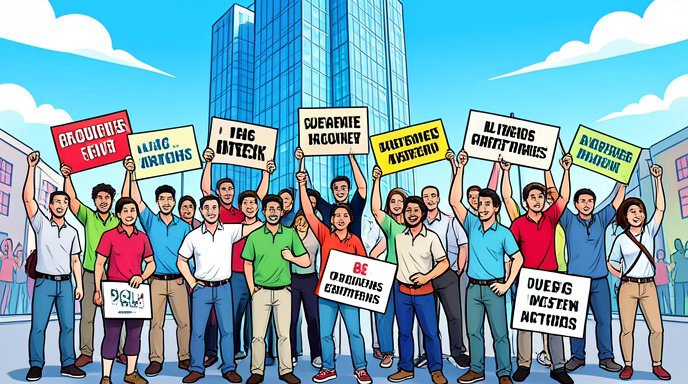
A new political effort is trying to turn Silicon Valley’s internal anxiety about AI into election-year power. On Thursday, Democratic strategists launched Guardrails Alliance, a super PAC designed to mobilize tech workers, unions, and allied advocates into a campaign for AI guardrails and against the influence of wealthy pro-industry groups.
The group’s positioning is striking because it comes from inside the sector it hopes to push back on. Rather than treating tech workers as passive observers of AI policy, the organizers are betting that employees who feel exposed to automation, workplace disruption, and concentration of power will help fund and fuel a broader political counterweight.
The money gap it is trying to close
Guardrails Alliance is entering a field already defined by enormous spending. According to The New York Times, the rival pro-AI political network Leading the Future has a budget exceeding $100 million.
By comparison, Guardrails says it has raised $5 million so far, including money for an associated nonprofit, and it is aiming for $15 million by the end of the cycle. That still leaves it far behind the biggest players, but the gap is part of the message: the new PAC wants to show that grassroots energy can matter even when it cannot match Big Tech’s war chest dollar for dollar.
Why the initiative is resonating now
The launch lands at a moment when AI money is flooding politics. The New York Times reported earlier this year that AI companies, industry groups, and top executives had already poured at least $83 million into federal campaigns and committees in 2025, with another $65 million from Meta at the state level, bringing the total to about $150 million and counting.
Other reporting has also described tech and AI interests as major political spenders in California and beyond, with tens of millions flowing into state races and influence campaigns. That backdrop helps explain why a worker-backed counter-movement could find an audience: the political system is already being reshaped by tech capital, and some of the people building the technology want a seat at the table too.
The populist pitch: workers versus insiders
The core argument behind Guardrails Alliance is straightforward: the people most exposed to the consequences of AI should not be spectators while wealthy donors determine the rules. The Times described the effort as a grassroots movement built around small contributions from ordinary workers, including those affected by the AI boom.
That framing matters politically. Instead of presenting AI regulation as a niche policy fight between Washington and Silicon Valley, the group is casting it as a broader labor and democracy issue — one in which employees, unions, and local communities have a direct stake in how quickly companies automate work and how much political sway they gain in the process.
What this means for the 2026 election cycle
Guardrails Alliance is still tiny relative to the largest tech-backed political operation. But its launch signals that the AI era is not only generating more money for campaigns — it is also producing a backlash from inside the industry itself.
If the PAC succeeds, its impact may be measured less by total dollars than by whether it can help frame AI policy as an issue of worker power, accountability, and democratic control. In a cycle already shaped by huge corporate spending, even a comparatively small but energetic and media-savvy fund could force candidates to answer a new question: not just how they will regulate AI, but whose voice in tech politics they think should count most.
The bigger fight inside Big Tech
This emerging split reflects a larger tension running through the tech sector. On one side are companies, executives, and aligned donors who are spending heavily to shape rules around AI, taxes, and regulation. On the other are workers and advocates who increasingly see AI not just as a productivity tool, but as a force that can reshape jobs, wages, and power inside the economy.
Guardrails Alliance is trying to convert that tension into a political machine. Whether it becomes a durable counterweight or just a symbolic challenge will depend on whether it can keep attracting small-dollar money, recruit credible messengers from within the tech world, and persuade voters that the fight over AI is also a fight over who gets to govern the future.

Get All The Latest Updates Delivered Straight To Your Inbox For Free!