
The Hidden Challenges of Training AI Robots: Why Data Collection Matters
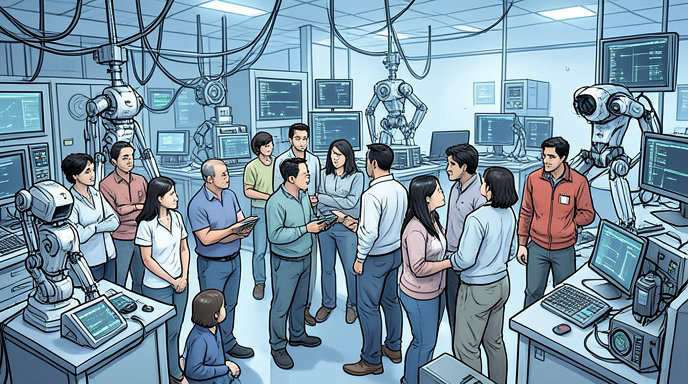
TL;DR
- Training robots is still far more about collecting the right physical-world data than about building larger models, because robots need demonstrations, sensor streams, and edge-case coverage that text-based AI does not.
- Companies working in physical AI, including XDOF-style data pipelines and collection workflows, are emerging around the labor-heavy tasks of teleoperation, annotation, validation, and dataset management.
- The biggest bottleneck for robotics in 2026 is not compute alone but the cost, time, and real-world complexity of building datasets that are diverse, accurate, and representative of deployment conditions.
The Hidden Challenges of Training AI Robots: Why Data Collection Matters
Robotics is hitting a data problem that looks very different from the one behind large language models. Unlike LLMs, which can be trained on internet-scale text, robot systems need representative data from the physical world: demonstrations, trajectories, sensor logs, and success/failure labels tied to real tasks and environments. Researchers note that robot learning lacks the kind of ready-made, large, downloadable datasets that transformed language and vision AI, making data collection an intrinsic limitation rather than just an engineering inconvenience.
That difference matters because robots must learn not just what objects are, but how they behave under force, motion, friction, timing, and spatial constraints. A robot that can “understand” instructions in language still has to learn how to grasp, lift, place, clean, sort, or assemble in messy real-world conditions, where tiny variations can break performance.
Why simulation is not enough
Simulation is useful, but it does not close the gap on its own. Robotics teams use simulated environments to scale up examples quickly, yet sources on robot learning emphasize that simulation still differs from reality, so real-world examples remain necessary for reliable training. In practice, that means simulators are often used to broaden coverage, while physical demonstrations anchor the model in actual sensor behavior and task dynamics.
The challenge is that real-world collection is slow. Robots need data from actual hardware moving through tasks, often with humans guiding the process through teleoperation or handheld recording systems. This is where the work becomes labor-intensive: each useful demonstration has to be captured carefully, synchronized across sensors, validated, and labeled before it can help train a policy.
Why companies like XDOF matter
This is the space where specialized physical-AI data companies are becoming important. The market is shifting toward firms that can build repeatable pipelines for teleoperation, sensor capture, annotation, quality control, and dataset structuring rather than simply training a model and shipping it. In that sense, companies like XDOF represent a broader trend: value is moving toward the infrastructure that turns messy real-world behavior into machine-learning-ready training data.
That infrastructure matters because robotics data is not just “more expensive text.” It is multi-modal and operationally fragile. Teams must decide which sensors to use, how to compress and store streams, how to align timestamps, how to preserve rare events, and how to avoid collecting mountains of redundant footage that adds little training value. The result is a data pipeline that looks closer to industrial production than software scraping.
The labor behind the dataset
A recurring theme across recent reporting is that robotics training data depends on human labor in ways many users never see. Teleoperation, first-person demonstrations, and annotation work often require people to physically perform tasks while capturing synchronized video and sensor signals. Some coverage of the broader AI data economy also highlights that these tasks can be extremely labor-intensive and, in some contexts, underpaid relative to the skill and repetition required.
The time cost can be stark. One recent analysis of robot post-training says that an hour of high-quality recording can require up to three hours of real work once collection, upload, structuring, validation, and labeling are included. That kind of overhead makes scale difficult: producing thousands of hours of usable robotics data can translate into many thousands of hours of labor.
What kind of data robots actually need
Unlike LLMs, which thrive on massive text corpora, physical AI needs data that reflects task execution in context. That usually includes human demonstrations, egocentric video, teleoperation traces, force or tactile signals, robot joint states, and outcome labels showing whether a task succeeded. A robotics data framework from industry guidance describes the field’s main sources as internet-scale data, simulation, egocentric video, teleoperation, and handheld collection.
Recent guidance also emphasizes that data quality is more important than sheer volume. Collectors are being pushed to prioritize diversity in camera pose, spatial arrangement, and task distribution, while ensuring the dataset actually matches the conditions the robot will face later. In robotics, coverage of edge cases and environment variation often matters more than simply having a lot of demonstrations.
Why this is different from the LLM boom
The LLM era created the impression that bigger models plus more compute can solve almost anything. Robotics is a reminder that some AI domains are constrained by the world itself. Text can be scraped at internet scale, but physical interaction must be enacted, observed, and often repeated by humans or robots in controlled settings.
That is why many observers argue that the next leap in robotics will depend less on model size and more on the quality of intentional data collection. Enterprises that want robots in warehouses, factories, retail, or homes will need datasets built around the specific tasks those robots must perform, not just generic demonstrations. In other words, the competitive moat may come from who can build the best data engine, not just the best neural network.
The operational race ahead
The emerging playbook is a hybrid one: collect real-world demonstrations, use simulation to widen coverage, annotate carefully, and filter aggressively so only useful data survives into training. Some teams are also investing in better compression, asynchronous logging, and smarter retention policies to reduce storage and synchronization burdens. Others are building structured task libraries and standardized teleoperation protocols so that collected data is more reusable across robots and environments.
For now, the central lesson is clear: physical AI will not be limited only by algorithms. It will be limited by the human effort required to teach machines how the physical world actually works.

Get All The Latest Updates Delivered Straight To Your Inbox For Free!