
Ford Fathom Is the Cheapest American EV That Can Power Your House
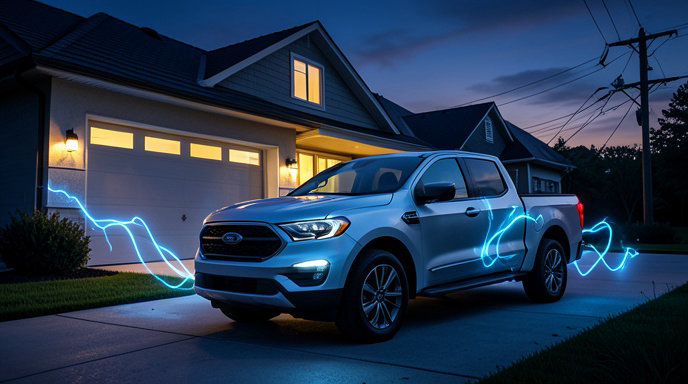
TL;DR
- Ford's upcoming Fathom is targeting a starting price around $30,000, making it the cheapest American EV with full vehicle-to-home backup built in as standard.
- Every Fathom will support bidirectional V2X power with up to 19.2 kW AC output, enough to run a typical American home for days, not just hours.
- Ford is launching two new bidirectional chargers alongside it - a Home Power Station for backup and a Grid-Ready Charger for V2G energy selling - to make V2H mainstream.
What Is the Ford Fathom
Ford is betting its affordable EV future on the Fathom. Built on Ford's new Universal EV Platform developed by the skunkworks team in California, the Fathom is a midsize electric pickup / utility vehicle designed from the ground up for cost, simplicity, and everyday practicality.
Unlike the F-150 Lightning, which positioned bidirectional power as a premium feature on a $60,000+ full-size truck, the Fathom bakes it in from the start. Ford executives are positioning it as the most affordable American EV with full house backup capability, with a target starting price around $30,000.
Production is planned at Ford's BlueOval City complex in Tennessee, with first customer deliveries expected in 2027. It will use prismatic LFP batteries that are cheaper, more durable, and cobalt- and nickel-free.
V2X Specs That Actually Matter
This is where the Fathom changes the game. While most affordable EVs still only offer one-way charging, Ford says the Fathom will come standard with full bidirectional capability.
The key numbers to know:
Bidirectional Onboard Power: Up to 19.2 kW AC output for home backup, matching the F-150 Lightning's Intelligent Backup Power system.
Usable Energy: Expected usable pack in the 70-80 kWh range for the standard-range model, with a larger pack option to follow.
Backup Duration: Ford estimates 3 to 5 days of essential home power from a full charge, depending on home size and usage. With rationing and solar pairing, that stretches to over a week.
Automatic Transfer: When paired with Ford's Home Power system and a dark-start battery, the truck can switch over to home power automatically in seconds when the grid goes down.
120V and 240V Outlets Onboard: In addition to whole-home backup, the Fathom will have Pro Power Onboard outlets in the bed and cab for tools, camping, tailgating, and job sites.
In short, you don't need the Extended Range model or an expensive trim to power your house. If it says Fathom, it can do V2H.
Two New Bidirectional Chargers
To make vehicle-to-home mainstream, Ford is launching an entirely new charging ecosystem with two bidirectional options:
1. Ford Home Power Station
This is the mainstream backup solution. It's a Level 2, 19.2 kW / 80-amp bidirectional AC charger designed for automatic whole-home backup.
When the grid fails, it works with Ford's Home Integration System - automatic transfer switch, inverter, and dark-start battery - to island your home and run it directly off the truck. No extension cords, no manual setup. Just seamless power.
Ford says installation will be simpler and cheaper than the original Sunrun-partnered system for the Lightning, with more certified installers and support for 200-amp homes without major panel upgrades.
2. Ford Grid-Ready Charger
This is the future-facing one. Also bidirectional and Level 2, but built for vehicle-to-grid, or V2G.
With utility approval and time-of-use rate plans, owners will be able to feed energy back to the grid during peak demand events and get credited on their bill. Think of it as using your Fathom as a rolling power plant at night to offset expensive daytime electricity.
Ford is working with major utilities in Texas, California, Florida, and Michigan on pilot V2G programs, with FordPass Energy software managing when to charge, when to hold reserve for driving, and when to sell.
Both chargers will support plug-and-charge, over-the-air updates, and full integration with the FordPass app for backup reserve settings, outage alerts, and energy history.
Why This Makes V2H Mainstream
Until now, vehicle-to-home has been a luxury feature. The F-150 Lightning, GMC Sierra EV, Tesla Cybertruck, and Hyundai IONIQ 5 all offer it, but only on models costing $45,000 to over $100,000, and often requiring $5,000 to $10,000 in home hardware.
The Fathom flips that script in three ways:
Price: At ~$30,000 before incentives, backup power is no longer a $70,000 proposition. It puts a mobile generator on wheels in driveways that could never afford a Lightning plus a Tesla Powerwall.
Standardization: By making bidirectional hardware standard on every Fathom, Ford creates instant scale. Utilities, charger installers, and electricians can finally standardize around one platform.
LFP Durability: One of the biggest concerns with V2H is battery degradation. Ford's switch to LFP chemistry, which tolerates thousands more cycles than NMC, makes daily cycling for backup and V2G far less risky.
How It Compares to the Competition
Against the Chevy Equinox EV, Tesla Model Y, and upcoming Rivian R2 - all expected in the $35,000 to $45,000 range - none currently offer full 19.2 kW whole-home backup as standard. The Equinox EV and Blazer EV offer limited V2H with extra hardware, Hyundai/Kia offer V2L outlets only, and Tesla has only just started enabling V2G-like Powershare features.
The Fathom's closest rival is really the F-150 Lightning itself. The Lightning offers more total energy - 98 to 131 kWh vs. an estimated 70-85 kWh for the Fathom - so it can power a home longer. But the Fathom is $25,000+ cheaper, more efficient, and easier to park and charge daily.
If Ford hits its price and timeline, it will own the cheapest American EV that can power your house - with no close second.
What Still Needs to Prove Out
There are still open questions. Ford hasn't confirmed final EPA range, final backup kW ratings for base vs. long-range packs, or installed pricing for the two new chargers.
Permitting and utility interconnection for V2G also remain slow in many states, meaning the Grid-Ready Charger's sell-back feature may launch in limited markets first.
And perhaps biggest of all: Ford needs to actually ship on time in 2027 at $30,000, something no American automaker has yet done with a profitable EV.
But if it does, the Fathom won't just be another cheap EV. It will be the first EV where powering your house isn't an upsell - it's the whole point.

Get All The Latest Updates Delivered Straight To Your Inbox For Free!