
Nvidia Unveils Free Open 40-Language Speech-to-Text Transcription AI Model
TL;DR
- Nvidia has released a new free and open speech-to-text model that can transcribe pre-recorded audio in up to 40 languages, available now via Hugging Face and its NeMo toolkit for commercial and research use.
- Unlike real-time voice APIs, the model is designed specifically for offline, recordings-only transcription, prioritizing higher accuracy, punctuation, and timestamps for meetings, call centers, and clinical documentation.
- The launch positions Nvidia directly against real-time rivals like ElevenLabs Scribe v2, OpenAI Whisper and GPT-4o Transcribe, with Nvidia betting that on-prem, batch accuracy will win enterprise healthcare and productivity tools.
A New Open Challenger for the Transcription Stack
Nvidia has quietly become one of the most important players in open voice AI. This week, the chip giant expanded that push with a new free, open-weights automatic speech recognition model built for high-accuracy transcription of recorded audio in up to 40 languages.
The model, distributed via Hugging Face and integrated into Nvidia's NeMo framework for conversational AI, is licensed for commercial use, allowing startups, hospitals, and meeting-tool developers to download, self-host, and fine-tune it without per-minute API fees.
While Nvidia is best known for the GPUs that power AI, it has steadily built a portfolio of open speech models under its Canary, Parakeet, and Granary families. This latest release continues that strategy: give developers a highly accurate, deploy-anywhere transcription engine to drive more on-device and data-center inference on Nvidia hardware.
Not Live, On Purpose: Built for Recordings, Not Calls
The most important detail is what the model does not do: real-time streaming.
Nvidia has optimized this model for offline, file-based transcription rather than low-latency live voice agents. Users upload meetings, dictations, lectures, podcasts, or phone call recordings, and the model processes the full audio file at once to return a complete transcript.
That recordings-only design is deliberate. By looking at full audio context in both directions instead of transcribing second-by-second, offline models can deliver significantly lower word error rates, better punctuation and capitalization, more accurate timestamps, and more robust handling of accents, crosstalk, and background noise.
For developers, it also means batch processing. Hours of audio can be transcribed in parallel on a single GPU in seconds to minutes, making it far cheaper for archiving, analytics, and compliance workflows than maintaining always-on streaming infrastructure.
Why Meetings and Medicine Are the Killer Apps
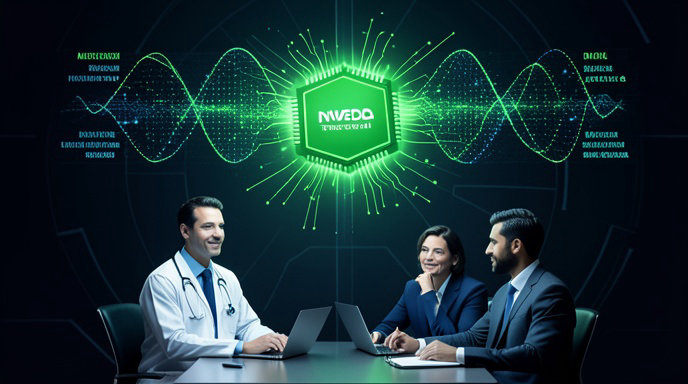
Nvidia is pitching the model squarely at two high-value markets: workplace productivity and healthcare.
For meeting and contact-center tools, the combination of 40-language support, word-level timestamps, and automatic punctuation makes it ideal for generating searchable meeting notes, action items, and sales call summaries. Multilingual teams can transcribe English, Spanish, Hindi, Arabic, Mandarin, French, German and dozens of other languages with a single model, rather than chaining together language-specific systems.
For medical transcription, the benefits are even larger. Clinical documentation requires near-perfect accuracy for drug names, dosages, and diagnoses, plus strict data privacy. Because Nvidia's model is open and self-hostable, hospitals and digital scribe startups can run it on-premises inside their own HIPAA-compliant data centers or on workstations with Nvidia RTX GPUs, ensuring patient recordings never leave the building.
That on-prem advantage also applies to legal, government, and financial services, where cloud API transcription is often blocked by data residency rules.
40 Languages, Punctuation, and Enterprise Accuracy
According to Nvidia's model card and early benchmarks shared by the company, the new system supports transcription across up to 40 languages, with particularly strong performance on English, European languages, and major Asian languages.
Key features highlighted for developers include:
- Inverse text normalization and rich formatting for readable paragraphs, capitalization, and punctuation out of the box, reducing post-processing work.
- Long-form audio handling for transcribing hour-long meetings and dictations without chunking errors.
- Robustness to noise and accents, trained on massive multilingual corpora including crowdsourced and synthetic data from its Granary project.
- NeMo and Hugging Face compatibility, with optimized inference pipelines for Nvidia TensorRT, Faster-Whisper-style serving, and RTX AI PCs.
Early community tests suggest word error rates competitive with or better than OpenAI's Whisper large-v3 on clean recorded speech, while running significantly faster on Nvidia GPUs due to optimized architectures like FastConformer and Transformer-Transducer designs used in previous Parakeet and Canary releases.
How It Compares to ElevenLabs and Other Rivals
The launch sets up a clear split in the voice AI market: offline accuracy vs. real-time speed.
ElevenLabs, currently the poster child for AI voice, recently pushed its Scribe v2 model as a real-time, low-latency transcription API with speaker diarization, streaming partials, and support for 100+ languages. ElevenLabs, Deepgram, AssemblyAI, and OpenAI's GPT-4o Transcribe API are built for live agents, voice bots, and live captioning where a 300-millisecond delay matters.
Nvidia is taking the opposite bet. It is not trying to power the live phone agent that responds instantly. It is trying to power the system of record after the call ends: the EHR note, the legal transcript, the searchable meeting archive.
The trade-off is clear. For live use cases, developers will still need streaming APIs from ElevenLabs or Deepgram. For batch use cases where accuracy, cost, and privacy matter most, Nvidia's free open model eliminates per-hour API costs that can quickly reach thousands of dollars per month at scale.
It also competes directly with other open options like OpenAI Whisper, Meta's SeamlessM4T, and Mistral's Voxtral, but Nvidia's advantages are permissive commercial licensing, enterprise support via NeMo, and day-one optimization for its own GPUs from cloud H100s to laptop RTX chips.
Free, Open, and Strategic for Nvidia
By making the model free and open, Nvidia is following a familiar playbook. Just as Meta used Llama to drive cloud demand, Nvidia is using open speech models to drive inference demand for its hardware.
A hospital system that adopts the model for on-prem clinical scribes still needs Nvidia GPUs to run it at scale. A meeting SaaS startup that offers unlimited transcription without OpenAI API fees can differentiate on price while standardizing on Nvidia-powered cloud instances.
The model is available now for download, with Python sample code, fine-tuning scripts, and deployment containers provided through Nvidia's NeMo repository. Developers can run a lightweight version locally for testing and scale to multi-GPU batch jobs for enterprise workloads.
What Comes Next
Nvidia's recordings-only focus is unlikely to last forever. The company has already teased streaming variants and tighter integration with its Riva live speech pipeline, speaker diarization for who-spoke-when labels, and distilled versions for on-device transcription without a cloud connection.
For now, the message to developers building the next Otter.ai, Nabla, or Abridge for medicine is simple: if you don't need real-time, you no longer need to pay per minute or send sensitive audio to a third-party API.
Download the weights, bring your own Nvidia GPU, and transcribe 40 languages on your own terms.

Get All The Latest Updates Delivered Straight To Your Inbox For Free!