
Trump DOE Approves $5B Loan for Constellation Nuclear Plants to Power AI Data Centers
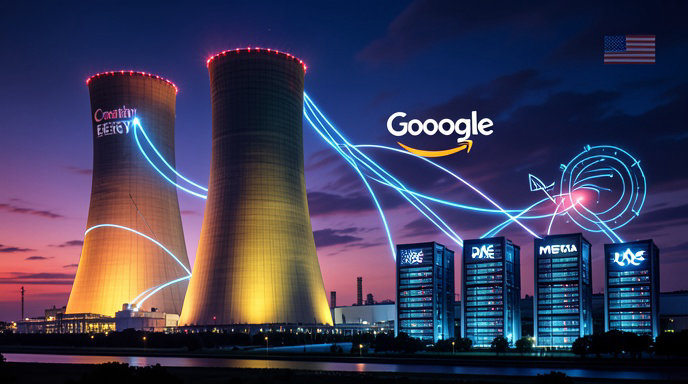
TL;DR
- The Trump Department of Energy has approved up to $5 billion in low-cost loans to Constellation Energy to modernize and uprate its existing nuclear fleet for AI-driven electricity demand.
- The funding will support power uprates, license renewals, maintenance upgrades and new equipment across Constellation's reactors, adding an estimated 1,100 to 1,200 megawatts of new carbon-free capacity without building new plants.
- Most of the new capacity is already spoken for through long-term power purchase agreements with Big Tech, with Meta set to receive the largest share, followed by Google and Amazon, to power AI data centers.
A $5 Billion Bet on Old Reactors for the AI Era
In one of the largest federal financings for civilian nuclear power in U.S. history, the U.S. Department of Energy under President Donald Trump has approved up to $5 billion in loans for Constellation Energy, the nation's largest nuclear operator.
The deal, confirmed in late October 2026, uses the DOE's Loan Programs Office to provide low-interest debt to refurbish, modernize and uprate Constellation's existing reactors. The goal is not to build new nuclear plants, but to squeeze far more power out of the ones America already has — fast enough to meet surging demand from artificial intelligence data centers.
For the DOE, it is a cornerstone of the Trump administration's push for American energy dominance and AI leadership. For Constellation, it locks in decades of federally-backed growth. For Big Tech, it secures the 24/7 carbon-free electricity needed to run the next generation of AI models.
How the $5 Billion Funding Works
The $5 billion comes as direct loans and loan guarantees from the DOE Loan Programs Office, not as a grant or subsidy that Constellation keeps outright.
Under the structure, Constellation will borrow at U.S. Treasury-backed rates that are significantly cheaper than commercial debt, repaying the loans over decades from electricity sales. The funding falls under DOE programs designed to support energy infrastructure reinvestment and maintain baseload clean power.
DOE officials said the financing de-risks large maintenance and engineering projects that utilities might otherwise delay. Constellation plans to use the money for turbine upgrades, new transformers and cooling systems, digital instrumentation and controls, steam generator replacements, and extended power uprates that require Nuclear Regulatory Commission approval.
The company must still meet environmental reviews, NRC licensing requirements, and project milestones before funds are fully disbursed. DOE stressed the loans will be repaid with interest, protecting taxpayers while accelerating deployment.
Why Uprates Instead of New Reactors
Building a brand-new large nuclear reactor in the U.S. can take a decade or more and cost $10 billion to $15 billion, as seen with Vogtle Units 3 and 4 in Georgia.
Uprates offer a shortcut. By upgrading pumps, turbines, generators and safety systems, and by optimizing reactor fuel and thermal limits with NRC approval, operators can raise a plant's output by 5% to 15% without pouring new nuclear concrete.
Constellation estimates the DOE-backed program will add roughly 1,100 to 1,200 megawatts of new capacity across its fleet — equivalent to more than one large new reactor, but delivered in increments over the next five to seven years and at a fraction of the cost and time.
The work will focus on its Illinois, Pennsylvania, New York and Maryland sites, including the Byron, Braidwood, Limerick, Peach Bottom, Calvert Cliffs and Nine Mile Point stations, along with life-extension work to keep 20 to 30-year-old upgrades running for another 20 years.
Where the Power Goes: Meta, Google and Amazon
Almost all of the uprated power is already commercially committed to Big Tech data centers through long-term power purchase agreements.
Meta is the biggest winner, securing an estimated 500 to 600 megawatts to support its AI data center clusters in the Midwest and Mid-Atlantic. The Facebook parent has aggressively pursued nuclear to meet its 24/7 clean energy goal for AI training and inference.
Google follows with around 300 to 350 megawatts tied to its data center expansion in Illinois and Pennsylvania, part of its broader plan to add advanced nuclear and geothermal to complement wind and solar.
Amazon Web Services will take roughly 200 to 250 megawatts for its cloud regions in Pennsylvania and Virginia, building on its existing nuclear deals including power from the Susquehanna plant and its investment in small modular reactors.
Constellation will deliver the electricity both through direct co-located supply and through the regional PJM and MISO grids with clean energy credits, ensuring round-the-clock matching for the tech companies' AI loads.
What It Means for US Nuclear Power
Analysts say the loan marks a turning point for U.S. nuclear policy: from trying to build entirely new designs to maximizing the current fleet first.
The U.S. operates 93 reactors providing about 18% of U.S. electricity and nearly half of its carbon-free power, but most were built in the 1970s and 1980s. Uprates, second license renewals to 80 years, and power electronics upgrades could add 10 to 15 gigawatts nationally by the mid-2030s, according to industry estimates.
The Constellation deal also validates the Loan Programs Office as a tool for nuclear preservation under a Republican administration, after it was heavily used for clean energy under President Joe Biden. Trump DOE Secretary Chris Wright has framed nuclear as essential for AI, reshoring manufacturing, and competing with China.
Rival operators including Vistra, Duke Energy and Southern Co. are now expected to seek similar DOE uprate loans.
What It Means for Big Tech Energy Deals
For hyperscalers, the Constellation loans solve two problems at once: electricity scarcity and carbon promises.
AI data centers can draw 100 to 500 megawatts each — as much as a small city — and utilities in PJM, the nation's largest grid, warn of capacity shortfalls by 2028-2030. By backing uprates with 15 to 20-year fixed-price contracts, Meta, Google and Amazon lock in firm, carbon-free baseload to complement intermittent renewables.
The structure is also becoming the template for Big Tech nuclear deals: tech companies provide demand certainty, utilities provide operations, and DOE provides cheap financing. Microsoft's deal to restart Three Mile Island Unit 1 with Constellation, Oracle's plans for nuclear-powered gigawatt campuses, and Amazon's SMR investments all follow a similar logic.
Critics caution that diverting existing nuclear output to data centers could raise prices for households unless new net capacity — like these uprates — is actually added. The DOE and Constellation argue this loan does exactly that by creating new megawatts rather than just reallocating old ones.
What's Next
Constellation will now finalize loan terms, begin detailed engineering, and file uprate applications with the NRC starting in 2027. First incremental megawatts are expected online as early as 2028-2029, with full program completion targeted around 2031-2032.
DOE is also reviewing additional nuclear loan applications totaling tens of billions, including for small modular reactors, uranium enrichment, and restart projects like Palisades in Michigan and Duane Arnold in Iowa.
If successful, the $5 billion Constellation program could become the model for how the U.S. powers the AI era: not by waiting for futuristic reactors, but by making today's reactors bigger, longer-lived, and directly wired to the cloud.

Get All The Latest Updates Delivered Straight To Your Inbox For Free!