
Fervo Energy’s $12 Billion Geothermal Bet Could Challenge Natural Gas
TL;DR
- Fervo Energy is positioning enhanced geothermal systems as a round-the-clock clean-power alternative to natural gas, backed by a reported $12 billion order pipeline.
- Its Utah Cape Station project is tied to an estimated 8.4 GW geothermal resource, though converting that resource into commercial generation will require major construction, financing and drilling progress.
- Fervo’s strategy depends on sharply reducing drilling costs and replicating oil-and-gas techniques at scale, potentially turning geothermal into a more flexible competitor in the clean-energy market.
A New Geothermal Race Is Taking Shape
Geothermal power has long offered one feature that wind and solar cannot consistently match: electricity generated around the clock. Historically, however, the technology has been limited by geography. Conventional geothermal plants generally need naturally permeable rock, underground heat and fluids that can be reached economically.
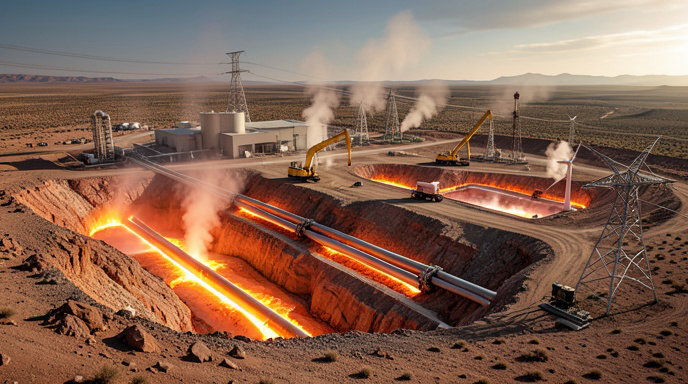
Fervo Energy is pursuing a different model. The Houston-based company is developing enhanced geothermal systems, or EGS, which use directional drilling and hydraulic stimulation to create or improve underground pathways through hot rock. Water is circulated through those pathways, absorbs heat and returns to the surface to drive turbines.
The approach borrows heavily from the shale industry. Fervo is applying horizontal drilling, multi-stage stimulation, advanced well logging and reservoir modeling to geothermal energy. Its ambition is to make hot rock available in far more locations—and to reduce costs enough for geothermal electricity to compete with natural gas and other firm-power technologies.
That ambition has helped attract substantial commercial interest. Reports describing as much as $12 billion in orders or contracted demand have put Fervo among the most closely watched companies in the next generation of clean-energy developers. The figure reflects a pipeline of customer commitments and anticipated purchases rather than a single completed sale, and the exact status of individual agreements remains important to evaluating the company’s progress.
Utah’s 8.4 GW Opportunity
Fervo’s largest public project is Cape Station in southern Utah. The company has described the surrounding resource as capable of supporting approximately 8.4 gigawatts of geothermal generation over time. That figure represents a resource estimate and development opportunity, not an operating power plant.
The scale is nonetheless significant. Eight gigawatts of continuously available capacity could provide a substantial amount of electricity while using far less land than an equivalent combination of intermittent generation and storage. It could also support data centers, industrial facilities and other customers that require dependable power at all hours.
Fervo has announced plans to develop Cape Station in phases. The initial phase is intended to demonstrate commercial-scale generation and establish the project’s operating model. Later phases would expand the well field, add generating capacity and potentially turn the site into one of the largest geothermal developments in the world.
The project’s location offers several advantages, including access to strong solar resources, transmission infrastructure and a hot underground geological formation. It also presents challenges. Building a geothermal plant requires extensive drilling before revenue-generating electricity can be produced, and every well carries geological and execution risks.
Why Drilling Costs Are Central
The economics of EGS depend heavily on drilling. In a geothermal project, wells are often the largest single capital expense. Developers must drill deep into hot rock, construct multiple well pairs and maintain the integrity of those wells under high temperatures and pressures.
Fervo is attempting to lower costs through techniques developed in oil and gas, including horizontal well designs and factory-style drilling processes. Its engineers have reported improvements in drilling speed and performance as the company has gained experience in Nevada and Utah.
The company’s commercial argument is straightforward: if drilling costs fall far enough, geothermal reservoirs could be developed more like shale fields than traditional geothermal sites. Repetition would allow developers to standardize equipment, improve crews’ productivity and create a learning curve similar to the one that transformed U.S. oil and gas production.
That comparison is promising but not guaranteed. Geothermal wells encounter unusually high temperatures, abrasive rock and difficult downhole conditions. Equipment that performs reliably in conventional oil and gas operations may require significant modification. A cost reduction achieved in a pilot project must also be demonstrated across dozens or hundreds of wells.
The EGS Engineering Challenge
Creating an artificial geothermal reservoir is more complex than simply drilling a hot well. A viable project needs a network of fractures that can move water efficiently without losing fluid underground or triggering unacceptable seismic activity.
Fervo injects water into hot rock to open or connect fractures. The resulting reservoir must have enough permeability to produce strong flow rates while remaining stable over decades. Engineers also need to manage the chemistry of the circulating water, which can damage equipment or reduce plant performance.
Induced seismicity is another issue. Hydraulic stimulation can cause small earthquakes, and regulators and local communities will expect developers to monitor and manage that risk. Fervo has emphasized monitoring and controlled stimulation, but the company’s long-term social license will depend on how safely projects operate at commercial scale.
The technology is therefore not simply a matter of reproducing oil-and-gas drilling. It combines drilling, reservoir engineering, power-plant design, water management and seismic monitoring in a single operating system.
A Potential Competitor to Natural Gas
Natural gas remains one of the most important sources of firm electricity in the United States. Gas plants can be built relatively quickly, ramp up when demand rises and provide power when renewable output is low. Those attributes have made gas a default partner for wind and solar.
Geothermal could challenge gas by offering similar reliability without direct combustion emissions. A geothermal plant does not need fuel deliveries, and its output is not dependent on weather conditions. Once a reservoir and plant are operating, the facility can deliver predictable power with a relatively small surface footprint.
This could be particularly attractive to technology companies and data-center operators. Artificial-intelligence workloads are driving demand for large, dependable power supplies, while many corporate buyers are seeking electricity with lower emissions. A round-the-clock geothermal contract could be more valuable to such customers than a portfolio of intermittent renewable-energy certificates.
Geothermal also has an advantage over batteries for long-duration, continuous operation. Storage can shift electricity over hours, but serving industrial or data-center demand through extended periods of low wind and sunlight may require much larger systems. Geothermal avoids that requirement by generating power continuously.
Still, natural gas has a mature supply chain, established financing models and decades of operating experience. Gas plants can also be deployed in regions where geothermal resources are difficult to access. Fervo must therefore compete not only on emissions but also on delivered cost, construction schedules and reliability.
The Importance of Customer Commitments
Fervo’s reported order pipeline is significant because it suggests customers are willing to support geothermal before the technology has reached mass deployment. Long-term power-purchase agreements and commercial commitments can help developers secure project financing, manufacture equipment and plan drilling campaigns.
Early customers also provide a market signal. If utilities, technology companies and large energy buyers are prepared to purchase power from EGS projects, other investors may become more comfortable funding the sector.
However, an order pipeline is not the same as booked revenue. The value of commitments depends on factors such as whether agreements are binding, when projects must deliver power, the price of electricity, permitting milestones and the customers’ ability to cancel or renegotiate contracts.
For Fervo, converting commercial interest into operating assets will be the decisive test. The company must show that it can deliver power at the promised scale and price while maintaining reservoir performance over time.
Financing and Construction Risks
Cape Station will require billions of dollars in capital if it reaches its full potential. Developers must fund exploration, drilling, stimulation, gathering systems, turbines, substations and transmission connections. Capital is spent well before a project generates significant electricity, creating a financial risk that is more pronounced than in some conventional power projects.
Interest rates, equipment costs and transmission delays could all affect the economics. Geothermal projects can also face lengthy permitting processes, especially when they involve federal land, water use or subsurface stimulation.
The project’s phased structure is intended to manage those risks. A smaller initial build can provide operating data, establish reservoir performance and demonstrate revenue generation before later capacity is financed. That approach may make investors more comfortable, but it also means the 8.4 GW resource will be developed over many years rather than appearing immediately on the grid.
A Broader Geothermal Market
Fervo is not the only company pursuing next-generation geothermal. Startups and established energy firms are exploring closed-loop geothermal systems, superhot-rock resources and other methods for extracting heat from the earth. Government agencies have also increased support for geothermal research and demonstration projects.
The sector’s progress could have benefits beyond a single company. Better drilling tools, high-temperature materials, reservoir models and monitoring systems may reduce costs across the industry. Oil-field service companies could become important suppliers, while utilities may gain a new option for replacing retiring coal plants or limiting dependence on gas.
The market opportunity extends beyond electricity. Geothermal heat could support industrial processes, district heating, mineral extraction and potentially the production of low-carbon fuels. These applications could create additional revenue streams for projects with favorable underground resources.
What Fervo Must Prove Next
The next milestones will be practical rather than promotional. Fervo must demonstrate consistent well productivity, reliable reservoir circulation and predictable plant output. It must also show that stimulation can be performed safely and that wells retain performance over long operating periods.
Cost data will be equally important. The company’s competitiveness depends on reducing the cost per drilled foot, shortening construction timelines and increasing the amount of electricity produced by each well pair. Small improvements could compound across a large development, but setbacks could quickly raise the cost of power.
Transmission and permitting will also determine how quickly Utah’s resource can reach customers. A large underground resource has limited commercial value without the substations, transmission lines and regulatory approvals required to connect it to the grid.
The company’s reported $12 billion opportunity should therefore be viewed as a measure of market interest and future potential, not a guarantee of delivered projects. The value of that pipeline will become clearer as agreements move toward financial close, construction and commercial operation.
A High-Stakes Bet on Firm Clean Power
Fervo Energy is betting that geothermal can move from a specialized renewable technology to a scalable infrastructure platform. Its Utah development, drilling strategy and customer commitments reflect a broader effort to bring oil-and-gas execution methods to clean energy.
If the company succeeds, EGS could provide a new source of firm, low-carbon electricity in regions previously considered unsuitable for conventional geothermal. It could help data centers and industrial customers meet rising power demand while reducing reliance on gas-fired generation. It could also give utilities a dependable complement to wind, solar and storage.
The risks are substantial. Underground reservoirs are difficult to predict, drilling is expensive, and commercial-scale geothermal has not yet been proven across the enormous capacity implied by Fervo’s resource estimates.
That is why Cape Station matters beyond Fervo itself. The project will test whether advanced drilling can unlock a new class of geothermal resources—and whether the technology can deliver clean electricity at a price capable of challenging natural gas.

Get All The Latest Updates Delivered Straight To Your Inbox For Free!