
Porsche Shuts Down E-Bike and Battery Subsidiaries in Major Restructuring
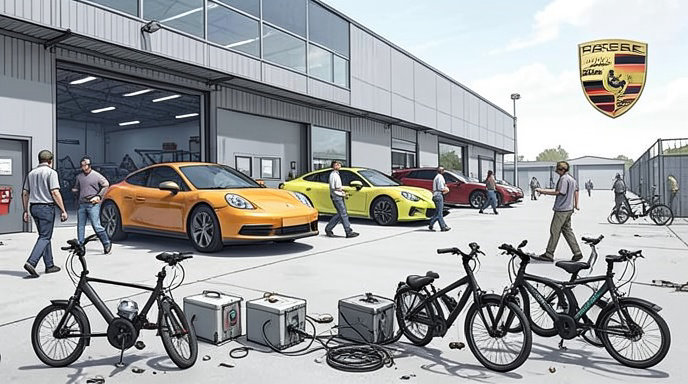
TL;DR
- Porsche is closing three subsidiaries—Cellforce Group (battery), Porsche eBike Performance, and Cetitec (software)—affecting more than 500 employees as part of a major strategic realignment.
- The closures reflect "fundamentally changed market conditions" and Porsche's pivot away from electric-focused ventures back toward its core automotive business, including plans to revive combustion engine models.
- CEO Michael Leiters stated the company must "refocus on our core business," signaling a dramatic shift from Porsche's previous commitment to an electric-first future.
A Strategic U-Turn: Porsche Abandons Electric Ambitions
German automaker Porsche announced Friday a sweeping restructuring that marks a striking reversal from its ambitious electric vehicle strategy. The company is shuttering three key subsidiaries and eliminating over 500 jobs as it attempts to stabilize declining sales and profits. This move represents one of the most visible signs yet that Porsche's grand vision for an electrified future has hit a significant roadblock.
The decision comes just weeks after Porsche sold its stake in Bugatti and the Rimac Group, signaling a broader retreat from experimental ventures and a return to traditional automotive strengths.
The Three Casualties
Cellforce Group stands as perhaps the highest-profile casualty in this restructuring. The battery subsidiary, which focused on developing high-performance lithium-ion pouch cells for electric sports cars and motorsport applications, will be dissolved. The division had already undergone a "realignment" in August 2025 when Porsche abandoned its plans to manufacture its own batteries, converting Cellforce into a research and development arm. Now, the company says Cellforce "no longer has a sufficiently viable long-term perspective," and approximately 50 employees will lose their jobs.
Porsche eBike Performance, the e-bike drive systems division acquired through the 2022 acquisition of Fazua GmbH, will also cease operations. The closure affects roughly 360 employees across facilities in Ottobrunn, Germany, and Zagreb, Croatia. Porsche cited "fundamentally changed market conditions for e-bike drive systems" as the reason for discontinuing the business. A Porsche spokesperson confirmed that "Fazua customers and dealers will continue to have long-term access to spare parts and service," though further details remain forthcoming.
Cetitec, a networking software subsidiary that developed data communication software for both Porsche and the broader Volkswagen Group, rounds out the trio of closures. The company will wind down operations, affecting approximately 90 employees—60 in Germany and 30 in Croatia.
A Technology-Open Powertrain Strategy
In corporate-speak that underscores its strategic pivot, Porsche announced it is pursuing a "technology-open powertrain strategy." This euphemism signals that the automaker will increasingly rely on external partners for battery technology rather than developing capabilities in-house. The move represents a significant departure from the vertical integration approach Porsche had been pursuing.
This shift also hints at a broader recalibration of Porsche's product roadmap. Reports suggest the company is now accelerating plans to introduce new internal combustion engine models—including a redesigned Macan SUV—that it had previously thought would be unnecessary in an all-electric future.
The Human Cost
The restructuring will displace more than 500 workers across the three subsidiaries. While Porsche has not announced specific severance or retraining programs, the scale of job losses underscores the painful reality of the company's strategic realignment. For employees at these divisions, the closures represent an abrupt end to projects and careers they had invested in during Porsche's electric push.
CEO Michael Leiters acknowledged the difficulty of these decisions in a statement: "We must refocus on our core business. This is the indispensable foundation for a successful strategic realignment. This forces us to make painful cuts—including our subsidiaries."
Why the Sudden Reversal?
Porsche's dramatic about-face reflects multiple converging pressures. Weakening demand for premium electric vehicles, rising tariff costs, and the unexpected complexity of Porsche's electric strategy transition have all contributed to declining profitability. The automaker's previous confidence in an EV-dominated future now appears to have been overestimated, at least in terms of near-term market realities.
The e-bike division's closure particularly underscores how even adjacent markets to automotive have proven challenging for traditional carmakers to penetrate. Despite acquiring Fazua and investing in e-bike technology, Porsche found the market conditions unsustainable.
Looking Ahead
Porsche faces difficult years ahead as it attempts to stabilize its business. The company must now manage the transition back toward internal combustion engines while simultaneously completing its EV portfolio transformation. The irony is stark: Porsche spent years insisting the future was electric, only to find itself now scrambling to resurrect combustion technology it had begun phasing out.
The restructuring represents not just a corporate pivot but a humbling acknowledgment that Porsche's previous strategic bets did not pan out as anticipated. Whether this refocusing on core automotive business proves sufficient to restore profitability remains to be seen.

Get All The Latest Updates Delivered Straight To Your Inbox For Free!