
Revolutionizing AI on Mac: Osaurus Combines Local and Cloud Models
TL;DR
- Osaurus is emerging as a Mac-first AI runtime that lets users switch between local models and cloud providers without giving up control of their files, tools, or memory.
- The open-source app now supports a wide range of models, including Apple Foundation models, local MLX-based models, and cloud services like OpenAI, Anthropic, Gemini, xAI, and OpenRouter.
- Recent momentum includes voice support, strong download growth, and early interest in business use cases where privacy and on-device processing matter most.
Osaurus is betting on a new kind of AI workflow for Mac
A new wave of Mac software is trying to solve one of the biggest tensions in modern AI: users want the power of frontier models, but they do not necessarily want their data, files, and workflows leaving their own hardware. Osaurus, an open-source, Apple-only LLM server and AI runtime, is positioning itself as one of the most interesting answers to that problem.
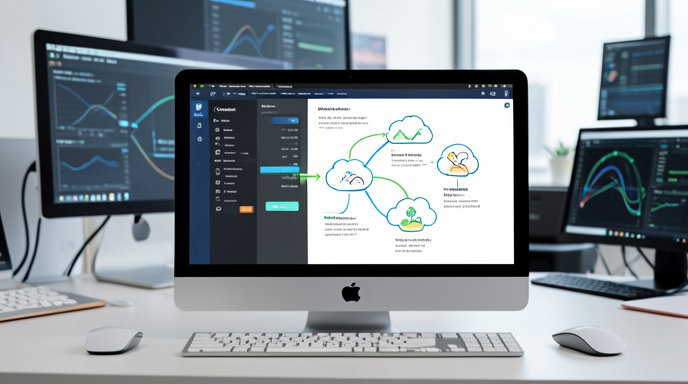
The idea behind Osaurus is simple, but increasingly compelling. Instead of forcing users to pick between fully local AI and cloud-based AI, it creates a single layer that can connect to both. That means a Mac user can run one task on a local model, route another to a cloud provider, and still keep the surrounding context — memory, tools, and file access — on their own machine.
For many users, especially those handling sensitive work, that hybrid approach may be the sweet spot.
Local-first, but not local-only
Osaurus is built around the reality that not every AI task needs the same setup. Fast drafting, privacy-sensitive note taking, and offline workflows may be better suited to a local model. More complex reasoning, multilingual tasks, or demanding coding requests may be worth handing off to a cloud model.
According to the project’s documentation, Osaurus supports local MLX models on Apple Silicon, Apple’s on-device Foundation models on newer versions of macOS, and Liquid Foundation models as well. It also connects to cloud providers including OpenAI, Anthropic, Gemini, xAI/Grok, Venice AI, OpenRouter, Ollama, and LM Studio.
That flexibility is the core of the product. Users are not locked into a single model vendor or inference mode. Instead, they can treat AI models like interchangeable engines, choosing the best one for the job while preserving a consistent workflow around them.
Why Mac users are paying attention
Osaurus arrives at a moment when interest in local AI on Apple hardware is rising fast. Apple Silicon has become especially attractive for running large language models efficiently, thanks to its unified memory design and Neural Engine acceleration. That has made Macs — especially high-memory Mac minis and Mac Studios — appealing to developers, enthusiasts, and businesses that want always-on AI machines.
Osaurus taps into that trend directly. It is designed specifically for macOS and optimized for Apple hardware. The app can run fully on-device when needed, but it can also extend outward to the cloud when the task calls for more capability.
That balance is likely to appeal to users who want the convenience of modern AI assistants without surrendering all control over their local environment.
Security and privacy remain central
One of Osaurus’ biggest selling points is that it keeps important pieces of the AI experience on the user’s machine. That includes memory, files, and tools, which can be sensitive in both personal and professional settings.
For industries like legal services, healthcare, finance, and consulting, the ability to keep data local while still using advanced AI tools is more than a convenience — it may be a requirement. The project’s founders are reportedly already thinking about those kinds of enterprise use cases.
This is where Osaurus may have an edge over more traditional chatbot apps. Rather than acting as a thin client for a remote model, it gives users a local control layer that can stay consistent even when the underlying model changes.
More than just a model switcher
Osaurus is not only about swapping between local and cloud inference. It also functions as an MCP server, which means it can expose tools and capabilities to other AI applications. That opens the door to more automated workflows, agent-like behaviors, and custom integrations.
The platform also includes features such as:
- multi-layer memory
- custom agents
- plugin support
- schedules and watchers for autonomous execution
In other words, Osaurus is trying to become a broader AI runtime rather than just a model launcher. That makes it part of a larger shift in the AI stack, where the software layer around the model matters as much as the model itself.
Voice support and growing momentum
The project has also been expanding beyond text. More recently, voice capabilities were added, making Osaurus more useful as a general-purpose AI interface rather than a narrow developer tool.
Momentum appears to be building as well. The project’s website says it has been downloaded more than 112,000 times since launch. That level of interest suggests that the market for local-and-cloud hybrid AI tools on Mac is real, not hypothetical.
Osaurus’ founders, including co-founder Sam Yoo, are currently participating in the New York-based Alliance startup accelerator, which may help the project move from a popular open-source tool into a more structured product strategy.
A growing market for AI infrastructure on the Mac
Osaurus is part of a broader trend: the Mac is increasingly becoming an AI workstation and even an AI server. As more people look for ways to run models locally, Apple hardware has gained a reputation as a practical, energy-efficient platform for inference.
That has created opportunities for software that helps people manage model selection, context, memory, and tool access across both local and cloud environments. In this sense, Osaurus is not just another chatbot app. It is infrastructure for people who want to build their own AI stack on macOS.
The bigger picture
The AI market is moving quickly from a phase of model excitement to a phase of workflow consolidation. Users are no longer just asking which model is best. They are asking how to use several models safely, efficiently, and without constantly switching apps or exposing sensitive data.
Osaurus fits that moment well. By letting Mac users move between local and cloud AI while keeping control of their hardware-side data and tools, it offers a practical answer to one of AI’s most pressing product questions: how do you get the best of both worlds?
If Osaurus continues to expand its model support, agent features, and enterprise focus, it could become one of the defining pieces of software in the emerging local AI ecosystem for Mac.

Get All The Latest Updates Delivered Straight To Your Inbox For Free!