
Tesla's Robotaxi Challenges: Unveiling Crash Reports and Teleoperator Issues
TL;DR
- Tesla has unredacted 17 Robotaxi crash narratives filed with NHTSA, offering the first clear look at what happened in each incident.
- Two low-speed crashes involved teleoperators taking over after the ADS got stuck, raising questions about remote assistance safety and readiness.
- The revelations add to pressure on Tesla as it tries to scale Robotaxi service while facing safety concerns, slow expansion, and regulatory scrutiny.
Tesla has finally revealed the details behind 17 crashes involving its Robotaxi program, and the newly unredacted reports paint a more complicated picture than the company’s earlier filings suggested.
For months, Tesla stood apart from other autonomous vehicle operators by withholding the narrative descriptions in its crash reports to the National Highway Traffic Safety Administration. Now, those descriptions are public, and they show a mix of incidents: some caused by other drivers or external factors, and others that expose real weaknesses in Tesla’s autonomous driving stack and its remote support system.
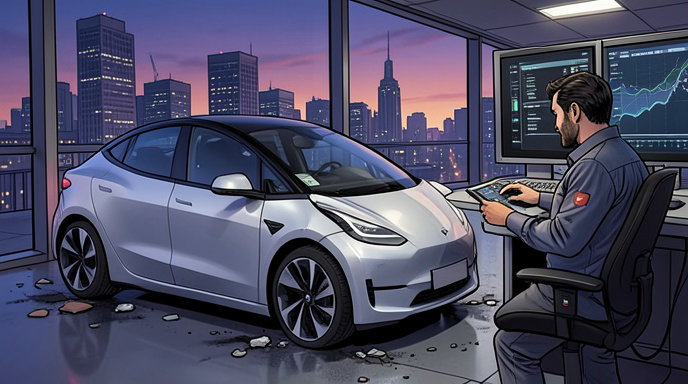
The most attention-grabbing details are two crashes in which a teleoperator remotely took control after the vehicle’s autonomous system got stuck. In both cases, the intervention ended badly.
The first incident occurred in July 2025, when a safety monitor requested help because the ADS would not proceed forward. A remote teleoperator took over, drove the vehicle up a curb, and into a metal fence at low speed. It was the only crash in the set that resulted in a reported injury, though it was not severe enough to require hospitalization.
The second took place in January 2026 under a similar setup. Again, the ADS apparently could not navigate the situation on its own, and a teleoperator stepped in. This time the vehicle was driven into a construction barricade at around 9 mph.
A Long-Awaited Look Inside Tesla’s Crash Reports
Tesla’s newly unredacted submissions are notable not just for what they say, but for what they represent: a rare moment of transparency from a company that has typically provided far less detail than rivals like Waymo, Zoox, Avride, and May Mobility.
Those companies have generally published multi-paragraph accounts of each incident. Tesla, by contrast, had marked every crash narrative as confidential business information. In doing so, it limited public visibility into the exact circumstances surrounding its Robotaxi incidents.
The newly released narratives now give regulators, analysts, and competitors a much clearer view of how Tesla’s early ride-hailing deployments are performing in the real world.
What the Crash Narratives Show
Not every crash appears to reflect a fault in Tesla’s autonomous system. Some incidents were caused by other vehicles, road conditions, or circumstances that were largely outside Tesla’s control.
That said, a portion of the narratives do highlight genuine operational limitations. The pattern is especially concerning when the system requires human backup and still fails during intervention.
In the two teleoperator incidents, the vehicle was already in trouble before the remote operator stepped in. But the fact that the remote assistance itself led to a collision raises a different kind of concern: not just whether the ADS can handle complex environments, but whether Tesla’s fallback system is reliable enough to be trusted.
Why the Teleoperator Crashes Matter
Teleoperators are supposed to be a safety net. When the autonomous system gets confused, stuck, or unable to continue, a remote human operator can help resolve the situation or guide the vehicle safely to its destination.
But these incidents suggest that Tesla’s remote support pipeline may not yet be mature enough for consistent real-world operation. If the system cannot proceed on its own and remote operators are then unable to recover it safely, that weakens confidence in the overall autonomy stack.
The concern becomes even sharper given Tesla’s broader ambition to reduce or eliminate in-vehicle safety monitors over time. If a teleoperator can crash the car at low speed while trying to help, then removing the onboard human presence too early could increase risk rather than reduce it.
Scaling Too Fast, or Too Slowly?
Tesla’s Robotaxi rollout has been notably cautious, especially when compared with the company’s long-running promises about full self-driving capability. The latest crash disclosures may help explain why.
Even with Elon Musk’s repeated claims about autonomy progress, Tesla appears to be moving carefully with its ride-hailing ambitions. Musk recently said that ensuring the service is “completely safe” is the main bottleneck to expansion, describing the company’s approach as deliberately cautious.
That caution may be wise. Autonomous ride-hailing depends not only on accurate perception and planning, but also on robust operational controls, remote support, and a well-tested safety framework. Tesla now seems to be learning how difficult it is to make all of those pieces work together at scale.
Regulatory and Competitive Pressure
The NHTSA reporting process is designed to give regulators insight into how autonomous systems are performing on public roads. Tesla’s decision to initially redact its crash narratives likely increased scrutiny, especially since other ADS operators have been more forthcoming.
Now that the narratives are public, Tesla is likely to face more questions about how it classifies incidents, how remote interventions are managed, and how it plans to improve safety as it expands.
There is also a competitive angle. Tesla’s data had been unusually opaque compared with other companies in the sector, and the company itself argued that disclosure could harm its business by revealing progress to rivals. But the newly exposed incidents may have the opposite effect: they show just how much work remains before Robotaxi can be positioned as a truly scalable service.
The Bigger Picture for Tesla’s Autonomous Ambitions
Tesla’s Robotaxi program remains early, and the company is operating at a much smaller scale than more established autonomous ride-hailing players. Still, the crash reports are a reminder that autonomy is not just a software milestone. It is an operational discipline.
The real challenge is not simply getting a car to drive itself in ideal conditions. It is handling edge cases, backing up the vehicle safely when the system fails, and doing so consistently enough to earn public trust. The two teleoperator crashes suggest Tesla still has work to do on that front.
For now, the unredacted reports offer a clearer, and more sobering, look at the state of Tesla’s Robotaxi program. They show progress in transparency, but also persistent uncertainty about whether the company’s autonomy and remote support systems are ready for broader deployment.
As Tesla continues to push toward a larger Robotaxi rollout, the central question may no longer be whether the cars can drive themselves in good conditions. It may be whether Tesla can build an operational system that stays safe when things stop going according to plan.

Get All The Latest Updates Delivered Straight To Your Inbox For Free!