
US Travelers on Air Force One Ordered to Dispose of Gifts After China Summit
TL;DR
- Travelers aboard Air Force One were told to discard China-issued gifts, lapel pins, credential badges, and even burner phones before flying back to the U.S.
- The move appears to be a security precaution tied to long-running U.S.-China espionage concerns, even as the summit itself was publicly cordial.
- The incident highlights how tightly controlled presidential travel is, especially when foreign governments distribute items that could pose tracking or surveillance risks.
Why Travelers Had to Toss the Souvenirs
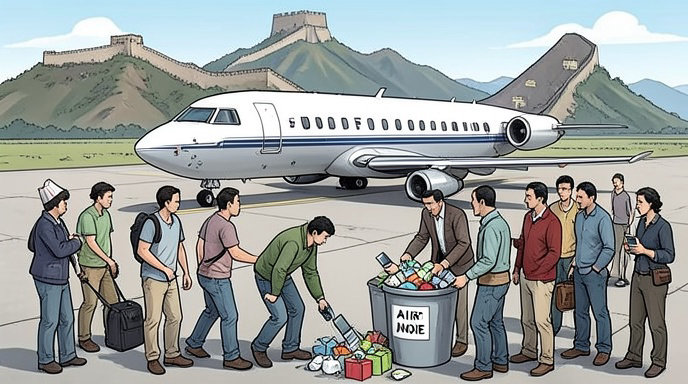
Passengers and staff aboard Air Force One were reportedly ordered to throw away a batch of items handed out during a diplomatic trip to China, including gifts, pins, credential badges, and burner phones used by White House personnel. The items were placed in a bin at the bottom of the aircraft stairs before boarding, according to reporters traveling with the president.
The directive was not accompanied by an official public explanation, but the most likely reason is security. In high-stakes diplomatic environments, even small objects can raise concerns about hidden electronics, tracking devices, or other forms of covert surveillance.
A Routine Trip, But Not a Routine Security Posture
The summit in Beijing appeared outwardly smooth, with the U.S. delegation and Chinese officials presenting a cordial public face. But the underlying relationship between Washington and Beijing remains defined by intense strategic competition, intelligence gathering, and mutual distrust.
That tension helps explain why authorities would be especially cautious about anything distributed by the host government. In diplomacy, souvenirs are rarely just souvenirs. A badge, a lapel pin, or a phone handed out at an official event can be treated as a potential security liability until proven otherwise.
Why Burners and Badges Were Targeted
The most notable items reportedly discarded were burner phones and press or delegation credentials. Burner phones are inherently sensitive because they may contain communication histories, SIM data, or hardware that could be compromised. Even if they are disposable by design, they still fall into a broader category of devices that security teams prefer not to bring back across borders.
Credential badges also draw attention. These items can contain embedded identifiers, RFID components, or simply enough information to make them useful in intelligence mapping. In a tightly monitored travel environment, the safest answer is often to dispose of them rather than risk introducing unknown hardware onto the aircraft.
The Espionage Backdrop
The U.S.-China relationship has long been shaped by fears of hacking, surveillance, and intelligence collection. Both governments are highly capable in cyber and signals intelligence, and both have publicly accused one another of aggressive espionage tactics.
That context makes the Air Force One directive feel less unusual than it might at first glance. In previous incidents around the world, governments have warned officials not to use foreign-issued electronics or accept items that could conceal surveillance components. The principle is simple: if an object comes from a rival state and could plausibly be compromised, it may never make it past the security checkpoint.
Air Force One’s Tight Rules Are Part of the Brand
Air Force One is famous not just as a presidential aircraft, but as a heavily controlled environment. Reporters and staff travel under strict protocols, and the aircraft is treated as an extension of the White House, with its own rules about what can be brought on board and what must be left behind.
That includes items far less sensitive than foreign-issued devices. In general, anything that could create a security question is handled conservatively. The “nothing from China allowed on the plane” approach reflects that mindset: eliminate uncertainty first, sort out details later.
What This Means for U.S.-China Diplomacy
The optics of the trip matter. A successful summit can project calm and cooperation, but operational security procedures reveal what the public handshakes cannot. When U.S. officials are told to discard gifts before leaving China, it signals that trust remains limited even at the highest diplomatic level.
For travelers, the takeaway is blunt: the age of high-tech rivalry has made even small diplomatic tokens suspect. For the broader relationship, it is another reminder that the U.S. and China may be able to negotiate in public, but neither side is likely to relax its guard any time soon.
The Bigger Picture
What happened on Air Force One is a small episode, but it captures a much larger reality. Modern diplomacy is inseparable from cybersecurity, surveillance fears, and counterintelligence concerns. A lapel pin, a badge, or a phone may look harmless, yet in the wrong context it can become part of a much bigger security puzzle.
In that sense, the discarded souvenirs are more than just souvenirs. They are a snapshot of the mistrust that continues to shape the world’s most consequential geopolitical relationship.

Get All The Latest Updates Delivered Straight To Your Inbox For Free!