
Visualizing Malware: What Would the World's Largest Malware Repositories Look Like?
TL;DR
- Malware is no longer just a matter of “how many samples,” but also how much physical storage they would occupy if laid end to end as hard drives.
- New threats increasingly blur the line between file, container, and memory, making malware repositories harder to detect, classify, and remove.
- Visualizing malware as stacked drives is a useful way to understand the scale of the problem — and why modern defense now depends on layered detection, not just disk scans.
The Scale Problem Hidden in Plain Sight
Cybersecurity has always had a numbers problem. Security teams track malware families, hash counts, phishing campaigns, botnet nodes, and intrusion attempts — but those metrics can feel abstract. One way to make the threat more tangible is to imagine malware not as code, but as physical hard drives stacked on top of each other.
That mental model is more than a gimmick. It helps illustrate just how massive the global malware ecosystem has become. Every malicious document, trojan, ransomware builder, RAT loader, and stolen credential cache adds another tiny grain of digital dust to a mountain that now spans cloud infrastructure, decentralized storage, virtual disk images, memory-resident payloads, and compromised software distribution channels.
In other words: malware is no longer a box of infected files. It is an industrial-scale data problem.
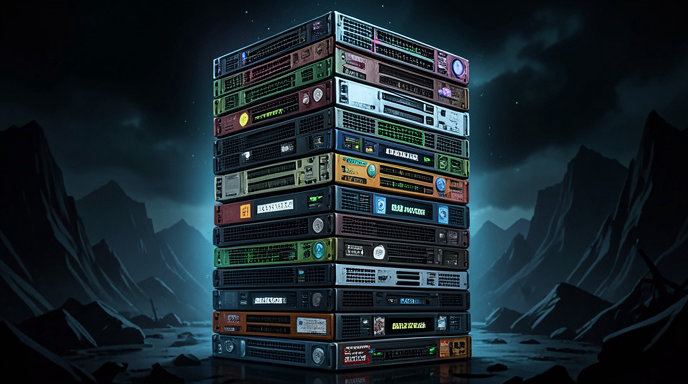
Why the “Stacked Hard Drives” Image Works
The hard-drive comparison resonates because storage has always been a physical proxy for digital scale. A single malicious file may only be a few kilobytes or megabytes. But when threat researchers talk about repositories containing millions of samples, the total footprint becomes surprisingly large.
That footprint is especially important because malware is not just one thing. It includes:
- loaders and droppers
- encrypted payloads
- phishing attachments
- command-and-control scripts
- stolen archives
- packed binaries
- fileless stagers and memory-only components
A repository that tracks malware at internet scale can quickly resemble a warehouse more than a folder. And as researchers continue to catalog samples from campaigns across the globe, the “stacked drives” visualization becomes a useful shorthand for how quickly malicious data accumulates.
The Bigger Problem: Malware Is Getting Harder to Pin Down
The latest campaigns show attackers leaning into formats and environments that complicate detection. Recent phishing operations have used virtual hard disk files, or VHDs, to distribute malware in ways that sidestep traditional warnings. When users double-click a VHD, Windows mounts it like a new drive, and files inside can appear more trustworthy than downloaded attachments normally would.
That matters because security controls often rely on the assumption that suspicious files stay suspicious as they move through the system. But when malicious content is hidden inside a mounted volume, it can inherit the appearance of a local disk rather than an internet-downloaded file.
This technique is part of a broader shift. Attackers are increasingly:
- hiding payloads inside disk images
- using decentralized storage to host malicious files
- staging malware in cloud services
- executing payloads in memory instead of on disk
- chaining scripts and loaders to avoid detection
Each of these methods makes malware less like a single file and more like a distributed infrastructure problem.
Malware Repositories Are Growing — But So Is the Noise
It’s tempting to imagine that bigger malware databases always mean better security. In practice, the opposite can also be true. As repositories grow, so does the challenge of filtering signal from noise.
Security teams and researchers must distinguish between:
- genuinely malicious samples
- test malware and proof-of-concept code
- repacked or duplicated binaries
- altered variants of known families
- benign tools abused in attacks
- transient payloads that never touch disk
This is why raw sample count can be misleading. A repository with fewer unique families may be more valuable than one with millions of duplicates. Similarly, a small set of highly evasive samples can cause more damage than a giant archive of older, already-detected malware.
The visual metaphor of stacked drives also highlights another reality: malware collections are not static. They are constantly being cloned, mirrored, modified, and rehosted across the web.
From Disk to Memory: The Attack Surface Keeps Moving
A major reason malware repositories feel limitless is that defenders are no longer dealing only with disk-based threats. Recent research has shown a rise in malware designed to target system memory, where traditional filesystem scanning is less effective.
Memory-resident malware can:
- evade disk-based antivirus checks
- disappear after a reboot if not paired with persistence
- modify behavior at runtime
- use obfuscation to resist static analysis
That shift means the “storage” of malware is increasingly temporary, dynamic, and distributed. Some malicious code lives in RAM only long enough to steal credentials, inject processes, or drop the next stage. Other attacks mix memory execution with registry changes or scheduled tasks so they can survive restarts.
From a visualization standpoint, this makes the problem even stranger: not all malware can be neatly stacked as a set of drives. Some of it is better thought of as smoke — present, dangerous, and difficult to pin down.
The Supply Chain and the Trust Problem
Another layer in the malware-storage story is the supply chain. Attackers don’t always need to invent a new delivery mechanism if they can compromise an existing one.
The recent compromise of a popular virtual mounting tool showed how trusted software itself can become a malware distribution channel. In those cases, the danger is not just the malicious file; it is the trust users place in the source.
That trust extends to:
- software installers
- cloud-hosted files
- peer-to-peer storage systems
- document-sharing platforms
- remote management tools
- browser-based downloads
Once a legitimate path is hijacked, malware can move with the credibility of the platform behind it. This is one reason why digital safety now depends as much on provenance and integrity as on signature detection.
Why This Matters for Everyday Users
For most people, the biggest risk is not the scale of malware repositories themselves — it’s the way that scale powers targeted attacks. Attackers can cheaply store, duplicate, and redeploy malicious files until one version gets through.
That means everyday users face a landscape where:
- a PDF may not be a PDF
- an archive may hide a disk image
- a disk image may contain a script launcher
- a script may fetch a payload from a cloud service
- a payload may never appear on disk at all
This layered model is what makes phishing so effective. It is no longer just about tricking someone into opening an attachment. It is about exploiting the fact that modern operating systems, collaboration tools, and cloud services are designed to trust convenience.
How Security Defenders Are Responding
Defenders are adapting with equally layered controls. Rather than relying on one gate, security programs increasingly combine:
- attachment sandboxing
- behavior-based detection
- endpoint telemetry
- memory scanning
- cloud threat intelligence
- reputation checks on files and URLs
- user training and phishing awareness
The goal is to catch malware at multiple points in its lifecycle, because no single control sees everything.
A VHD-based phishing campaign, for example, may evade one layer of scanning but still reveal itself through unusual process behavior, suspicious PowerShell activity, or anomalous outbound connections. Similarly, memory-only malware may leave no file behind, but it often still produces telltale traces in process trees, registry changes, and network patterns.
The limits of any one technology are exactly why “stacked drive” thinking is useful. Malware is not a flat problem. It is layered.
The Future: Bigger Repositories, Smarter Evasion
If the current trend continues, the world’s largest malware repositories will not just grow larger — they will become more fragmented, more distributed, and harder to catalog in one place.
Expect continued use of:
- virtual disks and container formats
- decentralized file hosting
- cloud APIs for staging and exfiltration
- fileless and memory-only payloads
- obfuscation and runtime mutation
- compromised legitimate software channels
That means the next era of cybersecurity won’t be defined only by how much malware exists, but by how invisible it can become.
And that is what makes the “hard drives stacked on top of each other” image so effective. It turns an abstract threat into a physical one. It reminds us that behind every sample is a real storage cost, a real detection challenge, and a real opportunity for attackers to hide in plain sight.
Bottom Line
Visualizing malware repositories as towers of hard drives is a powerful way to understand scale, but it also exposes the deeper issue: the threat is no longer confined to files on disk. Malware now lives in containers, in memory, in cloud services, and in the trust relationships that connect them.
The world’s largest malware repositories are not just large. They are increasingly evasive, distributed, and operationally complex. And that is what makes digital safety in 2026 so difficult: defenders are not simply counting files anymore. They are tracking an ecosystem.

Get All The Latest Updates Delivered Straight To Your Inbox For Free!