
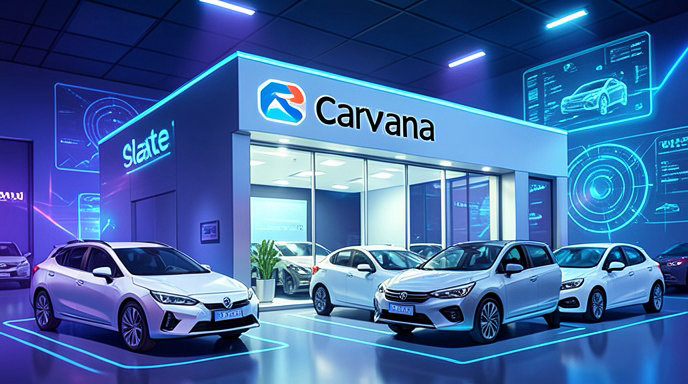
Carvana Partners with Slate Auto to Revamp Car Sales Strategy
TL;DR
- Carvana and Slate Auto are linked by a strategic interest in simplifying EV sales and ownership, with Slate emphasizing a low-friction service model and Carvana continuing to expand how customers buy vehicles online.
- Slate Auto is a Bezos-backed EV startup positioning itself around affordability, customization, and convenience, including service access through independent repair networks and Tesla Supercharger compatibility via NACS.
- Guggenheim Partners’ ties to the companies matter because of its capital connections to Slate and the broader relevance of investor overlap in the fast-changing auto retail and EV market.
Carvana Partners with Slate Auto to Revamp Car Sales Strategy
Carvana is increasingly pushing beyond its used-car roots and into broader vehicle retail experiences, using partnerships and operational expansion to make online car buying feel closer to a full-service dealership alternative. In that context, a collaboration with Slate Auto fits Carvana’s broader strategy of reducing friction for shoppers who want a simpler path from browsing to ownership.
Why Slate Auto is an attractive partner
Slate Auto has been positioning itself as a convenience-first EV brand built around a stripped-down, customizable truck that can be configured for different use cases. The company has also leaned into practical ownership support, including a service expansion program with RepairPal’s network of independent shops and adoption of the North American Charging Standard to open access to Tesla’s Supercharger network.
What the partnership signals for car sales
The strategic value of any Carvana-Slate alignment is straightforward: Carvana can help scale a digital retail channel, while Slate can provide an EV product built for easy purchase, service, and charging access. That combination could appeal to buyers who want an affordable EV without the complexity of a traditional dealership experience.
Carvana has already demonstrated a willingness to invest in adjacent automotive businesses to strengthen its platform, including its 2021 partnership with Root, where it committed about $126 million to build integrated insurance solutions for online car buyers. That history suggests Carvana views partnerships not as side projects, but as a way to deepen customer engagement around the core vehicle transaction.
The Bezos and Guggenheim angle
Slate’s backers include Jeff Bezos, and the company has raised substantial capital from a group of high-profile investors. Guggenheim Partners’ involvement is relevant because it connects the financing story to a larger web of automotive and consumer-tech capital, underscoring how much of the EV market now depends on strategic investment rather than just product launches.
That investor overlap matters because it can shape distribution, service access, and scaling decisions long before a vehicle reaches mass-market adoption. In practice, the market implications go beyond one partnership: they reflect how EV startups and digital retail platforms are converging around the same goal of simplifying ownership.
What Slate brings to the market
Slate’s value proposition is unusual even by EV startup standards. The company has unveiled an entry-level electric truck that it says will cost less than $20,000 after the federal EV tax credit, with a modular design that can also convert into an SUV. Its stripped-back hardware choices, accessory ecosystem, and wrap-friendly exterior are designed to reduce manufacturing complexity while increasing personalization.
That approach makes Slate especially relevant to Carvana’s model, which depends on efficient online discovery and fulfillment rather than a sprawling dealer network. If the partnership develops further, Slate could become a test case for how minimalist EV brands are sold like digital consumer products rather than conventional automobiles.
The bigger automotive market implication
If Carvana and Slate can combine online retail, flexible service access, and simplified charging support, the result could pressure other automakers and retailers to rethink how much of the ownership journey still has to run through dealerships. The broader lesson is that the next competitive edge in auto retail may come less from inventory alone and more from the ecosystem around the vehicle: financing, service, charging, and post-sale support.
For now, the partnership narrative is as much about market positioning as it is about immediate sales volume. But with Slate’s Bezos-backed financing, Carvana’s e-commerce infrastructure, and Guggenheim-linked capital relationships in the background, the move points to a more integrated and investor-driven future for automotive retail.

Get All The Latest Updates Delivered Straight To Your Inbox For Free!