
Enterprise AI Takes Center Stage at VivaTech 2026
TL;DR
- VivaTech 2026 is putting enterprise AI and robotics at the center of Europe’s tech agenda, with a strong emphasis on business deployment rather than consumer apps.
- European companies are using AI to modernize manufacturing, logistics, healthcare, cybersecurity, and energy infrastructure, where compliance and operational reliability matter as much as model quality.
- The event reflects a broader shift: 87% of companies say they plan to increase AI investment, and Europe is leaning into industrial AI as a strategic alternative to Silicon Valley’s consumer-first AI race.
Enterprise AI Takes Center Stage at VivaTech 2026
Europe’s AI moment is different
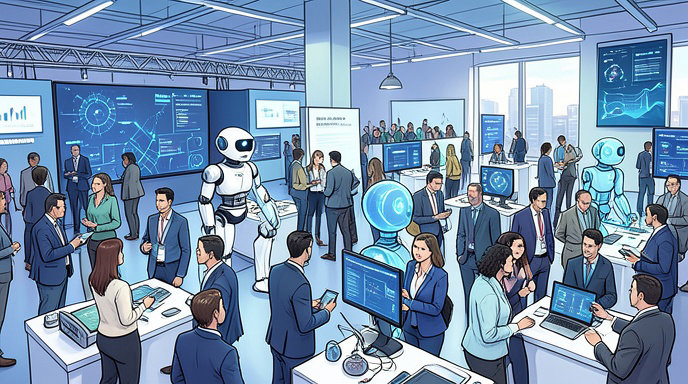
VivaTech 2026 is shaping up to be a clear showcase for enterprise AI, with the conversation focused less on consumer chatbots and more on the systems that run Europe’s economy and daily life. The event’s direction reflects a broader European strategy: using AI to improve complex, regulated, mission-critical operations rather than chasing the largest consumer platform.
Why enterprise AI is getting the spotlight
A major reason for the shift is practical. European firms are deploying AI where it can make measurable impact in manufacturing, logistics, healthcare, cybersecurity, and energy infrastructure. These sectors do not just need powerful models; they require compliance, integration with legacy systems, and trust from institutions that cannot afford failure.
That is why enterprise AI has become one of the biggest themes at VivaTech. According to VivaTech’s 2026 Confidence Barometer, 87% of companies plan to increase AI investment, and 53% are committed to substantial investment. The numbers suggest that AI is moving from experimentation to budgeted transformation across European industry.
The European model: industrial AI over consumer hype
Silicon Valley’s AI boom has largely revolved around consumer platforms and foundation models, while Europe is increasingly positioning itself around industrial AI. That means AI systems designed to support supply chains, transportation networks, healthcare operations, and other critical infrastructure rather than only end-user apps.
This distinction matters. Industrial AI is usually harder to build and slower to scale, but it can create deeper, longer-lasting value because it is embedded directly into business operations. In Europe, that approach also fits the region’s regulatory environment, where data governance, safety, and accountability are central concerns.
What companies are showing at VivaTech
At the conference, enterprise-focused AI is expected to span both software and robotics. Reply’s presence at VivaTech 2026 is centered on “making AI, agents and robotics happen across the enterprise,” signaling how quickly agentic systems are moving from concept to deployment. That aligns with the broader industry shift toward AI tools that can automate workflows, coordinate tasks, and assist human teams inside organizations.
The event is also set to feature a wide range of international delegations and corporate participants, underscoring VivaTech’s role as a meeting point for business development, research, and policy discussion. In its 10th edition, the conference is being framed as Europe’s largest startup and technology event, which gives enterprise AI a particularly influential stage.
Why robotics and agents matter now
The pairing of AI agents and robotics is one of the most notable trends around VivaTech 2026. Agents can automate repetitive knowledge work, while robotics extends AI into physical environments such as factories, warehouses, hospitals, and transport systems.
That combination is especially attractive in Europe, where labor shortages, aging infrastructure, and the need for productivity gains are pushing companies to adopt automation more aggressively. The result is a market where AI is not just an innovation layer but a core operating capability.
The investment outlook for Europe
The confidence data released by VivaTech suggests that corporate AI spending is still accelerating rather than cooling off. With most companies planning to raise investment, the question is no longer whether AI will be adopted, but where it will produce the most return.
For Europe, that likely means more attention to enterprise use cases that improve resilience, efficiency, and sovereignty. VivaTech’s messaging also highlights a renewed focus on national sovereignty and the human talent needed to sustain the next wave of innovation. That reflects a European priority: building AI ecosystems that are competitive, secure, and locally governed.
What to watch next
The biggest question coming out of VivaTech 2026 is whether Europe can turn its industrial strengths into a durable AI advantage. If enterprise AI continues to dominate investment and conference attention, the continent may carve out a distinct identity in the global AI race: less focused on flashy consumer products, more focused on the infrastructure that keeps modern society running.
The companies to watch are the ones building AI into the backbone of business operations, where the winners will likely be determined by reliability, integration, and trust rather than by attention alone.

Get All The Latest Updates Delivered Straight To Your Inbox For Free!