
Ford Revives Expertise: The Return of Experienced Engineers in the Age of AI
TL;DR
- Ford rehired, promoted, and brought back over 350 veteran engineers to fix vehicle quality issues that its AI and automated systems failed to resolve.
- The automaker's initial reliance on AI without sufficient human oversight led to major software bugs and industry-leading recalls, forcing a strategic pivot back to human expertise.
- By rebalancing machine automation with veteran intuition and mentorship, Ford reclaimed its top spot in the JD Power 2026 US Initial Quality Study, marking a 16-year high for vehicle quality.
Ford Revives Expertise: The Return of Experienced Engineers in the Age of AI
In a bold move to modernize its manufacturing, Ford executives recently bet heavily that artificial intelligence alone could ensure product quality and streamline vehicle design. The strategy involved replacing legacy processes with AI-driven automation and, in some cases, reducing the reliance on veteran engineers who had spent decades mastering the intricacies of car assembly.
However, the results were far from the seamless efficiency promised by the algorithms. Instead of a quality revolution, Ford faced a crisis of its own creation. The company's automated systems, trained on shrinking institutional knowledge rather than the robust judgment of human experts, began spreading mistakes. The fallout was severe: major software bugs, critical manufacturing errors, and industry-leading vehicle recalls that threatened the brand's reputation.
The "Gray Beard" Solution
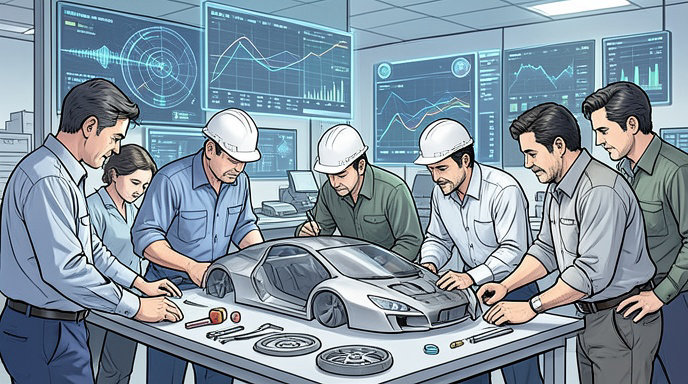
Recognizing that the machines were failing to catch quality issues that a seasoned worker would spot instantly, Ford made a decisive pivot. The company scrambled to rehire the very engineers it had previously let go. Over the course of roughly three years, Ford hired, promoted, and brought back more than 350 experienced technical specialists—often referred to as "gray beards" or "veterans" in the industry.
These returning experts were not just there to assemble cars; they were tasked with a critical reconstruction effort. Their responsibilities included:
- Fixing flawed data that had corrupted the AI models.
- Rewriting automated testing protocols to better reflect real-world manufacturing realities.
- Mentoring younger employees who lacked the deep, tacit knowledge required to identify subtle defects.
Why AI Couldn't Replace Human Intuition
The core of Ford's struggle highlights a fundamental limitation in current AI applications within the automotive sector. As industry experts noted, the AI models were only as good as the data they learned from. In manufacturing environments filled with decades of legacy processes and undocumented "tribal knowledge," data quality became a massive bottleneck.
Automated systems are optimized for speed and can miss the nuanced quality issues that a veteran line worker catches instantly. The knowledge required to run a complex assembly line is often too tacit and contextual to be easily encoded into machine learning models. Ford's executives admitted that the tools were trained on fading institutional knowledge, lacking the critical layer of human judgment necessary to ensure stability.
A Quality Comeback for the Industry
The strategic rebalancing of human intuition with machine automation has yielded remarkable results. By integrating the wisdom of veteran engineers with advanced AI tools, Ford successfully reversed its quality crisis. The company reclaimed its number one spot in the JD Power 2026 US Initial Quality Study among mass-market brands, achieving a quality ranking that hadn't been seen in 16 years.
This turnaround serves as a powerful lesson for the entire automotive industry. While AI remains a transformative tool for efficiency, Ford's experience proves that it cannot fully replace the human expertise required to deliver high-quality results. The future of manufacturing lies not in choosing between humans and machines, but in pairing the speed of automation with the irreplaceable intuition of experienced engineers.
The Path Forward
Ford's COO, Kumar Galhotra, noted that the company has since more than doubled its population of technical specialists. These specialists now lead mandatory design reviews and actively hunt for failure points before parts ever reach the plant floor. The automaker has also developed bespoke AI-enhanced scanning tools, but crucially, these are now validated and refined by human experts.
As the industry continues to integrate AI technologies, Ford's story stands as a testament to the enduring value of human expertise. The "solution" to the AI fallout was not to fix the code or collect more data, but to go back to the people who understood the machines best. In an age of rapid technological advancement, Ford has revived the expertise that built the company, proving that the strongest quality processes are built on a foundation of partnership between human and machine.

Get All The Latest Updates Delivered Straight To Your Inbox For Free!