
Tesla's $10B Texas Solar Factory Plan Seeks State Funding Boost
TL;DR
- Tesla is reportedly pursuing a $10 billion solar manufacturing facility in Texas, positioning it as one of the largest solar investments in U.S. history and a major expansion beyond its automotive and battery operations.
- The company is said to be seeking substantial state support through Texas incentive programs, including tax abatements and infrastructure grants, to offset construction and operational costs.
- If built, the factory could significantly boost domestic solar panel production, create thousands of jobs, and reshape Texas' energy economy, but faces questions about funding, supply chains, and long-term demand.
A Gigafactory for Solar?
Tesla is best known for its electric vehicles and battery storage, but the company has long had solar ambitions through its Solar Roof and solar panel businesses. Now, reports indicate Tesla is looking to dramatically scale up that side of the business with a dedicated, massive solar factory in Texas.
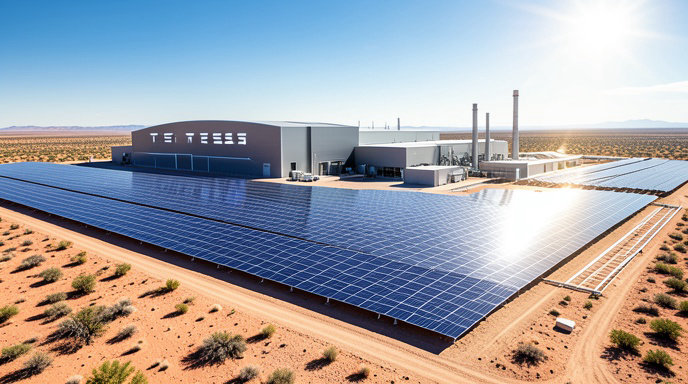
While Tesla already operates its Gigafactory Texas in Austin for vehicle production, the proposed solar facility would represent a separate, purpose-built campus focused entirely on solar manufacturing - from photovoltaic cells and modules to potentially inverters and related hardware. The reported $10 billion price tag would put it on par with Tesla's largest Gigafactory investments to date and signal a major bet on American-made solar at a time of surging demand and federal push for domestic clean energy supply chains.
Sources describing the proposal suggest Tesla is evaluating multiple sites in Texas, with proximity to its existing Austin operations, access to highway and rail logistics, and availability of large, flat industrial land cited as key factors. No final site has been publicly confirmed by the company as of August 12, 2026.
What Tesla Wants From Texas
The central element of the reported plan is not just the scale of the factory, but the request for public support to build it. Tesla is said to be in discussions with state and local officials about incentives to help defray the upfront capital costs.
In Texas, large-scale projects of this kind typically pursue support through programs such as Chapter 312 tax abatements, the Texas Enterprise Fund, and local infrastructure assistance for roads, utilities, and workforce training. For a $10 billion facility, the combined value of property tax abatements, job-creation grants, and site development aid could reach hundreds of millions of dollars over a decade.
Proponents of such deals argue that the state investment is justified by the long-term return in jobs, tax base, and industrial competitiveness. Critics often question whether highly profitable companies need public subsidies and whether the promised economic benefits materialize. Tesla has successfully negotiated incentive packages for its previous Texas and Nevada facilities, making this approach consistent with its expansion strategy.
Why Texas, Why Now
Texas is already the national leader in wind power and rapidly growing in utility-scale solar, making it a logical location for solar manufacturing. The state offers abundant land, a business-friendly regulatory environment, relatively low energy costs, and a large skilled manufacturing workforce anchored by the automotive, semiconductor, and energy sectors.
Timing also matters. Federal incentives under the Inflation Reduction Act have created strong tailwinds for domestic solar manufacturing, offering production tax credits for U.S.-made modules, cells, and wafers. Building a factory in Texas would allow Tesla to capture those federal benefits while also serving the booming Sun Belt solar market directly, reducing shipping costs and supply chain risks associated with overseas production, particularly from Southeast Asia and China.
For Tesla, vertical integration is another driver. Controlling solar production in-house could lower costs for its Solar Roof and Tesla Electric retail power business, and create tighter integration with its Powerwall and Megapack energy storage products.
Economic and Energy Implications
If realized at the proposed scale, a $10 billion solar factory would be transformative for both Texas and the broader U.S. solar industry.
Economically, a project of this size would likely create several thousand direct manufacturing jobs plus thousands more in construction and supporting supply chains. It could anchor a new solar manufacturing cluster in Central Texas, attracting suppliers of glass, polysilicon, and electrical components to the region.
For the energy sector, domestic production at this volume could help ease supply constraints, lower panel prices over time, and accelerate solar deployment across the U.S. Texas, which operates its own grid through ERCOT, has faced growing demand and reliability challenges. Adding more locally produced solar capacity and storage could support grid resilience, though it would not solve transmission and intermittency issues overnight.
For the U.S. solar industry as a whole, Tesla's entry at gigascale would increase competition for established manufacturers like First Solar and Qcells, potentially driving innovation but also pressuring margins in an already competitive market.
What Happens Next
As of now, Tesla has not issued a formal public announcement confirming a final investment decision, site selection, or definitive incentive agreement for the $10 billion solar factory. Any project of this magnitude would still require multiple steps, including local government approvals, environmental reviews, final incentive negotiations, and board-level approval.
State lawmakers and local county officials would need to weigh the cost of incentives against projected job creation and tax revenues, a process that typically involves public hearings and economic impact studies. Industry analysts will also be watching whether Tesla can execute on solar manufacturing at scale, an area where the company has previously faced production and cost challenges compared to its automotive business.
Whether the Texas solar Gigafactory moves from proposal to reality will depend on those negotiations in the coming months, but the sheer scale of the plan already underscores how central solar manufacturing has become to the next phase of the clean energy race in the United States.

Get All The Latest Updates Delivered Straight To Your Inbox For Free!