
NASA Selects Eric Schmidt's Relativity Space for Mars Mission, Challenging SpaceX
TL;DR
- NASA has chosen Relativity Space to build and fly the Aeolus Mars orbiter mission, with NASA supplying the science instruments and the company handling the spacecraft, rocket, and cruise operations.
- The mission is planned for 2028, a tight schedule that will test Relativity’s ability to mature its hardware quickly while competing with SpaceX in deep-space capability.
- The move gives NASA another major private-sector partner for Mars and raises the stakes in the commercial race to the Red Planet, especially because Relativity is now controlled by Eric Schmidt.
NASA Turns to Relativity Space for a New Mars Push
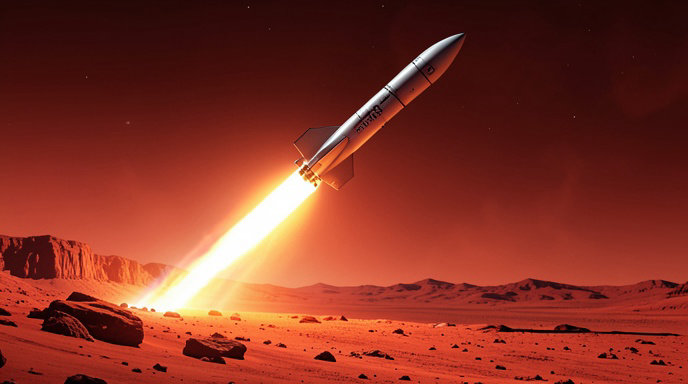
NASA has selected Relativity Space to carry out a Mars mission called Aeolus, marking a notable bet on a relatively new entrant in the space industry over more established launch players. Under the partnership, NASA will provide the atmospheric-science instrument payload, while Relativity will supply the spacecraft, rocket, and cruise operations needed to deliver the instruments to Mars.
The agreement reflects NASA’s growing reliance on public-private partnerships for ambitious science missions, with the agency focusing on the instruments and the commercial company taking on much of the development and launch burden. NASA says the mission is supported by its first six-year reimbursable Space Act Agreement, which is meant to provide a stable framework for sustained collaboration and mission continuity.
What Aeolus Will Study
Aeolus is designed to carry four science instruments that will measure and image Mars from orbit. NASA says the payload will provide the first integrated, daily, global view of Martian winds, temperatures, dust, and clouds.
That data is not just for climate science. NASA says it will also help make future landers, and eventually astronauts, safer by improving understanding of atmospheric conditions on the Red Planet.
Why This Matters for Relativity Space
Relativity Space is no longer just a launch startup trying to prove it can reach orbit. The company, now controlled by Eric Schmidt, has been placed in charge of a deep-space mission that requires designing and building a spacecraft, integrating NASA’s instruments, and getting the whole system to Mars on a demanding schedule.
That is significant because the mission is set to launch in 2028, which gives Relativity limited time to mature its hardware and mission architecture. The company is also expected to rely on its still-developing Terran R launch vehicle for the effort, adding another layer of execution risk to the program.
A Challenge to SpaceX
The NASA-Relativity deal is being read as a direct challenge to SpaceX, which has long dominated the public conversation around Mars and has positioned itself as the leading private space company for interplanetary exploration. If Aeolus launches on time and reaches Mars successfully, it could become the first private mission to reach the Red Planet, according to reporting on the contract.
That would matter symbolically as well as commercially. It would show that NASA is willing to spread major Mars opportunities across multiple private partners rather than concentrating future prestige missions around one company.
The Broader Commercial Space Race
Relativity is not entering Mars work from zero. In 2022, the company announced a commercial Mars partnership with Impulse Space, intended to deliver the first commercial payload to Mars using Relativity’s Terran R rocket. That earlier deal showed the company’s intent to compete in deep-space logistics, but the NASA mission is a much larger validation of its capabilities.
The new Aeolus contract also highlights NASA’s broader strategy: the agency handles the science, while the private sector builds and launches the infrastructure. That model reduces direct agency costs and shifts some development and execution risk to the contractor.
The Timeline Pressure
The 2028 launch target is ambitious by any standard, especially for a company still scaling launch-vehicle development and spacecraft integration. Relativity will need to complete the spacecraft design, finish building the rocket, and coordinate mission operations on a compressed timeline.
That schedule is part of what makes the story notable. NASA is not waiting for a fully mature commercial Mars market; it is helping create one by giving a major mission to a company still proving its long-term flight capability.
What Comes Next
If Relativity executes successfully, Aeolus could become a landmark mission for both the company and NASA’s commercial exploration strategy. It would also strengthen the case for a more competitive Mars ecosystem, where multiple private companies can vie for science, cargo, and eventually human-support roles.
For now, the key question is execution: whether Relativity can turn a bold contract into a real Mars mission on time, and whether SpaceX’s lead in the public imagination translates into sustained dominance in the next phase of planetary exploration.

Get All The Latest Updates Delivered Straight To Your Inbox For Free!