
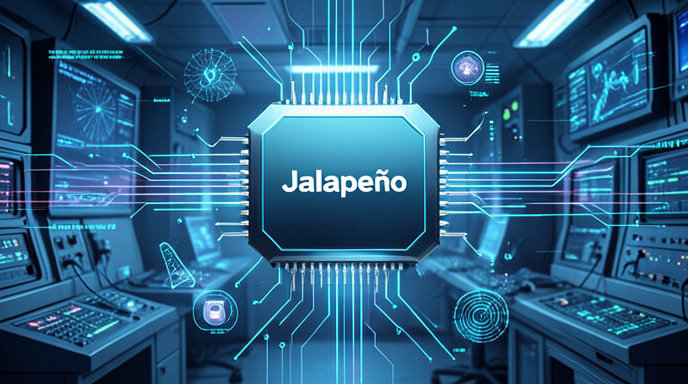
OpenAI Launches Custom Chip "Jalapeño" Designed for Advanced Inference Systems
TL;DR
- OpenAI has unveiled "Jalapeño," its first custom AI chip, co-developed with Broadcom specifically to optimize large language model (LLM) inference.
- The chip moved from design to manufacturing in just nine months and promises roughly 50% cost savings compared to standard Nvidia GPUs while delivering superior performance per watt.
- This deployment marks OpenAI's strategic entry into proprietary hardware, aiming to reduce dependency on Nvidia and scale toward a 10-gigawatt compute infrastructure by 2029.
OpenAI Launches Custom Chip "Jalapeño" Designed for Advanced Inference Systems
On Wednesday, OpenAI officially crossed a major threshold in its technological evolution by unveiling "Jalapeño," its first custom-designed artificial intelligence chip. Created in close collaboration with semiconductor giant Broadcom Inc., this breakthrough signifies OpenAI's formal entry into the proprietary hardware market. While the company has long been the architect of the world's most advanced AI models, Jalapeño demonstrates a strategic pivot to owning the full stack—from the neural networks themselves to the physical silicon that powers them.
The move is not merely about innovation; it is a calculated response to the escalating costs and supply chain vulnerabilities associated with relying exclusively on third-party hardware providers like Nvidia. By designing its own accelerator, OpenAI aims to secure a competitive advantage through enhanced performance, reduced operational expenses, and a more resilient supply chain for its massive AI infrastructure.
Design Philosophy: Purpose-Built for Inference, Not General Compute
Unlike general-purpose graphics processing units (GPUs) designed to handle a wide array of tasks, Jalapeño is an Application-Specific Integrated Circuit (ASIC) engineered with a singular focus: large language model inference. Inference is the compute-intensive process of running a trained model to generate answers for users—essentially the engine behind every ChatGPT response, API call, and Codex interaction.
The chip's architecture is optimized to minimize data movement between memory and computation, a key bottleneck in current AI systems. By tailoring the interplay between computation, memory, and networking specifically for LLM workloads, Jalapeño achieves a significantly higher performance-per-watt ratio than existing state-of-the-art accelerators. OpenAI's engineering teams utilized their own models to accelerate the chip design process, creating a feedback loop where the AI helps build the hardware that will eventually serve it.
Performance Metrics: 50% Cost Savings and Superior Efficiency
Early laboratory evaluations of Jalapeño have yielded promising results that could reshape the economics of AI deployment. According to Broadcom CEO Hock Tan, the new accelerator demonstrates approximately 50% cost efficiency compared to standard AI graphics processing units currently in use. While OpenAI notes that final performance benchmarks are still being measured, the company asserts that the chip delivers performance per watt substantially better than current leading hardware.
The speed of development is equally remarkable. The project moved from initial design concepts to manufacturing tape-out in just nine months. This rapid timeline underscores the maturity of OpenAI's engineering capabilities and the deep synergy between OpenAI and Broadcom. The chip is characterized by the companies as an "Intelligence Processor," a term reflecting its role as the first dedicated AI accelerator in OpenAI's platform designed to enhance the speed, reliability, and accessibility of advanced AI for a broader audience.
Strategic Implications: Breaking Dependency and Scaling to 10 Gigawatts
The introduction of Jalapeño carries profound implications for the broader artificial intelligence landscape. Historically, giants like Google, Amazon, Microsoft, and Meta have already built their own silicon to optimize their specific cloud and AI needs. OpenAI's entry into this race validates the trend that the most successful AI companies will eventually need to control their own hardware infrastructure.
For OpenAI, the primary strategic goal is to break its dependency on Nvidia, whose GPUs have become the de facto standard for AI training and inference. By diversifying its hardware supply, OpenAI can mitigate the risks of supply shortages and price hikes. Furthermore, this initiative is a critical step toward OpenAI's ambitious long-term vision: powering 10 gigawatts of compute capacity by 2029.
Deployment Timeline and Industry Rollout
OpenAI and Broadcom have announced that initial samples of Jalapeño are currently being evaluated for AI tasks. The companies are targeting a full rollout of the chips by the end of 2026. The deployment will begin at a gigawatt scale in data centers operated by Microsoft and other partners, leveraging existing infrastructure to support the massive computational demands of next-generation agentic products.
As Jalapeño moves from the lab to the global data center, it represents not just a new chip, but a new paradigm for how AI is built and delivered. By owning the hardware that powers its models, OpenAI is positioning itself to serve more intelligence with greater efficiency, pushing advanced AI toward broader access while securing its future in the rapidly evolving world of artificial intelligence.

Get All The Latest Updates Delivered Straight To Your Inbox For Free!