
Silicon Valley's Latest Innovation: Meet Stretch, the Home Assistant Robot
TL;DR
- Hello Robot’s Stretch 4 is the company’s latest home-focused mobile manipulator, built around a practical design rather than humanoid theatrics.
- The robot is positioned as a useful assistive platform for chores, care support, and research, with earlier Stretch deployments already showing promise in disability and aging-in-place contexts.
- Silicon Valley’s readiness for home robotics will depend less on hype and more on price, reliability, privacy, and everyday usefulness—the exact areas Stretch is trying to address.
Stretch 4 Signals a Different Kind of Home Robot
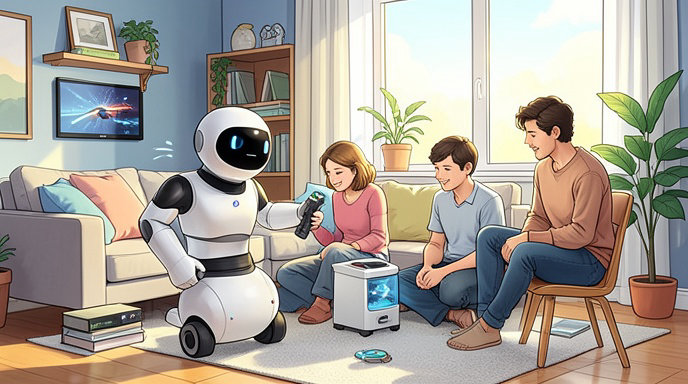
Hello Robot’s Stretch 4 is part of a growing wave of home robotics that favors function over spectacle. Instead of chasing a full humanoid form, the California-based company has built a wheeled robot with an omnidirectional base and a telescoping arm designed to handle real tasks in home and workplace settings.
That design choice matters. By avoiding the complexity of legs and humanoid locomotion, Stretch aims to solve the practical problems that matter most in daily use: moving through tight spaces, reaching objects, and completing repetitive chores without requiring a human-sized robot body.
Why Stretch Matters Now
The latest Stretch release arrives at a moment when robotics firms are pushing harder into consumer-facing applications. Hello Robot has long described Stretch as an open-source platform intended to help researchers and developers build robots that can assist people in homes and workplaces.
Stretch 4 continues that philosophy while sharpening the product’s identity as a “simply useful” robot built to put people first. In other words, the company is betting that the next breakthrough in home robotics will not come from flashy demonstrations, but from robots that can do boring, helpful work reliably.
From Research Platform to Real-World Assistive Tool
Stretch’s relevance extends beyond product launches and startup messaging. Earlier Stretch systems have already been used in assistive applications, including support for people with disabilities and care partners. In one reported household case, the robot helped a user feel “useful again,” underscoring the emotional as well as practical dimensions of home robotics.
The platform has also been used in research exploring how robots can help older adults with early-stage dementia remain in their homes longer by supporting social participation, cognitive assistance, and health and safety management. That gives Stretch a stronger foundation than many consumer robot demos: it is already tied to real use cases, not just speculative future scenarios.
What Makes Stretch 4 Stand Out
Stretch 4 is being framed as a practical mobile manipulator rather than a futuristic household companion. Its core appeal lies in a combination of mobility, reach, and software openness that makes it attractive for developers and researchers trying to build useful applications.
The company’s messaging also emphasizes accessibility and purpose-driven design. That focus sets Stretch apart in a field where many home robots still struggle to justify themselves outside controlled demos or niche pilots.
Is Silicon Valley Ready for Home Robots?
The broader question is whether Silicon Valley is ready to let robots into everyday domestic life. The answer appears to be: technically, increasingly yes; socially and commercially, not quite yet.
Home robotics still faces several obstacles. Devices must be safe around children, pets, and older adults, operate consistently in cluttered environments, and earn trust in highly personal spaces. They also need to be priced realistically. Stretch 4 has been listed at $29,950, which places it well outside the typical consumer gadget market and suggests it remains closer to an advanced platform than a mass-market appliance.
That said, the market may not need a fully mainstream home robot before adoption begins. As with many emerging technologies, the first wave may come through care settings, research labs, and high-income early adopters before broader consumer use follows.
The Bigger Implication for Home Automation
Stretch’s launch reflects a wider shift in robotics: the transition from robots as novelty objects to robots as infrastructure. Rather than trying to replace human workers or mimic human bodies, Stretch is designed to handle narrow but meaningful tasks that can support independence, aging in place, and daily convenience.
If that approach succeeds, it could reshape expectations for home automation. The next phase of smart homes may not be dominated by voice assistants alone, but by mobile robots that can physically interact with the environment.
What Happens Next
For Hello Robot, the challenge is not just building a capable machine but proving that it can work safely, consistently, and affordably in real homes. The company’s open-source approach may help expand experimentation and accelerate new applications.
For the broader industry, Stretch 4 is a reminder that the path to useful home robotics may be shorter than the path to humanoid robots, but still requires patience, engineering rigor, and realistic expectations. Silicon Valley may be fascinated by robots that look human, but Stretch suggests that the future of home assistance may be built on robots that simply do the job well.

Get All The Latest Updates Delivered Straight To Your Inbox For Free!