
SoftBank Questions Elon Musk's Orbital Data Center Vision
TL;DR
- SoftBank CEO Masayoshi Son publicly rejected Elon Musk's plan to build AI data centers in space, arguing the economic case is flawed.
- Son contends that electricity costs only account for roughly 7% of data center operations, while hardware and chips make up the remaining 93%, negating the primary benefit of space-based power.
- The billionaire emphasized that the AI race will be decided on Earth, citing the immense complexity, maintenance costs, and latency issues associated with orbital infrastructure as insurmountable barriers.
SoftBank Questions Elon Musk's Orbital Data Center Vision
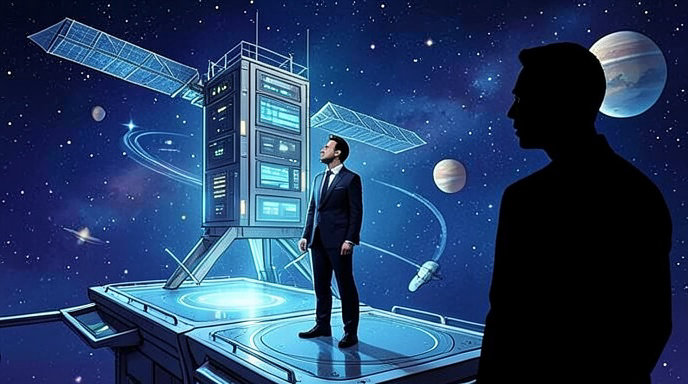
At SoftBank's annual shareholder meeting on June 23, 2026, a dramatic debate erupted over the future of artificial intelligence infrastructure. While Elon Musk has been championing an ambitious vision to construct massive AI data centers in orbit—powered by solar energy and connected via laser links—SoftBank founder and CEO Masayoshi Son publicly challenged the feasibility of the concept.
Son did not mince words, questioning the fundamental logic behind Musk's extraterrestrial proposal. "What's the point?" Son reportedly asked, emphasizing that the economic case for placing AI infrastructure in space is weak. The clash highlights a growing skepticism among industry leaders regarding the practicality of Musk's off-planet ambitions, suggesting that the future of AI compute power lies firmly on Earth.
The Economic Fallacy: Why Electricity Isn't the Answer
The core of Son's skepticism rests on a detailed breakdown of data center cost structures. Musk's primary argument for orbital data centers is the potential for significantly lower electricity costs, leveraging the unlimited solar power available in space. However, Son argued that this benefit is negligible when viewed against the total operational expenses.
According to Son, electricity accounts for only about 7% of the total cost of operating an AI data center. The remaining 93% is driven by high-performance computing hardware, specifically the chips required to train and run AI models, as well as cooling systems, servers, and other physical infrastructure.
"If electricity is only 7% of the cost, then saving on it won't justify the complexity," Son contended. He pointed out that the massive costs associated with launching equipment off Earth, the need for specialized orbital maintenance, and the networking challenges would far outweigh the modest savings from cheaper power.
The AI Race Will Be Decided on Earth
Beyond the financial arguments, Son expressed a strategic belief that the competition for AI supremacy will not wait for space-based infrastructure to mature. He noted that the "battle for AI" will be defined in the next few years, a timeframe that is too short to develop and deploy the complex orbital systems Musk proposes.
Son argued that the genuine competition for AI capabilities will unfold much nearer to home. "The AI race will be decided much closer to home," he stated, referencing reports from Bloomberg. He emphasized that building data centers on Earth is not only more viable but also essential for the rapid iteration and scaling required to dominate the current AI landscape.
Waiting a decade or more for space-based data centers to become a reality, he suggested, would be a strategic error in a field where speed is the ultimate currency.
Overcoming the Orbital Hurdles
Son's critique also touched on the technical and logistical nightmares inherent in orbital data centers. While Musk's vision relies on laser connectivity and satellite-scale infrastructure, Son highlighted several critical flaws:
- Latency and Communication Delays: Operating data centers in space introduces significant communication delays compared to terrestrial networks, which could hinder the real-time performance required for advanced AI applications.
- Maintenance Complexity: Unlike Earth-based facilities where technicians can easily access hardware for repairs, orbital data centers would require incredibly complex and expensive maintenance protocols.
- Launch Costs and Scale: The sheer volume of hardware needed to build gigawatt-scale data centers in space would require launching equipment over vast distances, a process that is both financially draining and technically precarious.
Experts, including professors from institutions like Polytechnic Institute, have previously noted that generating just one gigawatt of power in space would require approximately one square kilometer of solar panels, further complicating the scale of Musk's proposed "terrafab."
Conclusion: A Call for Earth-Based Expansion
Masayoshi Son's intervention serves as a stark reality check for the tech industry's growing fascination with space-based computing. While Musk's vision is undeniably bold and aligns with SpaceX's broader goals of expanding human presence beyond Earth, Son's analysis suggests that the economics and logistics simply do not align for AI infrastructure in the near term.
SoftBank is now concentrating its efforts on expanding data centers on Earth, prioritizing immediate scalability and cost-efficiency over the long-term, high-risk promise of orbital computing. As the debate continues, it remains clear that for the current generation of AI, the ground is the most practical place to build.

Get All The Latest Updates Delivered Straight To Your Inbox For Free!