
Walmart's Flipkart vs. Amazon: The Quick-Commerce Battle in India
TL;DR
- Walmart-backed Flipkart has rapidly expanded its "Minutes" quick-commerce service to over 1,000 micro-fulfillment centers in India, aiming for 1,500 by the end of 2026 to match Amazon's aggressive infrastructure growth.
- The rivalry between Flipkart and Amazon is forcing local startups like Blinkit, Zepto, and Swiggy Instamart to compete in a saturated market, leading to intense discounting strategies that target tier-2 and tier-3 cities.
- Consumers will benefit from faster 10-minute delivery windows and broader product availability, but the long-term profitability of the sector remains under pressure due to the high costs of hyperlocal logistics.
The New E-Commerce Frontline: India’s Quick-Commerce Explosion
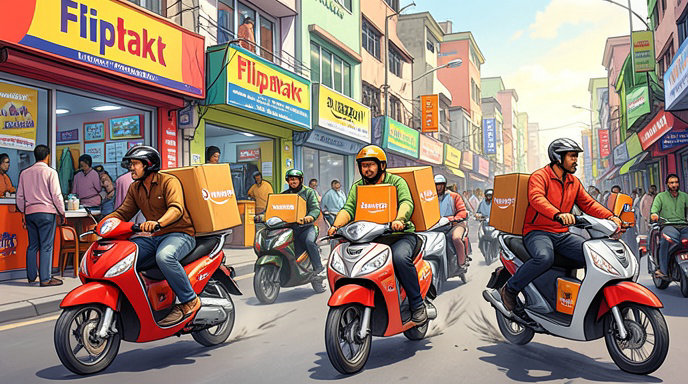
India's e-commerce landscape is undergoing a seismic shift. While the traditional model of next-day delivery once dominated, the race is now for speed. The battlefield has narrowed to "quick-commerce," or q-commerce, where the promise is delivery in under 10 minutes. At the center of this explosion stand two global titans: Walmart's Flipkart and Amazon. Their infrastructure war is not just about stockpiling warehouses; it is a strategic maneuver to redefine consumer expectations and dominate the next generation of online retail in South Asia.
Flipkart's Rapid Infrastructure Surge
Flipkart, the Indian e-commerce giant backed by Walmart, has executed one of the most aggressive expansion plans in the region's history. Less than two years after launching its "Minutes" service, Flipkart announced it has built a network of over 1,000 micro-fulfillment centers. These are small, strategically located warehouses designed specifically to enable hyperlocal deliveries in minutes.
The company's momentum is far from slowing. Flipkart has stated it plans to expand this network to 1,500 micro-fulfillment centers by the end of 2026. To sustain this rapid buildout, the company intends to open between 75 and 100 new centers every month while expanding into additional cities across the country. This infrastructure is the backbone of their strategy to counter Amazon's deepening presence in the Indian market.
Amazon's Counter-Attack and the Rising Stakes
Amazon is not standing idle in this race. As the retail giant expands its fast-delivery business in the South Asian nation, it is targeting the same 10-minute delivery milestone that Flipkart has already begun to achieve. Amazon's strategy involves a massive ramp-up of its own infrastructure, creating a direct rivalry with Flipkart's Minutes service.
The competition has intensified the stakes for everyone involved. The market is now crowded with major players racing to add infrastructure and customers. This includes established q-commerce startups like Blinkit, Zepto, Swiggy Instamart, and Amazon's own delivery network. The result is a saturated environment where the "10-minute delivery" promise is becoming a standard expectation rather than a luxury, forcing all players to invest heavily in logistics technology and last-mile delivery networks.
The Squeeze on Local Startups
The entry of Walmart and Amazon has created a formidable challenge for India's homegrown quick-commerce startups. Analysts warn that the heavy discounting strategies employed by these global giants could reshape the entire sector. Flipkart and Amazon are pushing beyond traditional metro cities, leveraging their massive capital reserves to offer prices that local startups struggle to match.
Startups like Swiggy, Zepto, and Blinkit, which have been racing to build India's 10-minute delivery empire, now face a "squeeze." They must compete with giants that have expanded their reach to over 19,000 pin codes across India. This expansion represents a staggering 30% increase from the previous year, with 70% of new customers coming from tier-2 and tier-3 cities. In these emerging markets, the average order value is around $15, a segment where profitability is already under pressure due to the high costs of hyperlocal logistics.
Implications for Consumers and the Future of Retail
For consumers, the immediate impact of this rivalry is positive. The competition between Flipkart and Amazon is driving down prices and increasing the speed of delivery. The promise of groceries, electronics, and even gold coins arriving in under 10 minutes is becoming a reality for millions of users. Furthermore, the expansion into tier-2 and tier-3 cities means that high-quality e-commerce services are becoming accessible to a broader demographic, fueling the digital economy in rural India.
However, the long-term future of the sector remains uncertain. The intense competition has led to a buildup of over 6,000 dark stores (distribution centers for online shopping) in operation, leading to significant overlap among players in major cities. While the volume of quick-commerce is booming—now accounting for 20% of the total e-commerce sector in India—the profitability of individual players is strained. The high costs of maintaining thousands of micro-fulfillment centers and the pressure to offer deep discounts threaten the financial sustainability of the model.
As Flipkart and Amazon continue to pour billions into this infrastructure war, the industry faces a critical juncture. The race for speed is won, but the race for sustainable profitability is just beginning. The future of e-commerce in India will depend on whether these giants can balance their massive operational costs with the revenue generated from the next generation of digital shoppers.

Get All The Latest Updates Delivered Straight To Your Inbox For Free!