
Data Centers in Crisis: Power Cuts Loom as Grid Struggles to Keep Up
TL;DR
- U.S. grid operators are confronting a new reliability risk as data centers draw huge amounts of power and can switch loads extremely fast, creating sudden swings that are difficult to manage.
- In the PJM region, operators and utilities have discussed temporary power cuts to data centers as a way to prevent broader blackouts during peak demand or emergencies.
- The tech industry is pushing back, arguing that curtailment rules could disrupt AI and cloud services just as demand for compute is accelerating.
Data Centers in Crisis: Power Cuts Loom as Grid Struggles to Keep Up
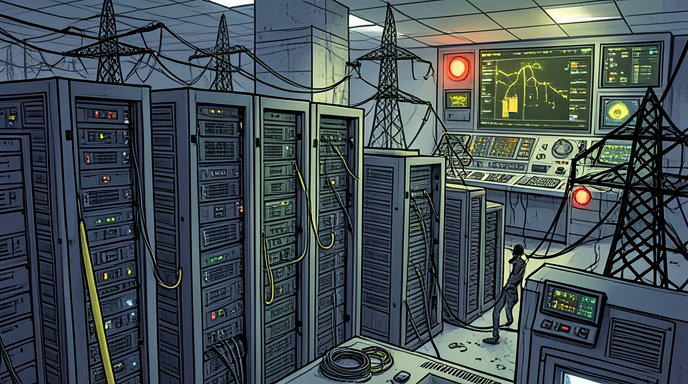
The largest U.S. power grid is under growing strain as utilities and regulators debate whether data centers should be temporarily disconnected during emergency conditions to avoid wider blackouts. The issue has moved from theory to urgent policy discussion because data centers are no longer just big electricity users; they are becoming dynamic, hard-to-predict loads that can change their power draw in seconds.
PJM Under Pressure
Traditional grid planning is built around forecasting demand and handling large generators going offline. Data centers complicate that model because their loads can swing abruptly when operators shift workloads, trigger safety systems, or move to backup generation. NERC, the North American Electric Reliability Corporation, warned that these rapid fluctuations can occur so quickly that grid operators have “little or no room for real-time responses.”
That warning matters because the scale is growing fast. Reuters reported that dozens of Virginia data centers unexpectedly disconnected from the grid last summer and switched to on-site generators, forcing PJM and Dominion Energy to reduce power generation to protect the system from a dangerous oversupply. A similar event earlier in the year involved roughly 40 data centers in Virginia shifting to backup power after a high-voltage line failure, raising fresh concerns about grid stability.
The Curtailment Debate
The central question now is whether grid operators should be able to cut power to data centers first during shortages, before rolling outages reach homes and businesses. That idea has been discussed inside PJM, where internal proposals reportedly explored load curtailments for large consumers if supply could not meet demand.
Supporters of curtailment say it is a practical emergency tool. If a cluster of hyperscale facilities can be disconnected or throttled briefly, operators may be able to preserve service for millions of other customers and avoid cascading failures. Critics argue that treating data centers as a controllable emergency resource could create uncertainty for cloud providers, AI companies, and customers that depend on always-on services.
A Warning From Grid Watchdogs
The latest alarm came from NERC, which issued a rare Level 3 “essential action” alert after previous warnings about the risks from data center growth. The watchdog said grid operators still lack adequate processes and methods to manage the risks created by these computational loads. It also asked operators to file mitigation plans quickly, underscoring how seriously it views the problem.
NERC’s concern is not only the amount of electricity involved, but the variability. AI training and other compute-heavy workloads can create rapid peaks and drops in consumption, and that volatility can stress local infrastructure even when total annual demand seems manageable. Reuters also reported that many data centers are built to protect sensitive equipment by switching to generators at the first sign of grid trouble, which can amplify instability at the worst possible moment.
What It Means for Tech
For the tech industry, the stakes are high. Google, Amazon, Microsoft, and other major operators are already in discussions with utilities over whether their energy needs can be met without causing blackouts during periods of peak demand. If curtailment rules become standard, operators may need to design facilities and workloads around new reliability requirements, not just speed and cost.
That could reshape how AI infrastructure is built. Data center developers may face tougher interconnection rules, more scrutiny from regulators, and pressure to add on-site generation, storage, or demand-response capabilities. In practice, that means future facilities may need to prove they can help the grid in emergencies, not just consume power when compute demand spikes.
The Bigger Grid Problem
The controversy is part of a larger structural issue: electricity demand is rising at the same time many grids are facing delays in new transmission, generation, and distribution upgrades. Regulators are now confronting a reality they were not designed for, where a single data center campus can behave more like an industrial plant than a conventional commercial customer.
That leaves grid operators with few easy choices. They can accelerate infrastructure buildout, tighten planning rules, or use emergency curtailment to protect reliability when the system is stressed. For now, the debate is no longer whether data centers matter to grid stability. The question is how much risk society is willing to tolerate—and who gets powered down first when the system is nearing the edge.

Get All The Latest Updates Delivered Straight To Your Inbox For Free!