
Nvidia's Cosmic GPU Mission: Pioneering Technology Beyond Earth
TL;DR
- Nvidia is pushing its computing platforms beyond orbit and toward the Moon, with new lunar deployments and earlier spaceflight tests showing commercial GPUs can operate in extreme environments.
- The company’s space strategy centers on onboard AI processing: analyzing data in space instead of sending everything back to Earth, which can save bandwidth and speed up decisions.
- If these missions hold up, they could reshape lunar robotics, imaging, and future extraterrestrial infrastructure by making powerful edge computing available far from Earth.
Nvidia’s Cosmic GPU Mission: Pioneering Technology Beyond Earth
Nvidia is moving from Earth-bound AI infrastructure into a new frontier: space computing. The latest wave of announcements and mission reports shows the company’s GPUs and edge AI systems being prepared for lunar orbit, lunar surface operations, and broader spaceflight use, marking a shift from experimental demonstrations to real mission hardware.
A push from orbit to the Moon
Nvidia recently announced its Space Computing initiative, saying the NVIDIA IGX Thor and Jetson Orin platforms, along with the RTX PRO 6000 Blackwell Server Edition GPU, are available now, while the NVIDIA Space-1 Vera Rubin Module will come later. That announcement frames space not as a novelty use case, but as a serious extension of Nvidia’s AI hardware roadmap.
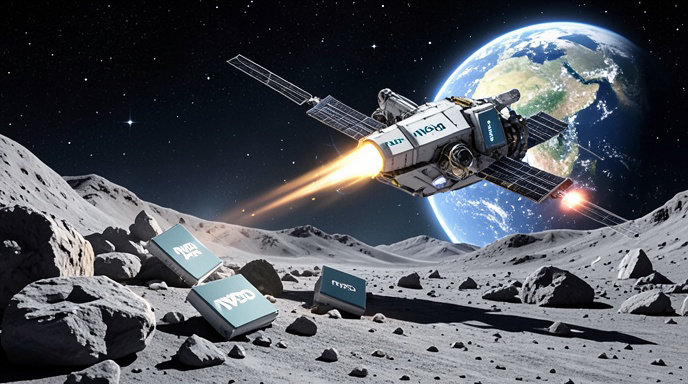
The most eye-catching development is the company’s move toward the Moon. TechCrunch reported that Nvidia is now sending GPUs to the Moon, highlighting the company’s effort to extend its hardware far beyond Earth’s surface. Separate reporting indicates that Firefly Aerospace is planning to operate an NVIDIA Jetson platform in lunar orbit as part of its Ocula moon imaging service on Blue Ghost Mission 2, with launch targeted for late 2026. Another report says Nvidia’s Jetson chips are also slated for lunar surface use on a rover developed by Lunar Outpost.
Why space needs GPUs
The reason GPUs matter in space is straightforward: processing power close to the source can reduce dependence on Earth-based downlink and remote control. In lunar missions, bandwidth is limited, communications can be delayed, and operators often need fast decisions based on sensor data.
Firefly’s Ocula concept illustrates the approach. According to reporting, the Jetson module embedded in telescopes aboard the Elytra spacecraft will run SciTec AI software to process imagery directly in lunar orbit, sending back only the most relevant insights rather than all raw data. That model is particularly valuable for imaging, mapping, and autonomous navigation, where onboard inference can make spacecraft more efficient and responsive.
From space-hardened testing to real missions
Nvidia’s path into space did not begin with the Moon. A 2024 video report described the first space-hardened Nvidia AI GPU being launched into orbit on August 16, 2024, in a collaboration between Cosmic Shielding Corporation and Aethero to test advanced electronics in space conditions. That kind of early validation matters because radiation, thermal swings, and vibration can quickly expose weaknesses in standard commercial chips.
The current wave of lunar plans suggests those experiments are now maturing into operational deployments. In other words, Nvidia is no longer just proving that GPUs can survive space; it is trying to prove they can be useful there.
The commercial space race gets an AI layer
Nvidia’s space move also reflects a broader trend in the commercial space sector: missions are becoming more autonomous, more data-heavy, and more dependent on onboard computing. Lunar rovers, imaging spacecraft, and future infrastructure will need local AI to interpret terrain, identify targets, and manage systems with minimal human intervention.
That is why the reported lunar rover project is important. By pairing Jetson chips with LiDAR mapping and rover autonomy, the mission points to a future where space hardware relies on the same kind of accelerated computing that powers robotics, industrial automation, and edge AI on Earth. The implication is not just better mission performance, but a possible standardization of AI compute platforms for off-world exploration.
What Nvidia stands to gain
For Nvidia, the business case is as significant as the technical one. If its hardware proves reliable in lunar orbit and on the lunar surface, the company could establish itself as a default compute supplier for a new category of customers: space agencies, satellite operators, lunar robotics firms, and deep-space infrastructure builders.
That would extend Nvidia’s reach into a market where performance, power efficiency, and reliability matter more than consumer scale. It would also reinforce Nvidia’s broader strategy of making its platforms essential wherever AI needs to run, whether in data centers, on edge devices, or beyond Earth.
The bigger implications for extraterrestrial computing
The long-term significance of these missions may be larger than any single rover or imaging payload. If GPUs can perform well in lunar environments, the same architecture could support autonomous mining equipment, habitat monitoring, scientific instruments, and communications relays on the Moon and eventually elsewhere.
There are still major technical hurdles. Space radiation, thermal management, and mission reliability remain serious constraints, and the sources show that these deployments are still early and mission-specific rather than a universal space standard. But the direction is clear: Nvidia is helping turn space computing into a real engineering category, not just a sci-fi concept.
What to watch next
The key developments to monitor are whether the lunar orbit and lunar surface deployments launch on schedule, how the hardware performs under real mission conditions, and whether the results convince other operators to adopt commercial GPUs for spaceflight workloads. If those missions succeed, Nvidia’s role in space could expand quickly from a headline-grabbing experiment into a foundational layer of lunar infrastructure.

Get All The Latest Updates Delivered Straight To Your Inbox For Free!