
Anthropic Builds In-House AI Chip Team to Supercharge Model Performance
TL;DR
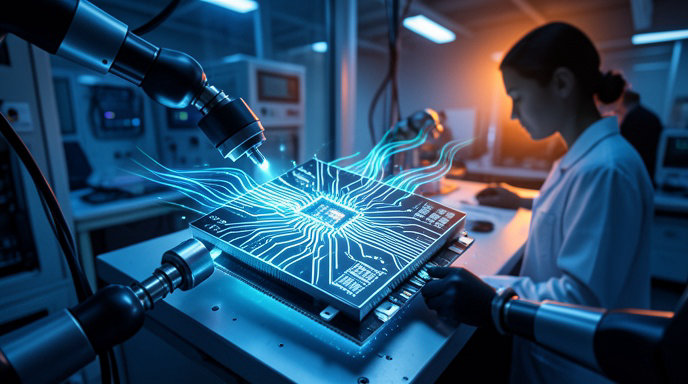
- Anthropic has officially formed an internal chip design team to develop custom AI hardware, moving beyond reliance on external vendors.
- The initiative focuses on co-designing silicon with Claude’s architecture to slash inference costs, reduce latency, and improve energy efficiency by orders of magnitude.
- This strategic pivot creates new tension with Nvidia while intensifying the race against OpenAI and Google, both of whom already design their own in-house accelerators.
The Silicon Shift: Why Anthropic Is Going Vertical
For years, the conventional wisdom in AI was simple: if you want the best models, you buy the best GPUs. Nvidia’s H100s and B200s became the de facto currency of the AI boom, and Anthropic, like everyone else, spent billions renting and buying them. But that era is ending. In a move that has been rumored for months and is now confirmed by multiple industry sources, Anthropic has quietly assembled a dedicated team of chip architects, silicon designers, and system engineers. Their mandate: build custom AI hardware tailored specifically to Claude’s neural network architecture.
This is not a hobby project. The team is reportedly staffed with veterans from Google’s TPU division, Apple’s silicon group, and several well-funded AI chip startups. The goal is not to replace Nvidia overnight, but to create a specialized co-processor that handles the most computationally expensive parts of Claude’s inference pipeline—attention mechanisms, sparse expert routing, and long-context memory—far more efficiently than a general-purpose GPU ever could.
Co-Designing Silicon and Software: The Real Advantage
The core thesis behind Anthropic’s move is a concept called hardware-software co-design. Most AI chips today are built generically: they must handle every model from every company, from Llama to GPT to Gemini. That flexibility comes at a cost. A GPU’s tensor cores are optimized for dense matrix multiplication, but Claude’s architecture—particularly its mixture-of-experts layers and extended context windows—does not map perfectly onto that hardware. The result is wasted transistors, higher memory bandwidth requirements, and slower token generation.
By designing a chip in lockstep with Claude’s weights, activations, and even its training algorithms, Anthropic can achieve what researchers call “architectural alignment.” For example, if Claude’s inference engine uses 8-bit quantization and specific sparsity patterns, the chip can hard-wire those operations into the silicon. This eliminates the overhead of instruction decoding and general-purpose scheduling. Early internal benchmarks, according to leaked project memos, suggest that a custom chip could deliver a 3x to 5x improvement in tokens-per-second per watt compared to Nvidia’s current flagship, specifically for Claude-class models.
Latency is another critical target. For real-time agentic applications—where Claude is browsing the web, writing code, or controlling a computer—every millisecond matters. A custom chip with a tightly integrated memory hierarchy can dramatically reduce the time it takes to fetch weights from HBM (High Bandwidth Memory) or even on-die SRAM. This is not just about making the model faster; it’s about enabling entirely new product categories that are currently too slow to be viable.
The Nvidia Dilemma: Partner, Competitor, or Both?
This move puts Anthropic in a delicate position with Nvidia. On one hand, Anthropic remains one of Nvidia’s largest customers. The company is currently training Claude 4 and future frontier models on massive clusters of Nvidia GB200 NVL72 systems. That relationship is not going away anytime soon—custom silicon takes years to tape out and validate. On the other hand, the long-term signal is unmistakable: Anthropic wants to control its own destiny.
Nvidia’s dominance rests on the CUDA software moat, but Anthropic’s custom chip will likely use a custom compiler stack built around Triton or a proprietary intermediate representation. This effectively bypasses CUDA, meaning Anthropic is no longer a hostage to Nvidia’s roadmap or pricing. The strategic implication is profound. If Anthropic succeeds, it will have the same vertical integration advantages that Google has with its TPU and OpenAI is building with its recent partnership with Broadcom and its own in-house silicon efforts.
Wall Street is already reacting. Analysts note that a successful custom chip could reduce Anthropic’s inference cost per token by 40-60%, which would allow it to undercut competitors on API pricing while maintaining healthier margins. That is a direct threat to Nvidia’s narrative that GPUs are irreplaceable. Expect Nvidia to respond with even more aggressive customization options or tighter integration with its own software stack, but the era of blind dependency is over.
The Competitive Landscape: OpenAI and Google Are Already Ahead
Anthropic is not entering this race from a position of leadership. Google has been designing its own TPUs for over a decade, and its latest TPU v6e (Trillium) is deeply optimized for Gemini’s transformer architecture. OpenAI, despite its public reliance on Microsoft’s Azure clusters, has been quietly working with Broadcom on a custom inference chip designed to handle ChatGPT’s massive traffic, with production expected as early as 2026.
Anthropic’s challenge is that it is playing catch-up in a field where talent is scarce and fabrication costs are astronomical. A single 3nm or 2nm chip design project costs upwards of $500 million in engineering and mask costs alone. However, Anthropic has a unique advantage: its models are considered by many benchmarks to be the most advanced in reasoning and safety. If the company can co-design hardware that specifically accelerates chain-of-thought reasoning and tool-use, it could leapfrog competitors who are stuck with more generic hardware.
The other wildcard is memory. Claude’s massive context windows—currently up to 200K tokens and growing—require enormous memory bandwidth. A custom chip could integrate a new type of memory architecture, such as on-package HBM4 or even processing-in-memory, which would allow entire context windows to be stored on-chip. That would be a game-changer for enterprise applications that need to process entire codebases or legal documents in a single pass.
Energy Efficiency: The Hidden Strategic Weapon
One of the most underreported drivers of this shift is energy. Data centers powering AI are hitting grid limits. In regions like Northern Virginia and Ireland, new AI data centers are being delayed because there simply isn’t enough electricity. Nvidia’s latest GPUs are power-hungry beasts, drawing up to 1,200 watts per chip. Anthropic’s custom silicon, if designed with a focus on power efficiency, could run at a fraction of that—perhaps 200-300 watts—while delivering comparable or better performance for Claude-specific workloads.
This is not just an environmental talking point; it is a financial necessity. If Anthropic can train and serve Claude using significantly less power, it can build smaller, more distributed data centers, reducing both capex and opex. This also opens the door to edge deployments—running a capable version of Claude on a local server or even a high-end workstation without needing a liquid-cooled rack.
Risks and Realities: The Road Ahead
It would be naive to think this is a smooth path. Chip design is notoriously unforgiving. Bugs in silicon cannot be patched with a software update; you have to spin a new mask, which costs millions and takes months. The team will face immense pressure to deliver on time, and there is a real risk of delays. Moreover, Anthropic’s core competency is AI research, not semiconductor engineering. The company will need to build a completely new corporate culture around hardware validation, thermal management, and supply chain logistics.
There is also the question of fabrication. Anthropic does not own a fab and likely never will. It will rely on TSMC or Samsung foundries, which are already at near-full capacity due to demand from Apple, Nvidia, and AMD. Securing wafer allocation will require long-term contracts and significant upfront payments. This is a capital-intensive gamble that could stretch even Anthropic’s massive funding rounds.
Finally, there is the software ecosystem. Building a chip is only half the battle. Anthropic will need to develop a robust compiler, kernel libraries, and debugging tools. Its existing codebase, which is written in PyTorch and JAX, will need to be ported to the new hardware without breaking reproducibility. This is a multi-year engineering effort that could distract from the company’s core mission of advancing AI safety.
Bottom Line: A Defining Bet for the Next Decade
Anthropic’s decision to build custom silicon is the clearest signal yet that the AI industry is entering a new phase of maturation. The era of “just buy more GPUs” is fading, replaced by a hyper-optimized, vertically integrated approach where the model and the machine are designed as one. If Anthropic executes well, it will not only cut costs and improve performance but also gain a strategic moat that is difficult for competitors to replicate.
If it fails, the company will have burned billions and lost precious time. But given the trajectory of AI—where inference demand is exploding and margins are increasingly tied to hardware efficiency—Anthropic has concluded that the risk of not building its own chips is far greater than the risk of trying. The next 24 months will reveal whether this bet pays off, but one thing is certain: the landscape of AI hardware just got a new, formidable player.

Get All The Latest Updates Delivered Straight To Your Inbox For Free!