
Ford’s $2B Factory Overhaul Paves the Way for Fathom EV Prototypes by Q1 2027
TL;DR
- Ford is investing $2 billion to retool a major assembly plant for the upcoming Fathom electric truck, with prototype builds scheduled to begin in Q1 2027.
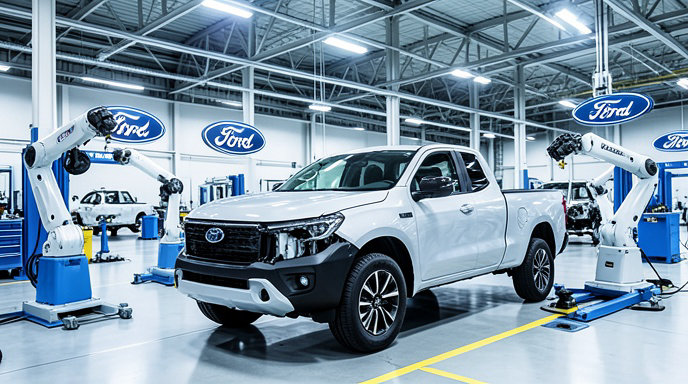
- The overhaul focuses on next-generation flexible manufacturing, including new body shops, battery pack integration lines, and advanced robotics to handle the Fathom’s unique unibody-frame hybrid architecture.
- The prototype phase signals that Ford is on track for a late-2027 or early-2028 market launch, positioning the Fathom as a critical bridge between traditional truck capability and EV efficiency.
The $2 Billion Bet: Inside Ford’s Largest EV Factory Conversion
Ford’s electrification strategy is entering its most tangible phase yet. The automaker is finalizing a massive $2 billion retooling effort at one of its key North American assembly plants, transforming a facility historically known for internal combustion pickups into a dedicated hub for the upcoming Fathom electric truck. While the company has remained tight-lipped on specifics, internal timelines confirm that prototype builds are slated to kick off in the first quarter of 2027. This is not just another EV launch—it’s a full-scale industrial metamorphosis designed to prove that Ford can build electric trucks profitably, at scale, and without compromising the rugged DNA that made the F-150 a legend.
What the $2 Billion Actually Buys: A Factory Reborn
The retooling scope goes far beyond swapping out a few conveyor belts. Sources familiar with the project describe a ground-up reconfiguration of the plant’s core manufacturing systems. The most significant investment is in a new, fully automated body shop capable of handling the Fathom’s mixed-material construction. Unlike traditional body-on-frame trucks, the Fathom is expected to use a skateboard-style battery platform combined with a high-strength steel and aluminum upper body. This requires precision welding and bonding technologies that were not present in the facility before.
The plant is also receiving a dedicated battery pack assembly line, allowing Ford to marry the cells, modules, and structural battery housing directly at the factory—a move that cuts logistics costs and reduces supply chain vulnerabilities. High-voltage cabling infrastructure has been upgraded throughout the facility, and new robotic gantries will handle the heavier battery packs, which weigh significantly more than a standard V8 engine and transmission combo. Paint shops have been modified with new curing ovens that can handle aluminum panels without warping, and the final assembly line has been redesigned to accommodate a flat-floor EV architecture that eliminates the traditional transmission tunnel.
Strategic Importance: Why the Fathom EV Is Ford’s Make-or-Break Moment
The Fathom is not just another entry in Ford’s EV lineup; it is the company’s answer to a shrinking window of opportunity in the full-size truck segment. The F-150 Lightning, while successful as a first mover, faced criticism over range degradation when towing and a chassis that felt compromised by the heavy battery pack. The Fathom is designed from a clean sheet to solve that problem. It reportedly features a structural battery that adds torsional rigidity rather than just mass, and a new dual-motor setup with torque-vectoring capabilities aimed at delivering best-in-class payload and towing numbers.
Strategically, the Fathom is the first vehicle built on Ford’s next-generation “Flex-EV” architecture, which is designed to support both pickup trucks and SUVs on the same modular platform. This means the investment in the factory is not a one-off; it’s a foundation for the next decade of Ford’s EV lineup. The success of the Fathom will determine whether Ford can maintain its market share in the most profitable vehicle segment in America against competitors like the Tesla Cybertruck, the upcoming Ram 1500 REV, and the Chevrolet Silverado EV. A failure here would not just hurt quarterly earnings—it would call into question Ford’s entire EV roadmap.
The Prototype Phase: What Q1 2027 Really Means
The confirmation that prototype builds begin in Q1 2027 is a critical data point for industry analysts. Prototype builds, often called “PPV” (Production Prototype Validation) vehicles, are not hand-built concept cars. They are assembled on the actual production line using the final tooling, fixtures, and robots. This phase is where Ford will discover bottlenecks, weld quality issues, and assembly ergonomics problems that cannot be simulated in a lab.
If the Q1 2027 prototype date holds, it implies a standard 9- to 12-month validation cycle. That would position the Fathom for official Job #1 (start of regular production) in late 2027, with customer deliveries beginning in early 2028. However, Ford has a history of aggressive timelines, and the industry-wide shortage of battery-grade lithium and advanced semiconductors could still push that window. The fact that Ford is committing $2 billion now, before final battery chemistry is locked in, suggests they are confident in their supply contracts and are betting on the factory’s flexibility to adapt to last-minute cell design changes.
Beyond the Truck: A Blueprint for Future Ford EVs
The retooling of this plant is being watched closely by Wall Street and the broader automotive industry because it represents a blueprint for how legacy automakers can repurpose existing assets instead of building expensive greenfield factories. Ford has stated that this facility will eventually produce multiple models on the Flex-EV platform, including a potential electric Expedition and a commercial van variant. The flexible body shop is designed to switch between different wheelbases and cab configurations with minimal downtime—a capability that was impossible in the previous, single-model dedicated line.
This approach also has significant labor implications. The $2 billion investment is expected to preserve thousands of union jobs that would otherwise be eliminated as internal combustion engine production winds down. Ford has already negotiated new contracts with the UAW that include wage increases tied to EV production targets, making this factory a test case for the "just transition" of the American auto workforce.
The Road Ahead: Risks and Market Realities
Despite the optimism, the Fathom faces a brutal market entry. The electric truck segment is no longer a novelty; it’s a price war. Tesla has repeatedly slashed Cybertruck prices, and GM is aggressively pushing fleet sales for the Silverado EV. Ford’s challenge is to price the Fathom competitively while recouping the $2 billion investment. Analysts estimate that Ford needs to sell at least 150,000 units annually at an average transaction price of $65,000 to make the factory economics work.
Additionally, the prototype phase is where hidden costs emerge. Tooling adjustments, software calibration for the battery management system, and supplier quality issues often cause delays that push back launch dates by six months or more. Ford’s leadership has already walked back some of its earlier EV production targets, citing consumer adoption rates that are slower than expected. The Fathom, therefore, is a calculated risk: it must be perfect out of the gate, or the $2 billion could become a sunk cost that drags on the company’s balance sheet for years.
Conclusion: A Defining Moment for Ford’s Electric Future
The Q1 2027 prototype build is more than a milestone on a calendar; it’s the moment of truth for Ford’s industrial strategy. If the retooled plant can produce a high-quality, high-volume electric truck without the teething problems that plagued the Lightning’s launch, Ford will have proven that it can compete on both technology and manufacturing efficiency. If it falters, the consequences will ripple across the entire North American EV supply chain. For now, the $2 billion overhaul is a declaration of intent: Ford is not just dabbling in electric trucks—it is building the factory to win the next decade.

Get All The Latest Updates Delivered Straight To Your Inbox For Free!