
Mazama Energy’s Supercooled Geothermal Drills Aim to Cut Clean Power Costs
TL;DR
- Khosla-backed Mazama Energy is developing supercooled drilling technology intended to keep geothermal tools working in hotter, deeper rock.
- The approach could make access to “superhot rock” more practical, potentially increasing geothermal output while reducing drilling-related costs.
- The technology remains under development, and commercial success will depend on field demonstrations, well durability, financing and the economics of power produced from engineered geothermal systems.
A race to drill hotter rock
Geothermal power has long offered something wind and solar cannot consistently provide: electricity around the clock, with a small land footprint and no dependence on weather. Yet conventional geothermal development is constrained by geography. The best-known resources are concentrated in areas where naturally permeable rock, underground heat and accessible fluids occur together.
Mazama Energy is pursuing a more difficult but potentially much larger opportunity: engineered geothermal systems built in hot, deep rock that does not naturally provide an easy path for water to circulate.
The company, which has attracted backing from Khosla Ventures, is working on drilling and geothermal technologies aimed at extreme underground environments. Its central challenge is familiar to anyone trying to reach superhot rock: temperatures that can damage electronics, weaken materials, degrade drilling fluids and shorten the life of equipment long before a well is completed.
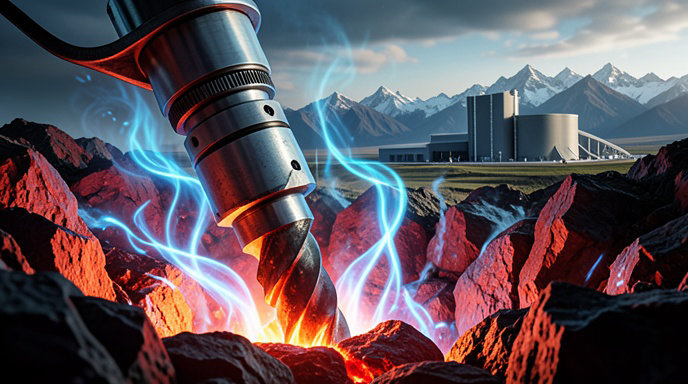
Mazama’s answer involves advanced cooling around the drilling system. By using supercooled components and carefully managed fluids, the company aims to protect drill bits and associated tools while they operate in conditions that would otherwise push conventional equipment beyond its limits.
Why superhot rock matters
The deeper a geothermal well goes, the more likely it is to encounter very hot rock. In principle, hotter formations can deliver more energy from a given volume of rock because the temperature difference between the underground reservoir and the surface is greater.
That creates a powerful economic incentive. A geothermal plant connected to a high-temperature resource may generate more electricity with fewer wells or a smaller surface footprint than a lower-temperature project. Superhot geothermal systems could also produce steam or high-quality heat capable of supporting efficient power-generation cycles.
The problem is that drilling into these resources is expensive and technically demanding. Geothermal wells can cost tens of millions of dollars, with drilling often representing the largest share of project capital. A failed well, damaged tool or unexpected delay can undermine the economics of an entire development.
Reducing the time and cost required to drill through hard, hot formations is therefore central to making engineered geothermal commercially competitive.
Keeping tools alive underground
Drilling systems normally rely on a combination of robust mechanical components, drilling fluids, sensors and downhole electronics. Each has temperature limits. As those limits are approached, the system can suffer from reduced reliability, inaccurate measurements, premature wear and unplanned trips out of the well.
Mazama’s supercooling concept is designed to create a more manageable operating environment at the cutting face and around sensitive drilling equipment. Cooling can help preserve the strength and performance of drill bits, while also protecting instruments that provide information about the direction and condition of the well.
The objective is not simply to drill deeper. It is to drill faster, with fewer interruptions and less equipment replacement.
That distinction matters because drilling productivity has an outsized impact on geothermal costs. A bit that lasts longer can reduce the number of trips required to replace it. Better thermal control can also allow drilling teams to use more sophisticated monitoring and steering tools, improving the chances of reaching the intended target on the first attempt.
The engineering trade-offs
Cooling a tool thousands of feet underground is far more complicated than cooling equipment at the surface. Any system must withstand high pressure, vibration, abrasive rock and rapidly changing conditions while delivering cooling capacity continuously.
The cooling process itself can introduce new engineering challenges. Fluids must be transported downhole, circulated reliably and recovered or managed at the surface. Equipment must be designed to avoid blockages, phase changes or pressure problems. The system must also fit within the limited diameter of a geothermal well.
There is an efficiency trade-off as well. Cooling consumes energy and requires additional hardware. The cost and complexity of that equipment must be outweighed by longer bit life, faster drilling, fewer failures and improved well productivity.
Mazama’s technology will ultimately have to demonstrate those benefits under realistic field conditions, rather than only in laboratory or controlled test environments.
A broader push into enhanced geothermal
Mazama is part of a larger effort to expand geothermal beyond naturally productive reservoirs. Enhanced geothermal systems seek to create or improve underground heat exchangers by circulating fluid through hot rock. Other companies are exploring closed-loop wells, advanced drilling methods, novel stimulation techniques and high-temperature power cycles.
The sector has gained momentum because geothermal can complement variable renewable generation. A successful engineered geothermal project could supply steady power without the need for large batteries or fossil-fuel backup. It could also provide clean industrial heat, a market that is difficult to decarbonize with electricity alone.
Recent advances in drilling, subsurface modeling and oil-and-gas service technologies have strengthened the case for the sector. Techniques developed for horizontal drilling and high-temperature wells may be adapted for geothermal use, although the underground conditions and project economics are not identical.
Superhot rock is among the most ambitious targets in that landscape. At sufficiently high temperatures, geothermal systems could deliver significantly more energy, but they also impose much tougher requirements on wells, seals, sensors, pumps and power equipment.
The cost question
For geothermal to compete more broadly with other clean-energy technologies, developers must lower the cost of drilling and improve the predictability of project construction.
A faster drilling system could reduce rig time, labor expenses and financing costs. More durable bits could lower consumables and reduce delays. Better downhole data could limit the risk of drilling an unproductive well. Together, those improvements could shift geothermal economics even if the underlying resource remains technically challenging.
However, drilling is only one part of the equation. Project developers must also pay for well completion, reservoir stimulation, surface pipelines, turbines, generators, transmission connections and long-term maintenance. The reservoir must sustain useful flow rates over many years, and operators must manage the risks of mineral deposits, corrosion, induced seismicity and changing underground pressures.
The value of reliable output may help offset some of those costs. Unlike solar and wind projects, geothermal plants can potentially operate at high capacity factors and provide firm electricity. That reliability may become increasingly valuable as grids add larger amounts of intermittent generation.
From prototype to power plant
The key milestone for Mazama will be moving from promising drilling technology to a repeatable field system. That means showing that supercooling works while drilling through the types of rock and temperature ranges targeted by commercial projects.
Field demonstrations will need to answer several questions. How much faster is the system than conventional drilling? How long do the bits last? What is the energy penalty for cooling? Can the equipment be deployed using existing rigs and supply chains? Does the technology improve the probability of completing a productive well?
Investors and utilities will also want evidence that the technology reduces total project costs, not merely the cost of a single drilling operation. A cheaper well is valuable only if it connects to a reservoir that can deliver dependable heat and power.
Mazama’s association with Khosla Ventures gives the company access to a prominent clean-technology investor, but venture backing alone cannot remove the geological and construction risks inherent in geothermal development. Commercial validation will require sustained testing, additional capital and partnerships capable of building and operating power projects.
A potential advantage for grid planners
If the technical hurdles can be overcome, engineered geothermal could occupy a distinctive role in future power systems. Solar and wind are often the lowest-cost sources of new electricity, but their output varies. Batteries can provide short-duration flexibility, while transmission can move power between regions. Firm geothermal generation could add another layer of reliability, particularly in regions with limited hydropower or constrained transmission.
Geothermal plants also produce electricity from a compact site and can operate without combustion emissions. In some designs, the same underground resource could support direct heat applications, district heating or industrial processes.
Those benefits make drilling innovation strategically important. The industry does not necessarily need to make every geothermal well cheap enough to compete with the lowest-cost solar project. It needs to make projects predictable and affordable enough for utilities, data centers, manufacturers and other large power users seeking reliable low-carbon electricity.
The road ahead
Mazama Energy’s supercooled drilling effort addresses one of geothermal’s most stubborn barriers: the inability of conventional tools to work efficiently in the hottest and most promising rock.
The concept is compelling because it targets the cost structure at its source. If drill bits and downhole equipment can survive longer, teams may be able to reach deeper resources more quickly and with fewer expensive interruptions. That could improve the economics of engineered geothermal systems and open locations that have previously been considered impractical.
Still, the technology faces a demanding path from development to deployment. The underground environment is unforgiving, and success will depend on proving reliability at scale, controlling the energy and equipment costs of cooling, and demonstrating that high-temperature reservoirs can produce power consistently.
If those hurdles are cleared, Mazama’s approach could help turn superhot rock from a difficult scientific target into a more practical source of firm clean electricity.

Get All The Latest Updates Delivered Straight To Your Inbox For Free!