
Nvidia Leads the Charge in AI Safety with Rapid Progress from New Alliance
TL;DR
- Nvidia has helped launch the Open Secure AI Alliance, a broad industry coalition focused on open-source tools for AI safety, cybersecurity, and agent security.
- The alliance has grown quickly, with reports ranging from more than 30 founding members to over 120 companies involved as inaugural partners or contributors.
- A key early output is NOOA, Nvidia’s open-source agent-harness project, designed to make AI agents easier to test, trace, audit, and control.
Nvidia Leads the Charge in AI Safety with Rapid Progress from New Alliance
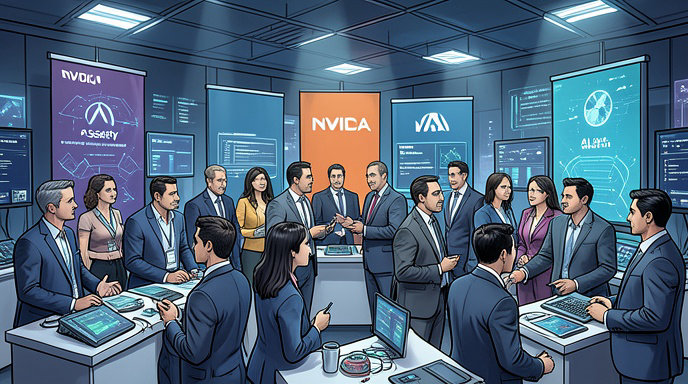
Nvidia has moved to the center of a new industry effort to harden AI systems against misuse, vulnerabilities, and agent-driven attacks. The company announced the Open Secure AI Alliance, a collaboration aimed at building and sharing open technologies, techniques, and tools for securing software and AI agents. Nvidia says the mission is to give defenders “open frontier tools they can trust and control.”
The alliance launched with a large cross-section of the tech industry, including cloud providers, cybersecurity firms, enterprise software companies, open-source foundations, and AI research groups. Nvidia, Adobe, Cisco, Cloudflare, CrowdStrike, Databricks, Dell Technologies, HPE, Hugging Face, IBM, Microsoft, Palantir, Red Hat, Salesforce, SAP, Siemens, Snowflake, Synopsys, the Linux Foundation, and others are listed among the inaugural partners.
Why the alliance matters now
The timing reflects rising concern about the security risks posed by AI agents and open-weight models. Recent reporting says the alliance was formed in the wake of a broader industry push to defend against AI-powered cyber threats and to improve transparency around vulnerabilities in the AI stack. CNBC reported that Nvidia said the initiative was motivated in part by a recent Hugging Face security incident, which it described as a reminder that defenders need open, frontier agentic systems for self-defense.
The group’s scope is broad. According to reporting on Nvidia’s launch, the alliance will work on identity, permissions, isolation, guardrails, logs, model formats, multi-model scanning, secure coding workflows, and vulnerability disclosure across the full agent stack.
Nvidia’s first technical contribution: NOOA
One of the alliance’s first concrete outputs is NOOA, the Nvidia Labs Object-Oriented Agent project. Nvidia says the open-source project is intended to make advanced AI safety capabilities more accessible for agent harnesses.
The Hacker News reported that NOOA is designed to make agent behavior easier to test, trace, audit, and govern, framing it as an early technical foundation for the alliance’s broader security goals. That focus suggests the alliance is not just a policy or branding exercise, but an attempt to produce practical infrastructure for real-world AI systems.
A coalition spanning rivals and adjacent industries
What stands out about the alliance is how many different parts of the technology ecosystem are involved. The participant list spans infrastructure vendors, cybersecurity specialists, software platforms, startups, and research organizations.
That breadth matters because AI security is not limited to model developers. It also depends on the surrounding systems that store data, authenticate users, manage permissions, log activity, and detect compromise. By bringing together firms from across those layers, the alliance is trying to address security as a systems problem rather than a single-model problem. This is an inference from the alliance’s stated focus on the full agent stack and its membership composition.
Notable absences and the open-vs-closed divide
Several reports note that major frontier AI labs such as OpenAI, Google, and Anthropic are not listed among the alliance’s founding members. That absence highlights a growing divide in the industry between companies promoting open-weight ecosystems and those that keep leading models more tightly controlled.
Reporting from CNBC and other outlets also tied the alliance to a broader policy push in favor of open-weight AI, including a letter from Nvidia, Microsoft, Meta, Palantir, and others warning policymakers against premature restrictions that could slow competition or push innovation overseas.
What “rapid progress” looks like in practice
The speed of the alliance’s expansion is one of the clearest signs of momentum. One report described the coalition as starting with more than 30 inaugural partners, while another version of the same Nvidia announcement described a group exceeding 120 companies. The difference likely reflects how the alliance has been presented across updates and coverage, with the core founding group appearing smaller and the broader partner ecosystem expanding quickly afterward. That interpretation is an inference based on the mixed reporting.
The rapid growth suggests strong demand for shared security standards around AI agents, especially as enterprises begin deploying more autonomous systems that can take actions, access tools, and interact with sensitive data. In that environment, security problems can spread quickly if the underlying controls are inconsistent.
The bigger industry signal
Nvidia’s role in the alliance shows how AI safety is increasingly becoming an industry coordination problem, not just a technical challenge for model builders. The alliance brings together companies that often compete directly, but it does so around a shared goal: making AI systems safer to deploy, easier to inspect, and harder to exploit.
If the group follows through, the most important outcome may not be a single product but a common security framework for AI agents—one that can help standardize how the industry tests, audits, and defends increasingly autonomous systems.

Get All The Latest Updates Delivered Straight To Your Inbox For Free!