
AI Agents Are Flooding Public Services With Automated Benefit Claims
TL;DR
- Researchers tracking government web traffic say AI agents are behind a sharp spike in automated applications for benefits like unemployment, food assistance, and housing aid.
- Unlike past bot waves, the vast majority of the traffic appears to come from real, eligible people using AI assistants to navigate confusing paperwork and file faster.
- The flood is overwhelming legacy government systems, forcing agencies to rethink bot defenses, verification, and how public services are designed for an agent era.
A New Kind of Traffic Jam
Government websites were never known for speed. Now they are slowing down for a completely new reason.
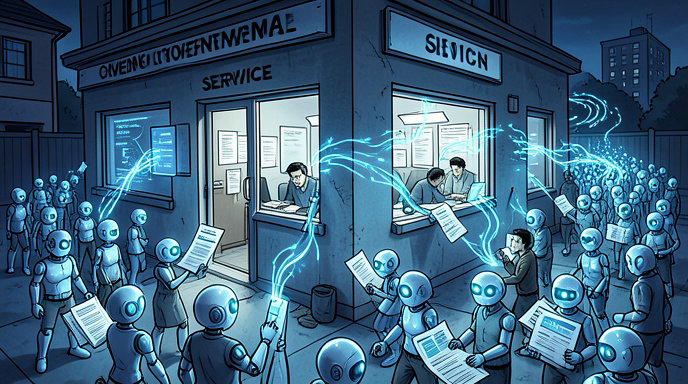
According to researchers who spoke with TechCrunch in recent weeks, public benefits portals across the U.S. and U.K. are seeing an unprecedented surge in machine-generated traffic. The culprit isn't classic fraud farms or scrapers. It's AI agents — autonomous tools from OpenAI, Anthropic, Google and startups that can click through forms, upload documents, and submit claims on a user's behalf.
The pattern was first flagged by infrastructure providers and academic teams monitoring bot activity. They noticed a jump starting in late 2025 that accelerated sharply this summer after the widespread release of general-purpose browser agents. On some state-level benefits and unemployment sites, automated sessions now account for 30 to 50 percent of all application starts, one research group estimated.
For agencies still running on decade-old mainframes and underfunded IT, the spike has been impossible to ignore.
Not Fraud — Just Frustrated Citizens
The twist is who is behind the bots.
In past waves, a surge like this would have immediately raised alarms about organized fraud, like the massive theft from pandemic-era unemployment programs. This time, researchers say the data tells a different story.
The agents are largely acting for legitimate, entitled citizens. Fingerprinting of session behavior, prompt traces, and follow-up interviews suggest real people are delegating the miserable work of claiming benefits to AI: parsing 40-page eligibility PDFs, filling out repetitive web forms, gathering pay stubs, drafting appeal letters, and re-checking portals for status updates.
Advocates for low-income and disabled Americans say this makes perfect sense. Applying for SNAP, Medicaid, SSI disability, veterans benefits, or housing assistance often requires hours of paperwork, precise language, and repeated logins. A single typo can trigger a denial and months of appeals. AI agents that can work through the night, remember deadlines, and translate bureaucratic jargon are an obvious fit.
One researcher described it as TurboTax for the safety net, only without permission. People who were always eligible but previously gave up are now able to get through.
Why Agents Love Government Forms — And Break Them
Ironically, government sites are both perfect and terrible for AI agents.
They are perfect because they are rule-based, form-heavy, and repetitive — exactly the kind of drudgery agents handle well. They are terrible because they were never built for programmatic access at this scale.
Most agencies offer no official API for benefits applications. That forces agents to do what a human would do: spin up a headless browser, click dropdowns, solve CAPTCHAs, and retry on crashes. Multiply that by thousands of users, each with an agent polling a portal every few minutes for an appointment slot or case update, and you get a distributed denial-of-service effect, even when no one intends harm.
IT vendors report seeing the same hallmarks: surges at 2 a.m., sessions that complete 90-minute forms in four minutes, and agents stuck in infinite retry loops when a site changes a single button label. Legacy queues buckle, costs for cloud hosting and identity verification spike, and real humans get locked out by anti-bot tools that can't tell a helpful agent from a malicious one.
Governments Caught Off Guard
For overwhelmed governments, the timing could not be worse.
Federal and state agencies are already facing staffing cuts, backlogs, and rising demand for aid. Now their fraud and cybersecurity teams are spending hours triaging traffic that turns out to be lawful. Traditional defenses like CAPTCHA, IP rate-limiting, and blanket bot bans are failing — they block disabled users relying on agents while doing little to stop sophisticated models that can solve visual puzzles.
In interviews, officials expressed a mix of sympathy and panic. They acknowledge the systems are too complex and that automation exposes real unmet need. But they also warn about accuracy, privacy, and equity. An agent can hallucinate income figures, submit duplicate claims across counties, or upload sensitive tax and medical documents to a third-party AI provider with unclear data retention.
The U.K., which has seen similar pressure on Universal Credit and NHS appointment systems, is already piloting agent-specific queues and verified assistant programs. In the U.S., a handful of states are quietly whitelisting certain assistive tools while cracking down on high-frequency polling.
What Comes Next: From Blocking Bots To Serving Them
Researchers and civic tech leaders agree on one point: this flood is not going away. As agents get cheaper and get baked into phones and browsers, filing for benefits by hand may soon feel as outdated as filing taxes on paper.
The long-term fix they propose is radical for government: stop fighting the agents and start designing for them.
That would mean publishing machine-readable eligibility rules, offering official benefits APIs with user consent, creating agent credentials similar to authorized representatives, and rebuilding application flows so an AI can complete them reliably without hammering servers. Some proposals even call for a public-interest agent — an open, audited assistant that helps people claim what they are owed without selling their data.
Until then, agencies are stuck in the middle. They cannot afford to let automated claims crash critical safety-net systems, but they also cannot afford to punish people for finally being able to navigate them.
As one researcher put it, the surge is a stress test and a signal. Citizens are showing governments exactly where the paperwork was too hard all along — by sending robots to do it for them.

Get All The Latest Updates Delivered Straight To Your Inbox For Free!