
GM Is Closing Its Brownstown Battery Plant, But EVs Aren't to Blame
TL;DR
- GM will shutter its Brownstown Battery Assembly Plant in late 2026, ending more than a decade of battery pack production at the suburban Detroit facility.
- The closure will impact around 120 to 200 hourly and salaried workers, with GM offering transfers to nearby EV operations in Detroit-Hamtramck, Orion, and Lansing.
- The move isn't a retreat from EVs, but a consolidation around GM's next-gen Ultium and LFP battery plants as older pack-assembly lines become obsolete.
The End of an Era in Brownstown Township
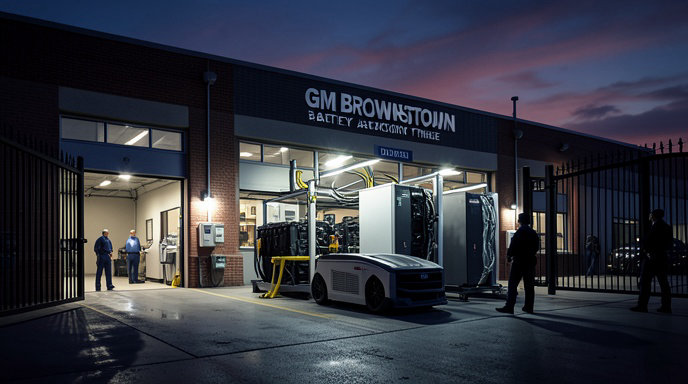
General Motors is closing the doors on one of the birthplaces of its electrified era. The Brownstown Battery Assembly Plant, a 300,000-plus-square-foot facility in Brownstown Township about 20 miles south of Detroit, is set to wind down production by the end of 2026.
Opened in 2010 with major federal investment, Brownstown was GM's first high-volume lithium-ion battery pack plant in the U.S. It built packs for the groundbreaking Chevrolet Volt, then the Cadillac ELR, Chevy Spark EV, Chevy Bolt EV and Bolt EUV, and most recently battery modules and packs for plug-in and Ultium-based prototypes.
For years, it was the quiet workhorse behind GM's early EV compliance efforts. Now, GM says the building has simply aged out of its future.
Why GM Is Really Closing It
It would be easy to frame the closure as another sign that the EV transition is stalling. It isn't.
According to GM, Brownstown was designed around first- and second-generation pack architectures — hand-intensive lines built for low-volume hybrids and the Bolt's older pouch-cell design. It was never retooled for the company's Ultium platform at scale, and it can't efficiently handle GM's shift to larger prismatic and lithium-iron-phosphate (LFP) cells.
In short: the chemistry changed, the form factor changed, and the manufacturing process changed. Brownstown didn't.
Instead of spending hundreds of millions to gut and rebuild a 16-year-old plant, GM is consolidating pack assembly inside its newer, highly automated battery plants in Ohio, Tennessee, Michigan, and Indiana — including Ultium Cells Lansing, Spring Hill, Lordstown, and its new Fort Wayne-area LFP joint venture with Samsung SDI.
Brownstown also relied on cells shipped in from elsewhere for final assembly. GM's new strategy is to co-locate cell and pack production under one roof to cut logistics costs, which alone makes standalone pack plants like Brownstown redundant.
What It Means for Workers
The human cost is real. Brownstown currently employs roughly 120 to 180 workers, most of them UAW-represented, down from a peak of several hundred during Bolt production.
GM has confirmed it will work with the UAW on placement opportunities, and the expectation is that most hourly workers will be offered transfers to Factory ZERO in Detroit-Hamtramck, Orion Assembly, or Ultium Cells Lansing — all of which are ramping hiring for the Chevrolet Silverado EV, GMC Sierra EV, Equinox EV, and Cadillac Escalade IQ.
The company has not announced layoffs tied to the closure yet, framing it as an idling and reallocation rather than a straight cut. Still, union leaders in Local 174 have raised concerns about seniority, commute distances, and whether temporary workers at Brownstown will get the same transfer rights.
GM has said it is evaluating future uses for the site, including potential sale, powertrain parts storage, or conversion to a data or service parts operation. No buyer has been named.
What It Means for Production
For consumers, expect essentially zero impact. Brownstown hasn't built a high-volume retail EV pack since the Bolt EUV ended production in late 2023.
GM's current EV lineup — the Equinox EV, Blazer EV, Silverado EV, Sierra EV, Lyriq, Vistiq, and Escalade IQ — already sources packs from its Ultium network. The next wave, including the returning 2027 Chevy Bolt on an LFP platform and lower-cost Equinox and Trax-size crossovers, will be supplied by Lansing and the Samsung SDI joint venture, not Brownstown.
If anything, the closure should improve margins. GM has repeatedly said its EVs will become variable-profit positive in 2025-2026 thanks to lower cell costs from LFP localization, higher automation, and scrapping legacy supply chains. Shutting a low-utilization building fits that playbook.
How It Fits Into GM's Broader EV Strategy
Zoom out, and Brownstown looks less like a retreat and more like a cleanup.
GM is in the middle of its second big battery pivot: from expensive nickel-cobalt Ultium pouches built only in the U.S. Midwest, to a mixed portfolio of high-nickel packs for trucks and SUVs plus affordable LFP prismatic cells for mass-market models.
That pivot includes $3 billion-plus in U.S. battery investments, a new LFP cell plant in Indiana slated for 2027, expanded cathode sourcing in North America to satisfy IRA tax credit rules, and a renewed push on plug-in hybrids as a bridge.
At the same time, GM has trimmed slower-selling EVs, delayed a second electric truck plant at Orion to late 2026, and cut $1.6 billion in EV capital spending to match slower-than-expected U.S. adoption.
Closing Brownstown lets GM tell Wall Street it's disciplined on costs, while telling EV advocates it's still investing — just in newer, cheaper tech elsewhere.
The Takeaway: Old Plants Die So New EVs Can Live
Brownstown deserves a proper sendoff. Without it, there is no Volt, no Bolt, and no early proof that GM could mass-produce lithium-ion packs in Michigan.
But auto plants don't close only when products fail. Sometimes they close because the product succeeded enough to outgrow them. As GM moves from retrofitted pack lines to gigascale cell-to-pack factories, Brownstown is a casualty of progress, not proof of an EV collapse.
The real test isn't whether GM keeps a 2010-era building open. It's whether its Lansing, Spring Hill, and Indiana battery hubs can deliver cheaper, longer-range EVs on time — and at a profit.

Get All The Latest Updates Delivered Straight To Your Inbox For Free!