
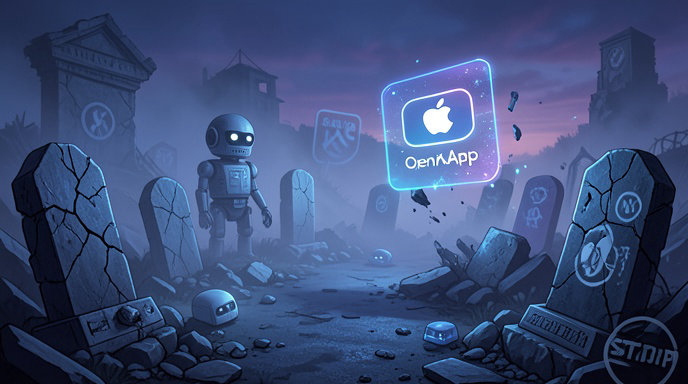
AI Graveyard 2026 - Failed AI Startups From Apple Siri Delays to OpenAI Super App Flop
TL;DR
- Apple's long-promised Siri AI overhaul has slipped again to 2026, turning a flagship Apple Intelligence feature into the poster child for overpromising AI.
- OpenAI's super app push, from its Sora video social app to its Atlas browser and Pulse assistant, has been marred by confusing launches, privacy backlash, and weak retention.
- The 2026 AI graveyard is filling fast with dead hardware, dead agents, and dead startups, as Humane, Rabbit, Builder.ai and dozens of agent wrappers shut down or pivot.
The Hype Bubble Finally Burst
2026 was supposed to be the year AI went mainstream. Instead, it became the year AI had to prove itself. After two years of trillion-dollar valuations, endless copilots, and demo videos that looked better than the products, users, regulators, and boards started asking the same question: does this actually work?
The answer, for a growing list of high-profile projects, was no. Welcome to the AI Graveyard 2026, our running tracker of the biggest shutdowns, delays, and flops. Some are officially dead. Some are technically alive but functionally gone. All of them tell the same story about what happens when ambition outruns execution.
Apple Siri - The Delay That Won't End
No entry looms larger than Apple's next-gen Siri. First teased as the crown jewel of Apple Intelligence at WWDC 2024, the personalized, context-aware Siri was supposed to understand your emails, messages, calendar and apps, and act across them.
It never arrived. Apple delayed it from iOS 18 to iOS 19, then to iOS 26, admitting in early 2025 that the architecture wasn't reliable enough. Internal reports described a Siri split into two brains that wouldn't merge, with failure rates of up to a third on complex queries.
By spring 2026, Apple was still promising a revamped Siri in iOS 26.4, with a stripped-down version rolling out to developers for testing. Features like on-screen awareness and cross-app actions remain in limited beta, while competitors ship full agents. Apple executives have reshuffled leadership, pulling in Vision Pro chief Mike Rockwell to fix Siri, and Craig Federighi has publicly called reliability the blocker.
For Apple, Siri isn't shut down, but it's the graveyard's most embarrassing resident: a flagship AI that missed two iPhone cycles, triggered lawsuits over false advertising, and forced Apple to offer free trials and partner with OpenAI and Google just to fill the gap.
OpenAI's Super App Mess
OpenAI tried to do everything in 2025 and 2026, and it showed. CEO Sam Altman talked openly about turning ChatGPT into a super app - part assistant, part browser, part OS, part social network. What users got was a confusing pile of overlapping launches.
The Sora video app launched as an invite-only iOS social feed in late 2025, instantly viral for AI-generated memes and deepfake concerns, then stalled on moderation issues, copyright lawsuits, and a sharp drop-off after the waitlist cleared. The Atlas AI browser, meant to kill Chrome, drew harsh reviews for being slow, hungry for RAM, and creepy with its background browsing agents. Pulse, the proactive morning-briefing assistant, spooked users by surfacing personal data unprompted.
Individually, none flopped outright - ChatGPT still tops 800 million weekly users. Together, they felt rushed, half-integrated, and reactive to Meta, Google and xAI. Developers complain OpenAI deprecates APIs and renames products too fast, while privacy advocates slammed default data-sharing for training. The super app vision is still alive, but 2026 proved OpenAI can't just ship its way to an ecosystem.
Dead Hardware - Humane, Rabbit And The Pin Dream
If software overpromised, AI hardware flatlined. The Humane AI Pin, the $699 screenless wearable that was supposed to replace the phone, was officially discontinued in February 2025 after HP acquired Humane's assets for $116 million. Servers went dark, pins became paperweights, and refunds fueled outrage.
Rabbit's R1 fared little better. After selling 100,000 units on CES hype, the $199 orange box was exposed as little more than an Android app in a box with unreliable Large Action Model tricks. By 2026, Rabbit has pivoted desperately to a generic agent platform, while most R1s sit in drawers.
They join a wider cull of gadgets from 2024-2025: the Friend pendant, Plaud-style clones that couldn't retain subscribers, and Amazon's Astro for Business, which Amazon killed to focus on home robots. The lesson: no one wants another device just for AI that their phone already does badly for free.
Dead Startups And Agent Wrappers
Below the giants, the startup die-off has been brutal. The most shocking was Builder.ai, once valued at $1.5 billion and backed by Microsoft and Qatar, which collapsed into insolvency proceedings in May 2025 amid allegations it faked AI work with human engineers and inflated revenue.
Character.AI, the a16z-backed roleplay darling, effectively exited the consumer race when founders returned to Google in 2024, followed by mass layoffs and a pivot to enterprise in 2025-2026. Inflection's Pi consumer assistant was gutted after Microsoft hired its team, leaving a shell product. Adept, the agent lab valued at over $1 billion, was acqui-hired by Amazon.
Then there are the thousands of GPT wrappers - PDF readers, meeting notetakers, copywriters - wiped out by ChatGPT-4o, Claude, and Gemini shipping the same features natively for free. Investors in 2026 now have a new rule: if OpenAI or Anthropic can kill you with one update, you're already in the graveyard.
Why Everything Keeps Failing
Look across the graveyard and the same causes of death repeat. Demos lie. Latency, hallucinations, and permissions make autonomous agents unreliable in the real world. Unit economics are brutal, with inference costs crushing hardware startups and freemium apps. Privacy and copyright lawsuits slow every super app and video model. And big platform shifts, from Apple Intelligence to Chrome's Gemini integration, crush startups overnight.
2026 isn't the end of AI. Enterprise copilots, coding agents like Cursor and Copilot, and image and video models are making real money. But the era of shipping a sci-fi demo and figuring out the product later is over. The graveyard will keep growing - and that's actually healthy for what's left standing.

Get All The Latest Updates Delivered Straight To Your Inbox For Free!