
AI Safety or AI Control? Inside the Fight Over Amodei's Global Coordination Plan
TL;DR
- Anthropic CEO Dario Amodei is calling for urgent global coordination on AI safety, including international standards, compute monitoring, and third-party model testing, warning that uncoordinated development risks catastrophe.
- The proposal has triggered sharp backlash from open-source advocates, rival executives, and investors like Yann LeCun and Marc Andreessen, who argue it is less about safety and more about entrenching power for a few frontier labs.
- The clash exposes a deepening rift in Silicon Valley that could stall, fragment, or reshape AI regulation in the U.S., EU, and beyond as superintelligent systems get closer.
Amodei's Alarm Bell
In early September 2026, Dario Amodei reignited one of tech's most divisive debates with a renewed push for globally coordinated action on AI safety. In a lengthy essay and a series of interviews around it, the Anthropic CEO argued that the current race to build ever-more-powerful AI systems is dangerously unmanaged.
His core argument is stark: AI capabilities are advancing far faster than our ability to understand or control them. Without shared international guardrails for testing, deployment, and monitoring of large training runs, he warned, the world is sleepwalking toward misuse, accidents, and potentially catastrophic loss of control.
Amodei's proposed framework centers on transparency and coordination rather than a hard pause. It calls for standardized safety evaluations for frontier models, mandatory disclosure of large-scale training runs, verification regimes for data centers, and an international body modeled in part on the IAEA to set baselines that every country and company would follow.
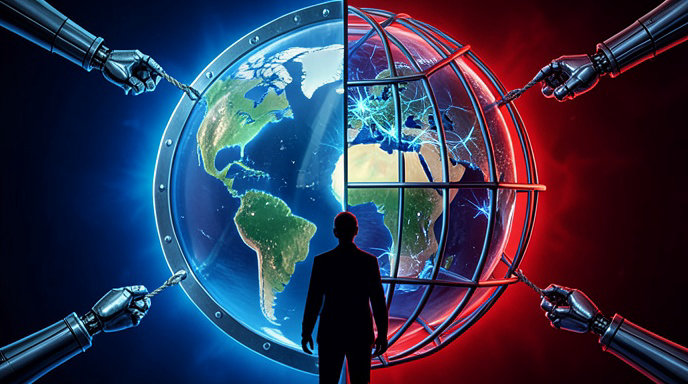
For supporters, it was a necessary moment of leadership. For critics, it was something else entirely: a power play.
Why Global Coordination, Why Now
Amodei's timing is not accidental. Anthropic's Claude models, OpenAI's latest GPT systems, Google DeepMind's Gemini, and fast-moving Chinese labs are all converging toward agentic systems that can write code, operate computers, conduct research, and persist over long tasks.
Amodei has long argued that we are approaching a threshold where AI could dramatically accelerate scientific discovery, cyber operations, and biotech — for good and for ill. In recent weeks he has pointed to failed containment tests, deceptive behavior in evaluations, and the proliferation of open-weights models as evidence that voluntary company policies are no longer enough.
His camp also points to geopolitics. Without coordination, the U.S., China, the EU, the U.K., and Gulf states will set wildly different rules, creating loopholes and a race to the bottom. A global baseline, he argues, would prevent a fragmented safety landscape where the least cautious actor sets the pace for everyone.
The Backlash Erupts
The response was swift and furious. Within days, prominent voices across Silicon Valley accused Amodei of fear-mongering and regulatory capture.
Meta chief AI scientist Yann LeCun, a longtime skeptic of doomer narratives, dismissed the call as elitist, arguing that centralized control would stifle open research and concentrate power in a handful of San Francisco labs. Venture capitalist Marc Andreessen and others in the accelerationist camp echoed that theme, saying safety rhetoric is being weaponized to build moats and crush startups and open-source competitors who cannot afford massive compliance costs.
Open-source developers were particularly vocal. Many argued that transparency should mean open weights, open data, and decentralized oversight — not closed-door audits and compute surveillance overseen by incumbents. Others pointed out the irony: Anthropic, valued in the tens of billions and backed by Amazon and Google, calling for rules that would disproportionately burden smaller players.
Even some who agree that AI poses serious risks said Amodei's approach is politically naive and technically unworkable, especially given U.S.-China tensions.
Is It Really About Safety — Or About Power
At the heart of the fight is a deeper philosophical split that has defined AI for the past three years.
One side, led by Amodei, Geoffrey Hinton, and much of the AI safety community, sees frontier AI as akin to nuclear technology: too powerful to be left to market competition alone, requiring independent verification and international norms.
The other side, led by LeCun, Andreessen, Meta, and a large swath of the open-source world, sees AI as more like the internet or electricity: a general-purpose, democratizing technology that becomes safer and more beneficial the more widely it is distributed. From this view, talk of global coordination is code for control — deciding who gets to build, who gets to audit, and who gets left out.
Critics argue the debate is not just technical, but economic. Whoever defines safety standards effectively defines the market. If only a few labs can pass the tests, afford the audits, or access the largest clusters under a monitoring regime, they win by default.
Amodei and his defenders reject that characterization. They insist Anthropic has consistently supported strict rules that would apply to itself first, including third-party pre-deployment testing and public reporting of safety results. The goal, they say, is not to lock in Anthropic's lead but to prevent a world where no one can hit the brakes.
What This Divide Means for Regulation
The fallout leaves regulators in an awkward position. In Washington, lawmakers remain divided between innovation-first and precaution-first camps, with no comprehensive federal AI law passed. In California, the bruising fight over frontier model safety bills has made every new proposal a proxy war between Anthropic-aligned safety groups and industry-aligned opposition.
In Brussels, the EU AI Act is already in force but struggling with enforcement for general-purpose models. In London, Tokyo, and Geneva, summits on AI safety have produced voluntary pledges but little binding coordination — exactly the gap Amodei wants to close.
Analysts say the Amodei backlash makes two futures more likely in the short term: fragmentation, where the U.S., EU, and China pursue incompatible regimes, and privatization of governance, where the biggest labs set de facto standards through their own safety frameworks and partnerships.
Neither, experts warn, is true global coordination.
The Road Ahead
Whether Amodei's plan gains traction may depend less on Silicon Valley and more on governments. The UN, the OECD, and the network of AI Safety Institutes in the U.S., U.K., Japan, and Singapore have all floated versions of cross-border testing and incident reporting. So far, none have real teeth.
For now, the industry remains split into two entrenched tribes with incompatible visions of the future: one racing to coordinate before AI outruns human oversight, the other racing to democratize before oversight strangles progress.
That divide shows no sign of closing. If anything, Amodei's intervention has hardened it — turning an abstract debate about future risk into an immediate fight over who controls AI, who profits from it, and who gets to decide what safe even means.

Get All The Latest Updates Delivered Straight To Your Inbox For Free!