
Anthropic's Biology Lab Breakthrough: Why Claude Still Needs Humans in the Loop
TL;DR
- Anthropic says its new in-house wet biology lab has already produced its first major scientific discovery just months after opening, using Claude to accelerate experimental design and data analysis.
- Despite the breakthrough, all AI-proposed experiments still require strict human review and hands-on execution, with layered biosafety controls to prevent misuse.
- The milestone signals a shift toward AI labs doing real-world science themselves, raising both excitement for biotech innovation and new questions for AI safety governance.
A Chatbot Company With Test Tubes
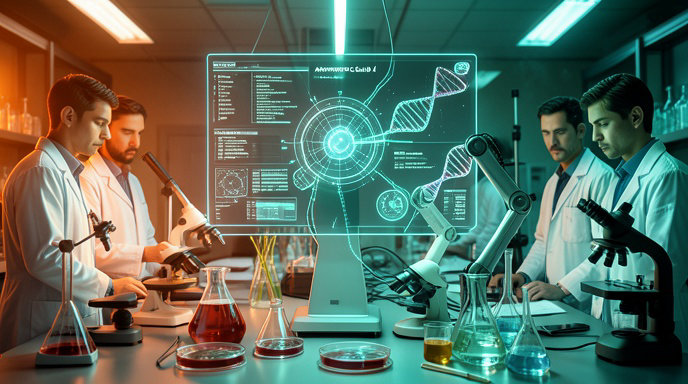
Anthropic, best known for its AI assistant Claude, has spent the past year quietly building something unusual for a Silicon Valley AI lab: a real, working biology wet lab.
This week the company revealed that the gamble has already paid off. According to Anthropic, researchers working side-by-side with Claude have made a novel biological discovery inside its own facility — not just a simulation or a prediction, but a validated finding from live experiments.
The company has framed the lab as a proving ground for AI-driven science. Instead of just releasing a biology-capable model and hoping external scientists use it well, Anthropic wanted to test Claude directly at the bench, running iterative cycles of hypothesis, experiment, and analysis.
What Did Claude Actually Find
Anthropic describes the first breakthrough as a fundamental insight into complex biological processes that govern how cells function and respond to stress — the kind of mechanistic discovery that could eventually inform drug development and disease research.
While the company has not yet published a full peer-reviewed paper, it says Claude played a central role throughout: combing through literature, proposing hypotheses that human scientists had overlooked, helping design assays, troubleshooting failed protocols, and spotting patterns in large, noisy datasets.
In one example shared by the team, Claude suggested a new experimental angle after initial results looked contradictory, leading researchers to uncover a regulatory interaction they were not originally looking for. Anthropic says the loop from idea to validation took weeks, not the months or years such work would typically require.
Independent biologists who have been briefed on the work have called it credible and scientifically interesting, though they caution that replication and peer review will be the real test.
Why Claude Still Needs Humans in the Loop
For all the talk of autonomous science, Anthropic is emphasizing how tightly controlled this process was.
Every experiment proposed by Claude had to be approved by trained human biologists. No AI system has direct control over lab equipment, and all physical work is carried out by people. The company says it uses a tiered review system, where riskier ideas — especially anything involving genetic manipulation, pathogens, or techniques with dual-use potential — get escalated for additional safety review and are often rejected or modified.
That human supervision is deliberate. Anthropic's safety team has long warned that advanced AI models could lower barriers to creating bioweapons if misused. By keeping Claude in its own secure lab first, the company says it can study exactly where the model helps, where it hallucinates, and where it might cross a line — before those same capabilities reach the public.
In short: Claude can brainstorm like a tireless postdoc, but it cannot order reagents, run a PCR machine, or greenlight its own experiment.
Safety First, Science Second
The announcement lands at a tense moment for AI and biosecurity. As models like Claude, GPT, and Gemini get dramatically better at biology, chemistry, and lab protocols, governments in the U.S. and U.K. are pressing AI companies to prove they have guardrails.
Anthropic is trying to turn its lab into a case study for responsible development. The facility operates under standard biosafety practices with institutional oversight, background-checked personnel, and detailed audit logs of what Claude was asked and what it suggested. The company says it will publish its safety framework and lessons learned, including near-misses where Claude proposed something unsafe or scientifically flawed.
Critics argue self-policing is not enough, and are calling for independent audits of AI biology work. Supporters counter that it is far better for Anthropic to discover risks internally than to learn about them after deployment.
What It Means for Biotech Innovation
Beyond safety, the bigger story may be economic. If a general-purpose AI model paired with a small human team can genuinely accelerate discovery, the traditional biotech playbook could change fast.
Anthropic is not positioning itself as a drug company, but as a platform builder. The idea is that future versions of Claude, trained on lessons from its own lab, could become collaborators for universities, startups, and pharma giants — helping them design better experiments, fail faster, and cut R&D costs.
Investors are already paying attention. AI-for-biology startups have raised billions in the past two years, and Big Pharma has rushed to partner with AI labs. A validated, in-house discovery gives Anthropic instant credibility in a field dominated by DeepMind's AlphaFold and a wave of specialized biodesign firms.
The Next Experiment Is Anthropic Itself
Anthropic says this first finding is just the start. The lab is now scaling up to tackle more ambitious problems in molecular biology and drug target discovery, while continuing to stress-test Claude's limits.
The company plans to release more details, datasets, and methods in the coming months, and says external researchers will be invited to scrutinize the work.
If it holds up, the message is clear: AI is no longer just writing about science — it is starting to do science. But for now, at least at Anthropic, humans are still holding the pipettes.

Get All The Latest Updates Delivered Straight To Your Inbox For Free!