
Ninja Crispi Microwave Review: The Appliance That Combines Microwaving and Air Frying
TL;DR
- No officially confirmed Ninja product called the “Ninja Crispi Microwave” or using “FusionCrisp” technology has been reliably documented as of November 2, 2026.
- The concept appears to combine microwave speed with air-fryer browning, but claims that it replaces two appliances should be treated cautiously until specifications and testing are published.
- Ninja’s confirmed Crispi products are portable glass air fryers, not microwave-air-fryer hybrids, so buyers should verify the model name before purchasing.
A promising idea without a verified product
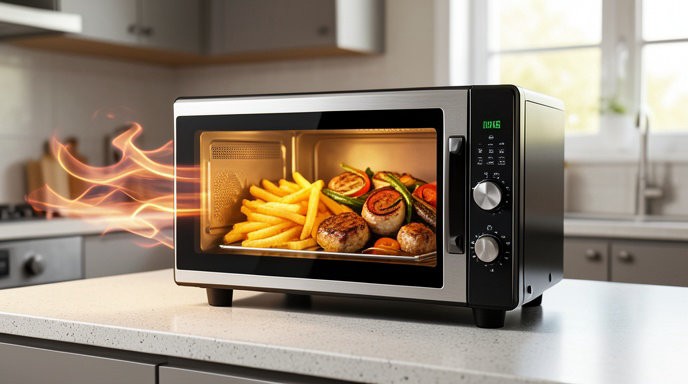
The supposed Ninja Crispi Microwave sounds like exactly the kind of countertop appliance many kitchens need: a device that can reheat food quickly in microwave mode while also delivering the browned, crisp exterior associated with an air fryer.
However, there is an important problem with the premise. As of November 2, 2026, there is no clearly verified, widely documented Ninja appliance officially named the “Ninja Crispi Microwave,” and there is no dependable public product documentation confirming a Ninja system called “FusionCrisp.”
That makes it impossible to provide a conventional hands-on review of its cooking performance, dimensions, price, controls or reliability. Reports or promotional material using those names should be checked carefully against Ninja’s official product listings and major retailer pages.
What Ninja’s Crispi range actually offers
Ninja’s confirmed Crispi products are centered on portable glass air-fryer cooking rather than microwave cooking. The range is designed around heat-resistant glass containers that can move between cooking, serving and storage, depending on the specific model and instructions.
The main appeal is convenience. Users can cook food in the same vessel they use to serve it, reducing the need for a separate basket or baking tray. The system is also aimed at portability, making it more practical for smaller kitchens, offices, dorm rooms and households that do not want a large traditional air fryer.
These products can air fry, roast, reheat and crisp food, but those functions should not be confused with microwave heating. An air fryer circulates hot air to brown and dehydrate food; a microwave excites water molecules to heat food rapidly. The two methods produce different results and are not interchangeable.
Why a microwave-air-fryer combination is appealing
Microwaves excel at speed. They are particularly useful for reheating leftovers, softening frozen foods and warming liquids. Their weakness is texture: foods such as fries, breaded chicken and pastries often emerge soft or chewy.
Air fryers solve some of that problem by circulating hot air at high temperatures. They can restore crispness to leftovers and brown the surface of food, but they generally take longer than a microwave and often require preheating. Their baskets also provide limited capacity and can be awkward to clean.
A genuine microwave-air-fryer hybrid could address both shortcomings. A user might microwave the center of a chilled meal and then switch to an air-fry or convection cycle to crisp the exterior. In theory, that could reduce cooking time while avoiding the soggy texture associated with microwave-only reheating.
The challenge is engineering those functions into one compact appliance. Microwave components require shielding and carefully designed interiors, while air-frying needs strong airflow, high temperatures and safe materials. Combining both systems without making the appliance bulky, expensive or difficult to clean would be the central test.
FusionCrisp claims need verification
The term “FusionCrisp” suggests a proprietary system intended to combine microwave heating with circulating hot air or another browning method. But without official technical information, it is not possible to determine whether the name describes a genuine new cooking platform, a retailer-created marketing term or confusion with another brand’s technology.
A credible product launch would normally provide details such as microwave wattage, convection or air-fry temperature ranges, cooking modes, cavity capacity, compatible cookware, safety certifications and cleaning instructions. It would also clarify whether the appliance can use microwave and high-temperature cooking simultaneously or only in separate stages.
Those distinctions matter. Sequential cooking can still be useful, but it is different from a true combined cycle. A product that microwaves first and air-fries afterward may save time compared with using two separate appliances, while a simultaneous system could potentially deliver faster and more even results.
Performance questions that remain unanswered
The most important unanswered question is whether such a device could produce genuinely crisp food without compromising microwave speed.
Crisping depends on surface moisture, airflow and temperature. Foods with wet coatings or dense breading may still require time to dry and brown. A small appliance could also struggle with uneven browning if its fan, heating element and cooking cavity are not well balanced.
Capacity is another concern. Countertop combination appliances often advertise family-size interiors but provide less usable space once an air-fry basket, turntable or raised rack is installed. Buyers would need to know whether the appliance can handle a full plate of leftovers, multiple portions of fries or a standard frozen pizza.
Noise and heat would also be important. Air-fryer fans can be loud, while microwave combination units may release substantial heat during convection cooking. A compact appliance that replaces two devices would be most useful if it did not introduce the noise, ventilation requirements and cleaning burden of both.
Could it replace a microwave and an air fryer?
In principle, yes—but only for households with modest cooking demands.
A well-designed combination unit could replace a basic microwave and a small air fryer for reheating leftovers, cooking frozen snacks, crisping prepared foods and preparing individual portions. It could be especially attractive in apartments, offices or kitchens with limited counter space.
It may not replace both appliances for larger households. A full-size microwave can offer more interior room, while a dedicated air fryer may provide a larger basket and stronger airflow. Users who regularly cook several servings of wings, vegetables or fries may prefer separate appliances or a larger multifunction oven.
There is also a workflow issue. Two separate appliances can operate at the same time. With a combination device, a household may have to wait for one cooking cycle to finish before starting another.
The Ninja Crispi advantage: glass cooking and portability
The strongest verified idea associated with Ninja’s Crispi range is its glass-container design. Compared with traditional nonstick air-fryer baskets, glass can make it easier to see food while it cooks and may simplify serving and storage.
That design also changes the appliance’s role. Rather than functioning only as a countertop cooker, a Crispi system can be positioned as a portable meal-preparation tool. A user can cook a portion, carry it and potentially store leftovers in the same container, subject to the model’s care and temperature instructions.
Glass is not automatically better in every situation. It can be heavier than a metal basket, may require careful handling and can take up more storage space. Users must also follow manufacturer guidance regarding thermal shock, preheating and compatible surfaces.
Buying advice for shoppers
Anyone encountering a listing for a “Ninja Crispi Microwave” should confirm the exact model number before buying. Check whether the product appears on Ninja’s official website, whether the seller is authorized and whether the manual clearly identifies microwave functionality.
The listing should specify microwave power in watts, air-fry or convection temperatures, capacity, included accessories and the types of containers that can be used. A genuine microwave must also include appropriate safety and regulatory information.
Be especially cautious of product pages that use the Ninja Crispi name but show a conventional air fryer, a generic microwave or a concept image. The presence of words such as “FusionCrisp,” “microwave air fry” or “two-in-one cooking” is not, by itself, evidence of an official Ninja product.
Verdict
The Ninja Crispi Microwave is an appealing kitchen-appliance concept, but it cannot currently be reviewed as a confirmed retail product on the basis of reliable public information. The combination of microwave speed and air-fryer crisping would solve a real everyday problem, and Ninja’s existing Crispi products show that the company is interested in compact, portable cooking systems.
For now, though, the documented Crispi range should be understood as an air-fryer family rather than a microwave replacement. Shoppers seeking a microwave-air-fryer combination should compare established combination ovens from brands that publish full specifications and manuals, rather than relying on an unverified product name.
If Ninja officially launches a Crispi microwave with FusionCrisp technology, the decisive tests will be speed, browning consistency, capacity, ease of cleaning and whether it truly eliminates the need for two countertop appliances. Until those details are confirmed, the product is better treated as an intriguing possibility than a purchase-ready appliance.

Get All The Latest Updates Delivered Straight To Your Inbox For Free!