
Apple's Foldable iPhone Hinge Built With AI and 3D Printing Explained
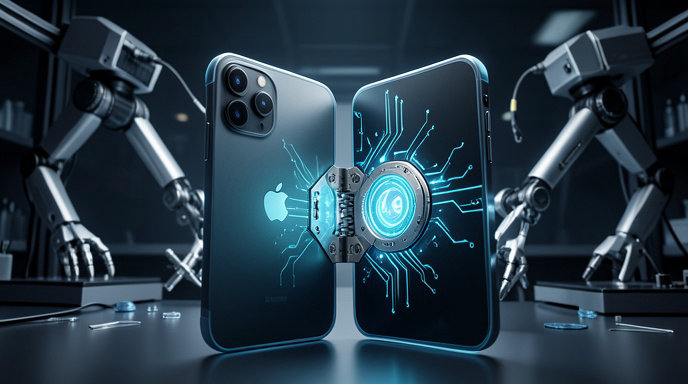
TL;DR
- Apple has reportedly cracked its foldable iPhone hinge using AI-driven generative design and 3D-printed liquid metal, creating a thinner, stronger mechanism with a nearly invisible crease.
- The advanced manufacturing process improves durability to over 200,000 folds but pushes production costs higher, helping explain the expected $2,000 to $2,500 price tag.
- Mass production of the hinge is now underway with suppliers Amphenol and EonTec, pointing to a launch alongside the iPhone 18 lineup in fall 2026.
The Hinge Was The Holdup
For years, the foldable iPhone wasn't delayed by screens or software — it was delayed by the hinge. Apple reportedly tested dozens of designs from Samsung-style waterdrop hinges to dual-axis concepts, but none met its standards for thinness, crease control, and long-term reliability. The company wanted a device that folds completely flat, opens with no visible crease, and survives years of daily use without loosening.
That is why the hinge became Apple's make-or-break component. According to supply chain analysts Ming-Chi Kuo and Jeff Pu, Apple has now finalized a custom design that is radically different from what Samsung, Google, and Huawei use today.
How AI Designed A Hinge Apple Engineers Couldn't
Instead of designing the hinge by hand, Apple engineers used AI-powered generative design tools to create it.
The process works like this: engineers input constraints — must be under 2mm thick when folded, must support a 7.8-inch inner display, must withstand lateral drops, must distribute stress evenly to avoid display creasing — and the AI model generates thousands of micro-structures and geometries that would be impossible for a human to model manually.
The winning design is a complex lattice-like internal structure with variable thickness and curved interlocking teeth. It spreads folding force across a wider area rather than concentrating it on a single center line, which is what causes the visible crease on Galaxy Z Fold phones.
Apple is also using AI for predictive simulation, running millions of virtual fold, twist, drop, and heat-expansion cycles in hours to spot weak points before a physical prototype is ever built.
Why 3D Printing And Liquid Metal Changed Everything
A design that complex can't be milled or CNC-machined at scale. That's where 3D printing comes in.
Apple is manufacturing key hinge components from bulk metallic glass, commonly known as liquid metal or amorphous alloy, using high-precision 3D printing and metal injection molding. Suppliers Dongguan EonTec and Amphenol are reportedly handling mass production.
Liquid metal is ideal for this job: it's 2.5x stronger than titanium, highly corrosion-resistant, extremely elastic, and can be printed into near-net shapes with micron-level accuracy. 3D printing allows Apple to create hollow, lightweight parts with internal channels and organic curves without assembly of dozens of tiny screws and plates.
The result is fewer parts, tighter tolerances, and a hinge that is both thinner and stronger. Reports suggest Apple has cut the hinge part count by nearly 30% while improving strength by up to 40% compared to traditional foldable hinges.
What It Means For Durability
Durability is where this combo should pay off for users.
Current foldables are typically rated for 200,000 folds, or about five years of 100 folds per day. Apple's AI-designed liquid metal hinge is reportedly targeting the same or better, with internal testing focused on three key upgrades:
- A nearly crease-free display. By controlling the bend radius with a waterdrop-style support plate generated by AI, the screen forms a soft teardrop shape inside instead of a sharp fold.
- Better dust and water resistance. A tighter, 3D-printed enclosure leaves less gap for debris — one of the biggest killers of foldable phones.
- No sag or wobble over time. Liquid metal resists deformation far better than stainless steel, meaning the phone should still snap flat after years of use and support flexed half-open modes for FaceTime and video.
If accurate, this would address the top two reasons iPhone users say they haven't switched to a foldable yet: screen crease and long-term reliability.
Why It Will Cost You
All this innovation isn't cheap.
Analysts estimate Apple's liquid metal hinge costs $30 to $40 per unit to produce, versus $8 to $12 for a standard foldable hinge. 3D printing with amorphous alloy is slower, requires specialized vacuum furnaces, and has lower yields than traditional milling.
That cost is a major reason the foldable iPhone — rumored to be called iPhone Fold or iPhone Ultra — is expected to start at $1,999 to $2,499. Apple is positioning it as an ultra-premium device above the Pro Max, with a 5.5-inch cover display, 7.8-inch inner display with Touch ID in the power button, dual rear cameras, and a super-thin 4.5mm unfolded chassis.
In other words, you're paying for the hinge as much as the screens.
Launch Timeline: When Can You Buy It?
With hinge production reportedly entering high-volume manufacturing in late 2025 to early 2026, the timeline is finally firming up.
Most reliable leakers now agree: Apple plans to unveil its first foldable iPhone in September 2026 alongside the iPhone 18 Pro and iPhone 18 Pro Max, with the standard iPhone 18 delayed to spring 2027. Foxconn is expected to begin final assembly in spring 2026.
Apple has not officially confirmed the device, and plans could still shift if hinge yields don't improve. But for the first time, the supply chain — not just renders and patents — is moving, which is historically the strongest sign an Apple product is real and close.
If Apple nails it, the AI-designed, 3D-printed hinge won't just enable a foldable iPhone. It could set a new manufacturing blueprint for MacBooks, iPads, and Vision Pro hardware next.

Get All The Latest Updates Delivered Straight To Your Inbox For Free!