
Cancer Survivor Founder Builds Glasses for Voice to Bring Emotion Back to Speech
TL;DR
- Uhura Bionics founder, a cancer survivor who lost his voice, is building AI-powered glasses for voice to replace robotic-sounding assistive devices.
- Selected for the Startup Battlefield 200 at TechCrunch Disrupt, the startup showcased silent-speech technology that restores expressive, emotional communication.
- The glasses use muscle signals and AI voice cloning to let users speak silently and be heard in their own natural tone.
From Silence to Startup
For most founders, a startup begins with a problem to solve. For the founder behind Uhura Bionics, it began with a voice he lost.
After a cancer diagnosis that damaged his vocal cords and left him struggling to speak, he experienced firsthand what millions of people with voice loss live with every day: assistive devices that are functional, but flat, robotic, and dehumanizing. Phone-type electrolarynxes, text-to-speech apps, and tracheoesophageal prostheses could produce words, but not warmth, humor, urgency, or joy.
That frustration became a mission: to reinvent assistive speech around emotion, identity, and human connection, not just intelligibility.
A Battlefield Moment at TechCrunch Disrupt
That mission earned Uhura Bionics a coveted spot in the Startup Battlefield 200 at TechCrunch Disrupt, where the company pitched alongside 200 of the world's most promising early-stage startups.
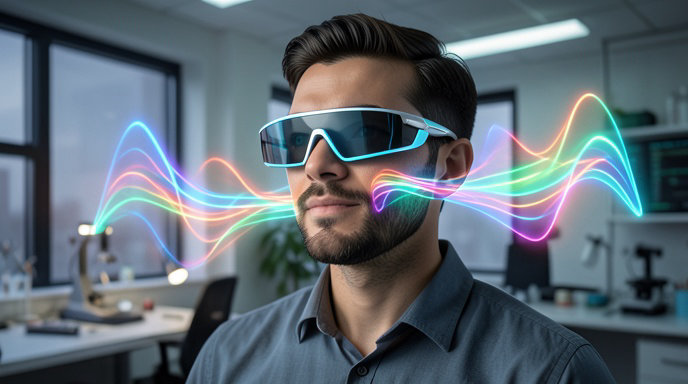
On the Disrupt stage, the team introduced its core concept: glasses for voice. Instead of a bulky handheld device held to the throat or a phone screen that forces users to type to talk, Uhura Bionics envisions everyday eyewear as a discreet, wearable voice system.
The selection marks a major visibility milestone for the startup, putting voice-loss technology — a category long overlooked in consumer tech — in front of investors, press, and potential partners focused on AI hardware, accessibility, and human-computer interaction.
Why Robotic Voices Are Not Enough
Traditional augmentative and alternative communication, or AAC, devices have changed little in decades. Stephen Hawking's iconic computerized voice brought awareness to the technology, but for many users, that same flat tone is still the reality.
Users and speech-language pathologists say current tools fail in three critical ways. They are slow, forcing a pause while someone types. They are conspicuous, drawing stares in social settings. And most importantly, they strip out prosody — the pitch, pace, and emotion that makes speech human.
For cancer survivors after laryngectomy, people with ALS, Parkinson's, vocal cord paralysis, and throat injuries, that loss is profound. You can say I love you, but you cannot sound like you mean it.
Uhura Bionics is betting that restoring emotion is just as important as restoring words.
How the Glasses for Voice Work
While still in development, Uhura Bionics has outlined a system that combines silent-speech sensing with generative AI voice reconstruction.
The glasses are designed to pick up subtle neuromuscular signals from the jaw, throat, and face when a user mouths words silently — no audible sound required. Machine learning models then decode those signals into speech intent, and a personalized AI voice model speaks the words aloud in real time.
Unlike generic text-to-speech, the system aims to preserve the speaker's own vocal identity, cloned from pre-loss recordings when available, or created to match age, accent, and personality. The goal is expressive output that can whisper, laugh, emphasize, and convey mood, delivered through a built-in speaker or connected phone.
By embedding the sensors in glasses — a form factor already worn by millions — the startup hopes to make assistive speech discreet, hands-free, and socially natural.
More Than Accessibility, A New Interface
Uhura Bionics positions its technology beyond medical devices alone. The company sees silent, expressive speech as a new computing interface for noisy environments, private calls, and future AR applications.
But the heart of the story remains accessibility. An estimated millions globally live with voice impairment due to cancer, neurological disease, trauma, or surgery, and many abandon traditional AAC devices because of stigma and poor user experience.
If Uhura Bionics can deliver lightweight, emotionally rich glasses for voice at consumer scale, it could do for speech what cochlear implants and advanced hearing aids did for hearing: move assistive tech from clinical to personal.
What Comes Next
Following its TechCrunch Disrupt showcase, Uhura Bionics is focused on prototyping, clinical validation, and partnerships with speech clinics, cancer centers, and ALS advocacy groups. Like most Battlefield 200 companies, it is also actively fundraising to move from lab demos to pilot trials.
Challenges remain, including decoding accuracy across different conditions, battery life in a glasses form factor, and FDA pathways for medical-grade claims.
Still, the response at Disrupt suggests the startup has struck a nerve. In a sea of AI chatbots and productivity tools, a cancer survivor building glasses so others can sound like themselves again stands out — not just as clever hardware, but as deeply human technology.

Get All The Latest Updates Delivered Straight To Your Inbox For Free!