
Elon Musk's Boring Company Pitches Austin to San Antonio Hyperloop Tunnel
TL;DR
- The Boring Company has floated a new concept for an Austin to San Antonio tunnel loop for Tesla-based pods, pitched as a 15- to 20-minute alternative to the congested I-35 corridor.
- No formal permits, funding agreement, or timeline have been announced, and Texas officials say the idea remains in early discussion stages as of September 2026.
- The proposal faces heavy skepticism due to The Boring Company's history of shelved projects in Los Angeles, Chicago, Baltimore, and Fort Lauderdale.
The Pitch: An I-35 Bypass Underground
Elon Musk's Boring Company is once again talking tunnels in Texas. According to recent local discussions and company pitches, the Bastrop-based firm has proposed a high-speed underground link connecting Austin and San Antonio — roughly 80 miles along one of the most traffic-choked corridors in the United States.
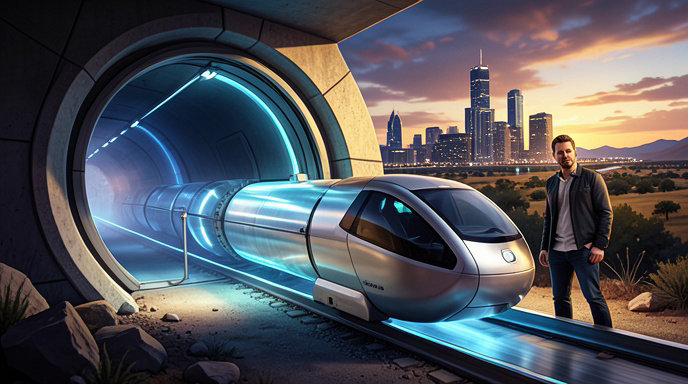
While the company has used the term Hyperloop in past concepts, the current Austin-San Antonio idea is being described more accurately as a Loop system: narrow tunnels carrying Tesla vehicles or purpose-built pods at highway-plus speeds, rather than a true vacuum-tube hyperloop. Early talking points suggest one-way trips in under 20 minutes, compared to 1.5 to 3 hours by car on I-35 during peak congestion.
No engineering plans, route maps, or applications filed with the City of Austin, City of San Antonio, or TxDOT have been made public. Sources familiar with the discussions describe it as an unsolicited pitch, not an approved project.
What Commuters Are Being Promised
For Texas commuters, the sales pitch is familiar and appealing. The Austin-San Antonio metro areas are among the fastest-growing in the U.S., with more than 5 million residents combined and tens of thousands making intercity trips daily for work, Austin-Bergstrom and San Antonio airports, universities, and logistics hubs.
The Boring Company claims its system would offer:
- Frequent, on-demand departures with no fixed train schedule, with cars entering tunnels via surface stations and merging into the main line.
- Projected fares far cheaper than high-speed rail, with past Loop pricing pitched at a few dollars per ride.
- All-electric, traffic-free travel immune to weather and I-35 construction delays tied to the massive I-35 Capital Express expansion in Austin.
Supporters argue that even a scaled-down, 100+ mph Loop could transform the emerging Austin-San Antonio mega-metro, easing pressure on I-35 and offering an alternative to the long-delayed Dallas-to-Houston high-speed rail effort.
A History of Big Promises, Thin Deliveries
That promise comes with major baggage. Since its founding in 2016, The Boring Company has announced a long list of ambitious projects that never materialized.
In Los Angeles, a 2.7-mile test tunnel in Hawthorne was built, but a proposed Westside to Dodger Stadium system and Sepulveda tunnel were scrapped after lawsuits and community opposition. In Chicago, a high-profile 2018 win to build an O'Hare Express Loop to downtown never broke ground and was eventually abandoned by the city. Similar proposals for a Baltimore-Washington Loop, a New York to Washington Hyperloop, and a Fort Lauderdale beach tunnel all generated headlines, environmental reviews, or memorandums — then quietly died.
The only commercial system operating today is the Las Vegas Convention Center Loop, a 1.7-mile, low-speed Tesla shuttle that has expanded slowly into the Vegas Loop. It carries passengers but operates far below original hyperloop speed promises of 150+ mph, typically running at 35-40 mph in congested convention traffic.
Critics say the pattern is clear: big renderings and fast timelines at announcement, followed by permitting hurdles, cost questions, and cancellations.
Why Texas Officials and Experts Are Skeptical
Transportation experts point to three major hurdles for Austin to San Antonio.
First is scale. An 80-mile intercity tunnel would be orders of magnitude larger and more expensive than anything The Boring Company has built. Even at the company's claimed $50-$100 million per mile — far below traditional subway costs — the project would cost $4 billion to $8 billion, with no identified funding source, private or public.
Second is permitting and geology. The route would cross the Edwards Aquifer recharge zone, environmentally sensitive land, multiple counties, and Union Pacific and TxDOT rights-of-way. Any tunnel would require extensive environmental review, water protection plans, and buy-in from Austin, San Marcos, New Braunfels, San Antonio, and state regulators. None have publicly endorsed the plan.
Third is technology questions. True hyperloop systems requiring near-vacuum tubes over 80 miles remain unproven at commercial scale, especially after Hyperloop One shut down in late 2023. A Tesla-in-tunnel Loop avoids vacuum tech but raises its own questions about throughput, ventilation, fire safety, and whether it can move enough people per hour to dent I-35 traffic.
Local leaders have so far responded with cautious interest rather than commitment, saying they are open to private innovation but focused on funded projects like I-35 expansion, Amtrak improvements, and the proposed Austin-San Antonio intercity rail studied by Lone Star Rail advocates.
What Happens Next?
For now, the Austin to San Antonio Hyperloop Tunnel remains a pitch, not a plan. The Boring Company has not announced a timeline for environmental studies, public hearings, or a demonstration segment, and the company has not commented on who would pay for construction or own the system.
If history is any guide, the next test will be whether the company files formal paperwork, secures land or right-of-way, and builds even a short test section in Central Texas — where it already has a presence with its Bastrop headquarters, Boring Bodega, and SpaceX and Tesla facilities nearby.
Until then, Texas commuters stuck on I-35 should treat this as Musk's latest what-if vision for Texas transit: technically intriguing, politically complicated, and, based on track record, far from guaranteed to leave the station.

Get All The Latest Updates Delivered Straight To Your Inbox For Free!