
Feds Probe Tesla Cybercab Hours After Austin Robotaxi Launch
TL;DR
- Federal safety regulators opened a formal probe into Tesla's Cybercab just hours after the first steering-wheel-less production robotaxis began carrying passengers in Austin on September 3rd.
- The investigation was triggered by multiple viral videos and police reports allegedly showing Cybercabs running red lights, making illegal turns, and stranding riders in traffic.
- Tesla denies any systemic defect and says it is cooperating, but the probe could delay its planned nationwide expansion and reshape federal oversight of autonomous ride-hailing.
From Celebration to Scrutiny in Under 12 Hours
Austin was supposed to be Tesla's victory lap. After more than a year of supervised Model Y robotaxi testing in the city, Tesla finally deployed what CEO Elon Musk has long promised: the production Cybercab — a gold, two-seat, fully driverless vehicle with no steering wheel, no pedals, and butterfly doors.
Shortly after 9 a.m. local time on Wednesday, September 3rd, the first batch of Cybercabs rolled out of Giga Texas and began picking up invited riders and Tesla employees in South Austin. Musk celebrated on X, calling it "the beginning of the end of personal car ownership."
By Wednesday evening, federal regulators had stepped in.
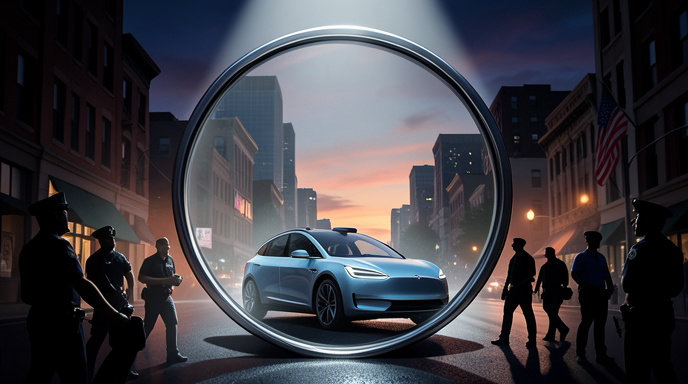
The National Highway Traffic Safety Administration confirmed Thursday morning that its Office of Defects Investigation has opened a preliminary evaluation into Tesla's Cybercab deployment, requesting logs, video, and operational data for the entire Austin fleet.
It is an unusually fast response, underscoring just how high the stakes are for Tesla and for Washington.
What Triggered the Probe
According to NHTSA, the probe was not planned in advance. It was prompted by a flood of real-world incidents captured within the first few hours of operation.
At least four widely shared videos appear to show Cybercabs behaving erratically in central Austin. In one clip viewed millions of times, a Cybercab hesitates in an intersection, then turns left across a solid red arrow on South Congress. In another, a Cybercab mounts a curb while attempting to pull over for a police cruiser, then freezes for nearly two minutes blocking a bike lane.
Austin police confirmed they responded to two separate 911 calls involving Cybercabs on launch day, including one where a rider reported being trapped inside a vehicle that pulled over and would not unlock its doors or respond to support.
NHTSA said it also received direct reports through its Vehicle Owner Questionnaire system. The agency is specifically focused on three categories: failure to obey traffic control devices, inappropriate stopping in active roadways, and loss of remote support connectivity.
Safety advocates say the pattern is familiar. Tesla's Full Self-Driving Supervised software has been under continuous federal scrutiny since 2023, with two still-open investigations into phantom braking and intersection violations. The Cybercab runs Tesla's latest unsupervised stack, dubbed FSD Unsupervised, which Tesla claims is 10x safer than a human driver — a claim regulators say has never been independently verified.
Tesla's Response: Cooperation, Defiance, and Data
Tesla's initial response has been a mix of cooperation and pushback.
In a statement issued late Wednesday, the company said safety is its top priority, that it is in contact with NHTSA, and that it will provide all requested data. Tesla engineering chiefs briefed on background said early reviews suggest some viral videos lack context, such as a delivery truck blocking sensors or incorrect mapping data from the city.
Musk himself was more defiant on X. He dismissed the probe as "politics as usual" and claimed Waymo vehicles commit far more traffic violations per mile in Austin without similar scrutiny. "Tesla will save millions of lives. The haters will try anything to stop it," he posted early Thursday.
Behind the scenes, Tesla has already taken action. Sources familiar with the operation say Tesla temporarily paused paid public rides Thursday morning, reverting to employee-only testing in a smaller geofenced area around Giga Texas while it pushes an over-the-air software update, version 14.2.1, aimed at intersection compliance.
The company insists no recall is warranted and that remote safety monitors can always intervene or unlock doors — directly contradicting some rider accounts from launch day.
Why This Probe Is Different
This is not just another Tesla investigation. There have been many. This one strikes at the core of Tesla's business model shift.
Unlike previous NHTSA probes into Autopilot and FSD in consumer-owned cars, the Cybercab has no driver at all. There is no steering wheel for a human to grab. NHTSA has no federal pre-approval process for such vehicles — it relies on post-deployment defect investigations and voluntary safety reporting.
That loophole is now under intense political pressure. Transportation Secretary officials confirmed Thursday they are reviewing Tesla's existing exemption petition that allowed it to deploy up to 2,500 Cybercabs per year without traditional controls.
If NHTSA finds an unreasonable risk to safety, it could order a grounding of the Austin fleet, force a physical recall, or deny a broader exemption — effectively freezing Tesla's plan to expand to San Francisco, Phoenix, Miami, and Dallas by the end of 2026.
What It Means for the Robotaxi Race
Tesla is not operating in a vacuum. Waymo now completes over 500,000 paid driverless rides per week across Austin, Phoenix, Los Angeles, and the Bay Area, with a safety record that has largely satisfied regulators. Amazon's Zoox just launched its purpose-built robotaxi in Las Vegas, and Hyundai-backed Motional is preparing a 2027 relaunch.
All of them follow a very different playbook: lidar + radar + cameras, years of slow city-by-city validation, and close coordination with local emergency responders.
Tesla is betting it can move faster and cheaper with vision-only AI and mass manufacturing. The Austin launch was meant to prove that thesis.
Now, analysts say the federal probe could become a defining test case for U.S. autonomous vehicle policy. A light-touch outcome — a software update and continued testing — would embolden Tesla and accelerate the industry. A harsh outcome — a suspension or mandated hardware changes — could push Congress to finally pass comprehensive AV legislation that has stalled for seven years.
For riders in Austin, the immediate future is uncertainty. Tesla's robotaxi app still shows Cybercabs as "temporarily unavailable," with Model Ys with safety monitors filling the gap.
For the rest of the country watching Austin, the message from Washington is clear: the driverless future has arrived, but it will not roll out without a federal chaperone.

Get All The Latest Updates Delivered Straight To Your Inbox For Free!