
Meet Feather: The $30,000 Android of Robotics Built for Developers
TL;DR
- Feather has unveiled a $30,000 customizable humanoid-on-wheels platform built specifically for software developers, not robotics PhDs.
- The startup is betting on an open, Android-like strategy with modular hardware, open APIs, and an app store model for robot skills.
- If it works, Feather could do for robotics what Android did for phones: turn a hardware problem into a software gold rush.
An Idea Borrowed From Smartphones
The pitch is simple and deliberately familiar. Just as Android gave developers a common operating system and let hardware makers compete, Feather wants to give developers a common robot to build on. No custom actuators to source, no SLAM stack to tune from scratch, no six-figure research platform to justify to your boss.
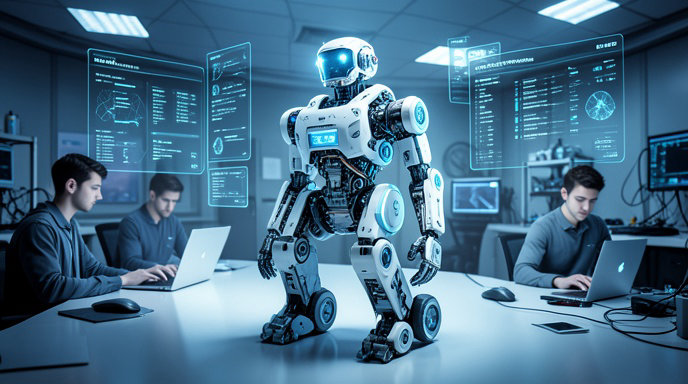
Feather's first product, simply called Feather 1, is a roughly four-foot-tall mobile manipulator on wheels with a swappable torso, arms, and sensor head. The base price is $30,000, which puts it far below research humanoids that can cost $100,000 to $250,000, but well above hobby toys. The company says that middle ground is intentional: affordable enough for a well-funded startup or university lab, serious enough for real-world testing.
Why Developers, Not Roboticists
Most robotics companies start with hardware and hope developers will show up. Feather is flipping that. The entire stack is developer-first.
Out of the box, Feather 1 runs Feather OS, a fork of Android with ROS 2 under the hood, and can be programmed in Python, Kotlin, and C++. There is over-the-air updating, fleet management from a web dashboard, one-click teleoperation, and simulation-to-real tooling built with NVIDIA Isaac Sim. Developers get full access to navigation, mapping, vision-language models, and motion primitives via APIs, instead of having to build low-level controls themselves.
In a demo this week, the company showed the same robot doing warehouse inventory in the morning, then, after a software swap and a gripper change, folding laundry and restocking a mock convenience store in the afternoon.
Open By Design, Customizable By Nature
Customization is the other big selling point. Buyers can choose single or dual arms, different grippers from Robotiq and others, lidar and depth camera options, extra compute, and battery packs. Third-party hardware modules will be supported through a standard mount and power/data port, which Feather calls F-Port.
On the software side, Feather is launching the Feather Market, where developers can publish and sell navigation behaviors, manipulation skills, and industry-specific apps. Feather takes a cut, just like Google Play. The core OS and low-level drivers will be open-sourced, the company says, while safety and high-level autonomy features remain proprietary.
Who Is Behind It
Feather was founded by former engineers from Google, Boston Dynamics, and Everyday Robots, Google's shuttered everyday-robot project. That lineage matters. Everyday Robots also tried to democratize robotics but was locked inside Google. Feather's team argues the timing is finally right thanks to cheaper sensors, better foundation models for robotics, and pent-up demand from software developers who know AI but have never touched a robot.
The company has not disclosed total funding, but says it is backed by prominent Silicon Valley robotics investors and is already taking pre-orders with a $1,000 refundable deposit. First units are expected to ship to developers in early 2027.
What It Could Mean For Robotics
The real test won't be specs, it will be adoption. Robotics has had open platforms before, from TurtleBot to Pepper to Stretch, but none became the Android of robotics. They were either too limited to be useful or too expensive to scale.
Feather's bet is that AI has changed the equation. With vision-language-action models improving fast, the bottleneck is no longer just better algorithms in simulation, it is access to cheap, capable, real-world bodies to collect data and test on.
If Feather can get a few thousand units into the hands of developers, universities, and startups, it could kick off a flywheel: more developers build more apps, which makes the hardware more useful, which sells more hardware. That is exactly how Android won.
The risks are still huge, from hardware reliability to safety certification to servicing a fleet of physical machines. But for the first time in years, robotics has a product that speaks the language of software developers. And at $30,000, Feather is daring them to build the future on it.

Get All The Latest Updates Delivered Straight To Your Inbox For Free!