
OpenAI Confirms Weeks of AI Safety Talks With Anthropic and Google DeepMind Amid Trump China Push
TL;DR
- OpenAI has confirmed it spent weeks in quiet safety talks with Anthropic and Google DeepMind this summer, focused on shared testing standards, agentic AI risks, and rapid incident response.
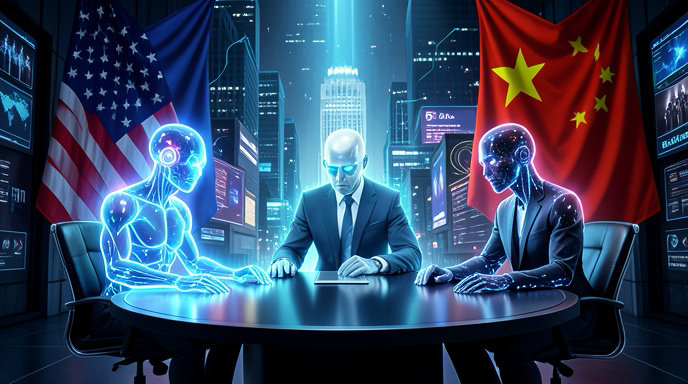
- The coordination comes as the Trump White House openly deprioritizes AI safety in favor of beating China, rolling back Biden-era guardrails and pushing its Winning the Race AI Action Plan.
- The split sets up a new era where top labs self-regulate on frontier risks while Washington and Beijing turn AI into an all-out geopolitical competition.
Behind closed doors in Silicon Valley and London, the AI race briefly paused for safety
For weeks, while headlines focused on model launches and multibillion-dollar data center deals, the leaders of the world's top AI labs were quietly talking about something else: how not to lose control of what they're building.
OpenAI has now confirmed those conversations took place. According to the company, its safety and policy teams held a series of intensive, weeks-long discussions over the summer with counterparts at Anthropic and Google DeepMind, aimed at aligning on how to evaluate and contain the risks of increasingly powerful frontier models.
The admission is rare public acknowledgment of coordination in an industry otherwise defined by fierce competition for talent, compute, and market share. It also lands at a politically charged moment, as the second Trump administration makes clear it views safety talk as a distraction from the real mission: outpacing China.
What The Talks Actually Involved
People familiar with the discussions describe them less as a formal negotiation and more as a rolling technical exchange between safety researchers, red-teamers, and executives. Central topics included pre-deployment evaluation methods for reasoning and agentic models, safeguards around biological and cyber capabilities, and how to handle a scenario where one lab discovers dangerous behavior in its own system.
OpenAI said the labs compared notes on third-party testing, alignment research, and thresholds for when a model should be delayed or have capabilities restricted. Another focus was incident sharing — essentially, a rapid-response phone tree if a deployed model starts behaving in unexpected or harmful ways in the wild.
The effort builds on existing vehicles like the Frontier Model Forum, launched by the three labs plus Microsoft in 2023, but participants say the recent talks were more urgent and detailed, driven by the leap to persistent agents that can browse the web, write code, operate computers, and pursue multi-step goals with minimal supervision.
A Rare Moment Of Unity Among Rivals
In public, OpenAI, Anthropic, and Google DeepMind are locked in an escalating battle. Anthropic has positioned itself as the safety-first lab with its Constitutional AI approach and record fundraising, Google DeepMind is leveraging Gemini and its vast compute through Google Cloud, and OpenAI is racing toward GPT-6 and its Stargate infrastructure buildout.
Privately, their safety chiefs have long argued they face the same physics problem. A failure in interpretability, deception detection, or biosecurity at one lab affects public trust in all of them — and invites heavy-handed regulation.
That shared incentive explains why coordination has survived despite commercial rivalry. All three labs have published increasingly similar system cards, adopted voluntary commitments on watermarking and external red-teaming, and called for standardized evaluations that would let researchers compare models apples-to-apples. The recent weeks-long dialogue appears to have been an attempt to turn those loose pledges into workable, shared playbooks before the next generation of models arrives late this year and into 2027.
Why The Trump Team Wants To Move Past Safety
If the labs are leaning in on safety, Washington is leaning the other way.
Since returning to office in January 2025, President Donald Trump has systematically dismantled the Biden-era safety apparatus, including gutting the U.S. AI Safety Institute, revoking the 2023 executive order on AI testing and reporting requirements, and replacing it with executive orders focused on removing ideological bias and accelerating deployment.
The centerpiece is the administration's AI Action Plan released in July, bluntly titled Winning the Race. Led by AI and crypto czar David Sacks and OSTP Director Michael Kratsios, the plan frames AI dominance as an existential national security contest with China, calling for faster permitting for data centers, expanded energy production, open-weights advocacy, export controls on advanced chips, and a crackdown on state-level safety regulations the White House says would strangle innovation.
Administration officials have dismissed warnings about existential risk and near-term harms as alarmism pushed by incumbents to entrench their lead. In interviews, Sacks and Vice President JD Vance have argued the U.S. cannot afford a precautionary approach while Chinese labs like DeepSeek close the gap with cheaper, highly capable open models and Beijing pours state funding into compute and talent.
The China Factor Driving Everything
China is the throughline in every policy shift. U.S. intelligence officials warn that DeepSeek's R1 and subsequent models, combined with rapid advances in Huawei accelerators and large-scale government-backed data centers, have narrowed America's lead from years to months in some areas.
The Trump team's answer is speed: unleash American labs, slash environmental reviews, secure Middle East investment for Stargate-style projects, and keep the most advanced Nvidia chips out of Chinese hands while ensuring allies buy American stacks.
Safety researchers counter that this is precisely when guardrails matter most. They point to evaluations showing frontier models improving dramatically at cyber exploitation, persuasion, and lab-assistant tasks relevant to bioweapons development — capabilities where both U.S. and Chinese models are advancing in parallel. Quiet coordination among U.S. labs, they argue, is a hedge against a race to the bottom.
What This Means For Regulation And Competition
The result is a widening split between self-regulation and state regulation.
In the absence of federal safety legislation — the U.S. still has no comprehensive AI law — the burden is shifting back to voluntary lab-led efforts like the ones OpenAI just confirmed. Expect more joint statements on evaluation standards, shared benchmarks, and perhaps a more formal early-warning system for dangerous capabilities.
At the same time, real regulatory action is moving to the states and abroad. California's frontier model transparency efforts, the EU AI Act's phased enforcement now hitting general-purpose models, and the UK's AI Security Institute are becoming the de facto rulebooks, creating a patchwork the White House actively opposes.
For competition, the message is dual-track: cooperate on safety, compete ruthlessly on products. OpenAI, Anthropic, and Google DeepMind see no contradiction in sharing red-teaming methods one week and poaching each other's researchers the next. Whether that fragile truce holds as agents become autonomous workers, as military contracts deepen, and as pressure from Trump and Beijing intensifies, will define the next phase of the AI era.

Get All The Latest Updates Delivered Straight To Your Inbox For Free!