
Tesla Cybercab Unveiled: Why Tesla's Gold Robotaxi Without a Steering Wheel Is Its Biggest Gamble Yet
TL;DR
- Tesla has formally launched the gold Cybercab, its purpose-built autonomous two-seater with no steering wheel or pedals, moving the concept from prototype to a production-intent robotaxi.
- The vehicle represents a make-or-break bet for Tesla, shifting its future from an EV automaker to an AI and autonomy platform reliant on unsupervised Full Self-Driving and a new ride-hailing network.
- While the technology promises ultra-low-cost transport via vision-only autonomy and wireless charging, it faces major regulatory, safety, and competitive hurdles that will determine if it can reshape the entire autonomous vehicle industry.
A Robotaxi Finally Built Like a Robotaxi
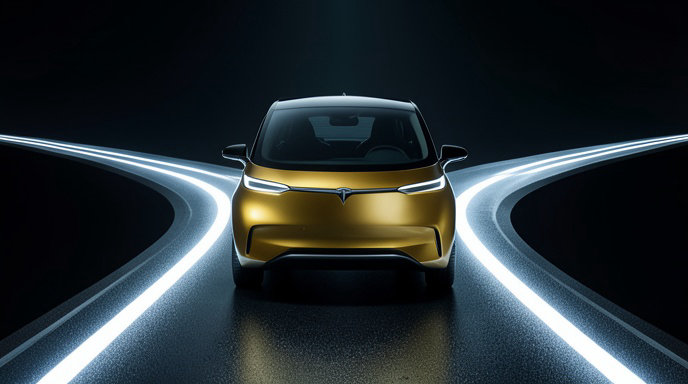
Tesla's vision for autonomy has always looked different from everyone else's, and now it has the hardware to prove it. The production Cybercab, finished in a signature metallic gold, is unlike any Tesla before it. It's a low-slung, futuristic coupe with butterfly doors, a tiny two-seat cabin, and absolutely no manual controls. No steering wheel. No pedals. No rear window. Just a large central display for passengers.
This isn't a modified Model 3 or Model Y with a driver-supervisor. It was designed from the ground up to be a robotaxi. First shown as a concept at Tesla's "We, Robot" event in October 2024, the Cybercab has now been formally launched as Tesla pushes toward volume production, which the company is targeting for 2026-2027 at its Texas Gigafactory. Tesla is also showing off its supporting ecosystem, including autonomous cleaning and wireless inductive charging, eliminating the need for a human to ever plug it in.
Why This Is Tesla's Fork in the Road
For years, Tesla has been valued as both a car company and a tech company. The Cybercab forces it to choose. This launch is arguably the most important pivot since the Model 3.
If successful, Tesla stops being a company that sells cars to people and becomes a company that sells rides by the mile. CEO Elon Musk has repeatedly said the future of Tesla depends on autonomy, predicting a fleet of millions of Cybercabs operating on a Tesla ride-hailing network that could be summoned via the Tesla app, similar to Uber or Waymo but without a driver. Musk has floated a target price of under $30,000 per vehicle and an operating cost as low as $0.20 per mile, numbers that would undercut both traditional taxis and public transit.
If it fails or is significantly delayed, Tesla risks falling behind while burning billions on a project that generates no near-term revenue. With EV sales growth slowing and competition intensifying from BYD and legacy automakers, the Cybercab is Tesla's answer to the question of what's next. It's an all-in bet that autonomy is the only path to its trillion-dollar valuation.
Inside the Tech: Vision, AI, and No Backup Plan
The Cybercab's technology is as radical as its design, and just as controversial. Unlike Waymo and Cruise, which rely on a combination of lidar, radar, and high-definition maps, Tesla is sticking to its vision-only approach.
The car navigates using eight cameras and Tesla's end-to-end neural network trained on billions of miles of real-world driving data collected from its existing fleet. Its Full Self-Driving (FSD) system, specifically the unsupervised version required for the Cybercab, is designed to make driving decisions like a human, without pre-mapped routes.
Other key innovations include:
- Wireless Inductive Charging - The Cybercab has no charge port. It charges by parking over an inductive pad, enabling fully autonomous operation and return to service without human intervention.
- Efficient Platform - Built on Tesla's next-generation unboxed manufacturing process, the vehicle is designed to be cheap to build, with roughly half the parts of a Model 3 and a much smaller battery optimized for city driving.
- Redundant Systems - To compensate for the lack of manual controls, Tesla says the Cybercab has redundant steering, braking, and power systems, plus a robust passenger safety monitoring system.
The Big Risks Behind the Bet
A car without a steering wheel cannot have a safety driver. That means Tesla needs to prove its system is safer than a human driver and convince regulators to allow it on public roads at scale.
The regulatory hurdle is enormous. In the U.S., federal motor vehicle safety standards still assume a vehicle has manual controls. Tesla will need exemptions from the National Highway Traffic Safety Administration (NHTSA) to deploy the Cybercab without a steering wheel, and individual state permits to operate a driverless ride-hailing service. So far, Tesla has been running limited robotaxi pilots in Austin using Model Y vehicles with a safety monitor, but the Cybercab removes that safety net entirely.
Then there is the liability and trust question. Vision-only autonomy has made huge strides, but critics argue it struggles in heavy rain, glare, and complex urban edge cases where lidar excels. Any high-profile crash involving a steering-wheel-free vehicle would invite intense scrutiny from regulators and the public. Tesla is also asking owners and riders to trust a system that has faced years of investigations over its driver-assist features.
How It Could Reshape Tesla and the Entire AV Industry
If Tesla pulls it off, the implications go far beyond one gold two-seater.
For Tesla, the Cybercab unlocks a new business model: Robotaxi-as-a-Service. Instead of a one-time $40,000 sale, a single Cybercab could generate hundreds of thousands of dollars in revenue over its lifetime. Tesla has suggested owners will be able to add their own Cybercabs to the fleet to earn passive income, creating an Airbnb for cars.
For the industry, it would validate a completely different path to autonomy. Waymo has spent over a decade and tens of billions of dollars building a lidar-based, geofenced service that operates in select cities. Tesla is proposing a cheaper, scalable, camera-based system that can theoretically work anywhere. A successful Cybercab would pressure every other AV company to justify their expensive sensor stacks and force ride-hailing giants like Uber and Lyft to rethink their futures.
For cities, it could mean a fundamental change in transportation. Cheap, ubiquitous robotaxis could reduce the need for private car ownership, reshape parking and public transit, and create a new era of personal mobility. Or, if rolled out poorly, it could add congestion and create new safety challenges.
The Road Ahead
The gold Cybercab is no longer just a stage prop. With prototype production underway and Tesla pushing for regulatory approval, the next 12 to 18 months will determine whether this is remembered as a visionary masterstroke or Tesla's most expensive gamble. The steering wheel is gone. Now Tesla has to prove it doesn't need one.

Get All The Latest Updates Delivered Straight To Your Inbox For Free!