
Why AI-Generated Menus Look Fake and Turn Customers Off
TL;DR
- AI-generated food photos all share the same glossy, plastic look with perfect lighting and impossible details that customers instantly read as fake.
- That sameness kills appetite and trust, with diners now actively avoiding restaurants whose menus look too polished, too generic, or physically impossible.
- Restaurant owners win by shooting real dishes in natural light, showing imperfections, and using AI only for layout and cleanup — never to invent the food itself.
The Shortcut Everyone's Taking
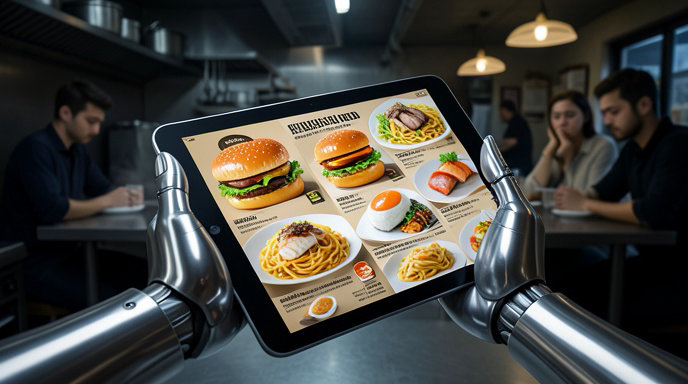
Open DoorDash, Uber Eats, or Instagram in 2026 and you'll see it immediately. The burger with the impossibly shiny bun. The ramen that seems to glow. The pizza with pepperoni in perfect formation.
For independent restaurants squeezed by food costs, labor shortages, and delivery app fees, AI image generators like Midjourney, Firefly, and GPT-4o image tools felt like a miracle. Why pay $2,000 for a food photographer when you can type "juicy smash burger on rustic wood table, professional food photography" and get 50 options in 30 seconds?
By this summer, thousands of ghost kitchens, cafes, and even sit-down spots had quietly swapped real photos for synthetic ones. Menu design apps now offer one-click "enhance" or "generate dish" buttons. The result is a flood of menus that look expensive at first glance — and deeply unappetizing on the second.
Why Your Brain Knows It's Fake
Humans are wired to read food. Before you take a bite, your eyes are scanning for freshness, temperature, texture, and grease. That's why AI food falls into its own uncanny valley.
First is the plastic texture problem. Generative models love smoothness and gloss. Cheese looks airbrushed, not melted. Fried chicken looks like molded plastic, not craggy skin. Lettuce looks vinyl. Sauces have a Vaseline-like sheen with no drips, crumbs, or variation. Your stomach expects juicy and messy. AI gives you clean and cold.
Then there are the impossible details. Look closely and the physics breaks. A fork melts into pasta. A burger has three extra layers that defy gravity. Steam rises in the wrong direction. Sesame seeds float above the bun. Chopsticks bend. Condensation on a soda glass forms in a perfect grid. Customers might not be able to name what's wrong, but they viscerally sense it: this isn't food I can actually order.
The Sameness Problem
The bigger issue in 2026 isn't just fakeness — it's sameness.
Because most owners use the same models with the same prompts like "delicious, ultra-detailed, professional lighting," every AI taco, salad, and sushi platter converges on the same style: dark moody background, perfect overhead drizzle, identical white bowl, that same fake wooden table.
Food photographers call it menu slop. On delivery apps, a dozen different restaurants in the same neighborhood now use near-identical hero images for "butter chicken," "poke bowl," or "chocolate cake." Diners scroll and everything blurs together. Nothing looks local, specific, or real.
That generic styling backfires hardest for the restaurants that need personality most. A family-run Thai spot ends up looking like a national chain. A vegan cafe ends up looking like a steakhouse that typed "vegan burger" into a prompt. When every dish looks perfect, none of them look believable — or craveable.
Trust Is the Real Casualty
This isn't just an aesthetic debate. It's hurting business.
Recent diner surveys and viral Reddit and TikTok taste-tests show the same pattern: when customers suspect AI menus, they assume the real food will be worse, smaller, or completely different. Delivery reviews are now full of photos comparing the glossy AI listing to the sad real-life box, with captions like "catfished by AI again."
Platforms are starting to react. Yelp, TripAdvisor, and Google have all tested labels or crackdowns on misleading AI food imagery this year, and delivery apps are getting more complaints about expectation mismatch. For restaurants, a fake photo that boosts clicks but tanks ratings and repeat orders is a terrible trade.
In hospitality, trust is appetite. If I don't believe your photo, I don't trust your kitchen.
What Restaurants Should Do Instead
You don't need a Hollywood shoot to beat AI. You need real.
Shoot your actual food, even with a phone. Owners getting the best results in 2026 aren't hiring huge crews — they're shooting near a window in daylight, turning off the overhead yellow lights, and photographing the dish exactly as it goes to a table. A slightly messy taco with a real lime wedge will outsell a perfect AI taco every time.
Show imperfection on purpose. Real melt, real char, real drips, real portion sizes. Include a hand holding the sandwich, a bite taken out, a cramped table in the background. Those flaws are signals that say: this exists, and you can eat it now.
Use AI as an assistant, not a chef. The smart workflow is hybrid: take a real photo, then use AI tools only to remove a trash can in the background, brighten shadows, or blur a license plate — not to generate the burger itself. Use generative AI for menu layout, descriptions, translations, and seasonal backgrounds, but keep the hero dish honest.
And label it. A small line like "real photos from our kitchen" on your menu or DoorDash profile is becoming a competitive advantage. In an era of synthetic everything, authenticity is marketing.
The Bottom Line
AI promised restaurants a shortcut to looking delicious. Instead it made everyone look the same — glossy, perfect, and fake.
Appetite isn't driven by perfection. It's driven by specificity: that exact crust on your pizza, that messy swirl of noodles in your bowl, that slightly uneven frosting your regulars recognize. No prompt can fake that.
If you want customers to drool, don't show them the platonic ideal of food. Show them lunch.

Get All The Latest Updates Delivered Straight To Your Inbox For Free!