
AI Productivity Paradox: Over 50% of Managers Struggle to Evaluate Employee Work
TL;DR
- More than half of managers now say AI has made it harder to evaluate employee performance, with new surveys putting the figure at 52-60% as AI-generated work obscures individual effort.
- Managers report eroding trust and a surge in review time, as they must check for AI hallucinations, inflated output, and homogenized work instead of judging skill and creativity.
- Experts say companies need new playbooks for performance reviews focused on judgment, prompting skills, and verified impact rather than raw output volume.
The Promise vs. Reality of AI at Work
AI was supposed to make work faster, easier, and more measurable. Generative AI tools promised to boost productivity by automating drafts, summaries, code, and analysis, freeing employees for higher-value thinking. And on paper, it worked. Output is up across marketing, engineering, customer support, and sales.
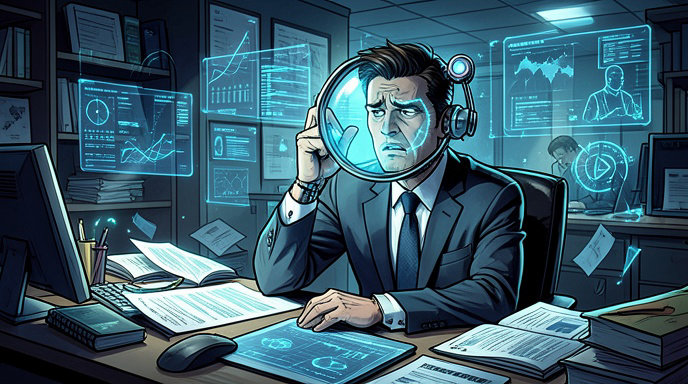
But a new wave of manager surveys reveals an unexpected side effect. More than half of managers say it is now harder to evaluate employee performance after AI adoption. When everyone can produce polished reports, clean code, and slick presentations in seconds, leaders are asking a difficult question: who actually did the work, and how good are they really?
The numbers come amid a broader productivity paradox in 2025 and 2026. While companies report efficiency gains from tools like Microsoft Copilot, Google Gemini, ChatGPT Enterprise, and Salesforce Einstein, frontline managers say visibility into effort, skill, and ownership has dropped sharply.
When Everyone Looks Like a Top Performer
Before AI, output quality was a reliable proxy for talent. A well-written brief, bug-free code, or insightful analysis signaled expertise and effort. Now that baseline has shifted.
Managers surveyed say AI has flattened performance signals. Junior employees can instantly produce senior-level drafts. Strong writers and weak writers produce suspiciously similar first drafts. Performance reviews that once took 30 minutes now require detective work to untangle what the employee thought versus what the model generated.
This is especially acute in knowledge work roles. In software development, leaders report struggling to review pull requests where AI assistants generated large portions of the code. In marketing and consulting, managers say deliverables look polished but lack original insight, making differentiation almost impossible.
The Trust Gap: Did You Do This, Or Did AI?
Beyond evaluation difficulty, managers report an erosion of trust. Recent workplace polls show a growing share of managers suspect employees of passing off AI-generated work as their own without review or disclosure. Employees, in turn, say they fear being penalized for using approved AI tools, leading to shadow AI use and under-reporting.
That mutual suspicion is poisoning performance conversations. Managers say 1-on-1s have shifted from coaching to interrogation: Walk me through how you built this. Show me your prompts. Explain this decision. Employees describe reviews as less fair, with high AI users rewarded for volume while careful reviewers who catch AI errors go unrecognized.
HR leaders warn this dynamic disproportionately hurts remote and junior workers, where managers have fewer informal signals of competence and rely heavily on written artifacts that AI can now fake.
Why Reviews Take Longer, Not Shorter
Ironically, a technology sold as a time-saver is making management more time-consuming. Managers say they now spend extra hours fact-checking AI-assisted work for hallucinations, verifying sources, testing code, and probing for critical thinking.
Instead of simply grading final output, they must evaluate process: quality of prompts, rigor of verification, ethical judgment, and ability to catch mistakes. Most current performance review templates were not built for that. More than half of managers in recent surveys say their company's review criteria have not been updated for AI, leaving them to improvise.
The result is review inflation on one side and review paralysis on the other. Some managers admit to giving higher ratings because output looks good, even when they are unsure of contribution. Others delay promotions because they cannot confidently attribute achievement.
How Companies Can Fix Performance Reviews for the AI Era
Experts say the solution is not banning AI, but redesigning how performance is defined and measured.
First, shift from output to impact. Instead of counting documents, tickets, or lines of code, leading firms are tracking business outcomes, error rates, client satisfaction, and revenue influence.
Second, make process visible. Companies like Shopify, Duolingo, and Box are experimenting with AI disclosure norms, prompt logs, and show-your-work reviews where employees explain decisions, trade-offs, and verification steps.
Third, evaluate new skills explicitly. Prompting, AI oversight, domain judgment, and responsible use are becoming formal competencies in updated rubrics. The best performers are not those who produce the most with AI, but those who know when not to trust it.
Finally, rebuild trust with clear policies. HR consultants stress that vague AI acceptable use policies fuel secrecy. Teams need explicit guidance on what AI use is encouraged, what must be disclosed, and how it will factor into ratings and promotions.
The Bottom Line for Managers
AI has not reduced the need for management. It has raised the bar for it. In a world where output is cheap, judgment is the scarce skill, and managers are on the front lines of telling the difference.
Until performance systems catch up, more than half of managers will continue to feel what the latest surveys capture so starkly: teams look more productive than ever, but knowing who is actually driving that productivity has never been harder.

Get All The Latest Updates Delivered Straight To Your Inbox For Free!