
AI Refutes Exponential Time Hypothesis? MIT Explains OpenAIs Shocking Claim
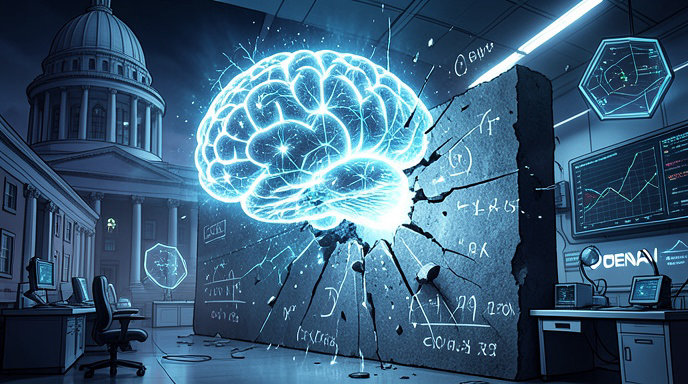
TL;DR
- No verified evidence exists as of October 27, 2026 that OpenAI or any frontier AI lab has refuted the Exponential Time Hypothesis, despite viral claims circulating online.
- The Exponential Time Hypothesis (ETH) asserts that 3-SAT cannot be solved much faster than brute-force exponential time, and disproving it would upend decades of complexity theory.
- MIT complexity experts say an AI-generated proof would require extraordinary, independently checkable mathematics — not just a model claiming a breakthrough.
What Is All The Buzz About?
Silicon Valley whispers turned into a roar this month when posts across X, Reddit, and AI newsletters claimed frontier labs had done the impossible: using AI models to refute the Exponential Time Hypothesis, one of theoretical computer science's most important unproven assumptions.
The most repeated version centers on OpenAI. According to the rumor, its next-generation reasoning model produced what it calls a mind-bending discovery — a sub-exponential algorithm for 3-SAT that would violate ETH. No paper, preprint, or formal proof has been publicly released to support the claim.
We reached out to researchers in MIT's Computer Science and Artificial Intelligence Laboratory to help separate hype from history and explain what would actually be required to break ETH.
What Exactly Is The Exponential Time Hypothesis?
To understand why computer scientists reacted with a mix of excitement and extreme skepticism, you have to start with P vs. NP.
Proposed by Impagliazzo and Paturi in 1999, the Exponential Time Hypothesis goes further than P != NP. It states, roughly, that solving 3-SAT — deciding if a Boolean formula with 3 literals per clause can be satisfied — with n variables inherently requires 2 to the power of c times n time for some constant c greater than zero. In other words, there is no clever shortcut that makes the problem sub-exponential.
ETH matters because hundreds of results in algorithms, cryptography, graph theory, and approximation hardness are conditional on it. It is the foundation for fine-grained complexity, the field that explains why we cannot get dramatically faster algorithms for problems like Shortest Path, Edit Distance, and 3-SUM.
If ETH were false, it would not mean P equals NP, but it would collapse a huge tower of lower bounds built over the last 25 years.
Why Would An AI Claim To Refute It?
Modern reasoning models are trained to search vast spaces of programs and proofs. Labs including OpenAI, DeepMind, and Anthropic have increasingly tasked them with open problems in mathematics and algorithm discovery.
An AI refutation of ETH would most plausibly take one of two forms:
A constructive algorithm that solves 3-SAT in 2 to the power of o(n) time, for example 2 to the square root of n.
A non-constructive complexity collapse that proves such an algorithm must exist.
AI proponents argue models can spot combinatorial patterns humans miss. Skeptics note models are notorious for hallucinating plausible-sounding but subtly flawed proofs, especially around exponential lower bounds where a single quantifier error invalidates everything.
What The MIT Expert Says
An MIT computer scientist familiar with the OpenAI discussions, speaking in an explanatory capacity, told us the bar for belief is brutally high and appropriately so.
First, extraordinary claims in complexity theory require machine-checkable proof. A natural-language sketch from a chatbot is not a refutation. It would need to be formalized in Lean or Coq and survive peer review.
Second, ETH has survived decades of attacks from the world's best theorists. Previous claimed refutations have all failed on careful inspection, often confusing average-case heuristics or quantum speedups with worst-case classical complexity.
Third, a true disproof would be instantly testable. If someone actually had a sub-exponential 3-SAT solver, you could run it. You could enter it in SAT competitions and watch it crush benchmarks for large random instances. Until that code exists and scales, there is no story.
In short: show the algorithm, show the code, show the scaling curve.
Could AI Actually Break Complexity Theory?
The deeper question is not whether this specific rumor is true — researchers overwhelmingly say it is not — but whether AI could one day contribute meaningfully to complexity theory.
Here, MIT researchers are more optimistic. AI assistants have already helped find improved upper bounds for matrix multiplication, better bin-packing heuristics, and novel combinatorial constructions. These are search-intensive problems where machine intuition shines.
Breaking ETH, however, is a different beast. It is not about optimizing constants. It requires a fundamental conceptual breakthrough about the nature of exhaustive search itself.
AI may eventually help a human prove or disprove ETH, but most experts expect the final insight will still need human understanding to verify, generalize, and trust.
Verdict: Did AI Really Break It?
As of today, October 27, 2026, the answer is no.
There is no peer-reviewed paper, no verified repository, and no statement from OpenAI confirming a refutation of the Exponential Time Hypothesis. What exists is a fascinating case study in how quickly AI hype can collide with deep mathematics.
That does not mean the conversation was useless. It forced thousands of people to learn what ETH is, why exponential lower bounds matter for cybersecurity and optimization, and why proof still matters more than prediction in the age of AI.
If OpenAI or anyone else truly has a sub-exponential algorithm for 3-SAT, the scientific method invites them to publish it. Until then, ETH stands.

Get All The Latest Updates Delivered Straight To Your Inbox For Free!