
Electric Plant Builds AI Translator to Decode Plants Electrical Language
TL;DR
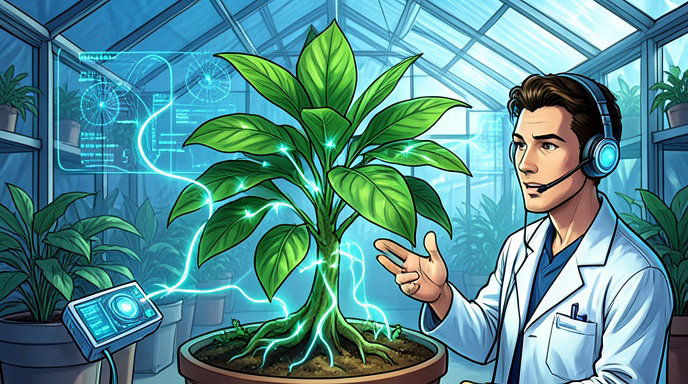
- Startup Electric Plant is developing an AI system that attaches electrodes to plant stems to capture subtle electrical signals and translate them into human-readable health and stress insights.
- The technology combines plant electrophysiology sensors with machine learning trained on environmental and physiological data to distinguish signals for drought, nutrient deficiency, pests, and disease.
- If scaled, the plant translator could enable precision farming with less water and chemicals, improve crop sustainability, and open a new channel for human-nature communication.
From Sparks in Stems to Sentences on Screens
There is a quiet electrical storm happening inside every plant. When a tomato is thirsty, when wheat senses aphids, when a leaf is cut, tiny voltage changes ripple through stems and leaves. For decades, plant scientists have known these bioelectric signals exist. Now startup Electric Plant wants to make them understandable.
The company's premise is simple and radical at once: what if crops could tell farmers exactly what they need, in plain language, before visible symptoms appear?
How The Plant Translator Works
Electric Plant's system starts with hardware: lightweight, low-cost electrodes clipped or pinned to stems and leaves. These sensors continuously record variations in electrical potential - the same kind of slow-wave potentials and action potentials researchers have measured in labs with bulky equipment.
The raw signals alone look like noise. The breakthrough, according to the company, is AI. Machine learning models are trained on vast datasets pairing electrical waveforms with ground-truth conditions like soil moisture, temperature, light, nutrient levels, pathogen exposure, and growth stage. Over time, the AI learns to recognize patterns - this spike shape means water stress, that long drift means nitrogen deficiency, another signature correlates with fungal infection.
Results are delivered via a dashboard or mobile alert. Instead of a squiggly voltage chart, a grower sees insights like: Block 4 showing early drought stress, recommend irrigation in 12 hours, or possible pest pressure detected.
Why Electrical Signals Instead of Cameras and Drones
Precision agriculture already uses satellite imagery, drones, and soil probes. Electric Plant argues electrical signals offer something different: speed and directness.
Visual symptoms like yellowing or wilting often appear days after stress begins. Volatile chemical signals and sap flow are useful but hard to interpret continuously. Electrical signals propagate in seconds to minutes after a stimulus, making them one of the earliest indicators that a plant has perceived a change.
In theory, that means earlier intervention, less crop loss, and far more targeted use of water, fertilizer, and pesticides.
What It Could Mean For Farming And Sustainability
For large-scale farming, the promise is resource efficiency. Irrigate only when plants signal thirst, not on a fixed schedule. Spray only where plants signal pest attack. Early trials described by the company and its agricultural partners focus on high-value greenhouse crops like tomatoes, cucumbers, and strawberries, where small savings in water and inputs quickly add up.
For sustainability, the implications go further. Agriculture accounts for roughly 70 percent of global freshwater withdrawals and a major share of nitrogen runoff. A real-time plant feedback loop could cut waste dramatically while maintaining yields - critical as climate change brings more heatwaves, droughts, and unpredictable pests.
Smallholder farmers could also benefit if sensor costs fall low enough, giving them a kind of expert agronomist wired directly to their fields.
Toward A New Kind Of Human-Nature Communication
Beyond agronomics, Electric Plant is tapping into a cultural fascination: decoding non-human languages with AI, from whale clicks to plant electrics.
Scientists caution that plants do not have neurons or conscious thoughts, and talk of translation should not be taken literally as plants speaking English. What the AI is doing is pattern recognition, linking physiology to human categories of stress and need.
Still, founders and supporters say even functional translation changes the relationship. A plant shifts from a passive object to be managed into an active signaler to be listened to. In greenhouses, offices, and eventually homes, people could receive a nudge that their plant is stressed long before it droops.
Challenges Ahead
Major hurdles remain. Electrical signals are noisy, vary between species and even between individual plants, and are influenced by wind, touch, and electromagnetic interference. Building robust models that generalize from lab to field across corn, soy, grapevines, and other crops will require enormous labeled datasets.
Durability, battery life, and cost of field sensors are also open questions. And agronomists will want independent, peer-reviewed validation that electrical AI predictions consistently beat existing soil and imaging sensors.
What's Next
Electric Plant is reportedly moving from controlled greenhouse pilots to larger field trials with farming partners, refining both its electrode hardware and cloud-based AI models. Like many ag-tech startups, its near-term business is likely subscription monitoring for commercial growers, with API integrations into irrigation and climate-control systems.
Long-term, the vision is a plant wearable as common as a fitness tracker - every significant crop wired, every whisper of voltage turned into actionable insight.
If it works, farmers won't just look at their plants. They'll hear from them.

Get All The Latest Updates Delivered Straight To Your Inbox For Free!